Long ago, in the cedar-shadowed mountains of Lebanon, there lived a noble king and his beloved queen, whose life was soon to be tested by the power of truth. Their palace overlooked green valleys where shepherds sang and the air carried the scent of wild thyme. The queen was admired not only for her grace but for her kindness toward the poor. Her virtue made her beloved by all, except one: the king’s second wife, whose heart burned with jealousy.
When the queen finally conceived, the entire kingdom rejoiced. But the jealous co-wife began plotting to destroy her happiness. She whispered to her servants, “If she bears an heir, my power will fade. I must see her shamed before the king.”
Months later, the queen gave birth to beautiful twins, a boy and a girl. The king was away on a hunting expedition, and the co-wife seized her chance. That night, she bribed the midwife to take the newborns and replace them with two wriggling pups. The midwife, frightened but greedy, carried out the evil plan. The twins were placed in a basket and set adrift down the mountain stream.
When the king returned, he was horrified to see animals lying beside his weary queen. Believing her cursed, he banished her to a distant corner of the palace, forbidding her from seeing him again. The jealous co-wife triumphed, pretending to comfort him while hiding her wicked smile.
But fate had not abandoned the innocent. Downstream, the basket floated into a humble village where an old woodcutter and his wife found it caught among reeds. When they opened it, they gasped to see two crying infants. “By God’s mercy,” the old woman said, “we shall raise them as our own.” They named the boy Jamil and the girl Jamila, and they grew up strong, kind, and wise.
As years passed, Jamil became known for his courage and integrity. Yet sometimes, when he looked at the distant palace on the hill, his heart stirred with a strange longing. “Mother,” he once asked, “why do I dream of marble halls and golden crowns?” The old woman wept but said nothing, for she feared the truth would bring him pain.
One day, while working in the forest, Jamil overheard travellers speaking of a mystical bird called The Shrieking Nightingale. “Its cry,” they said, “reveals secrets that even kings dare not utter. But beware, whoever seeks it must face danger and temptation.”
Jamil felt an unexplainable pull. “If this bird truly speaks truth,” he thought, “perhaps it will tell me who I am.” Against his sister’s pleas, he set off on a long and perilous journey.
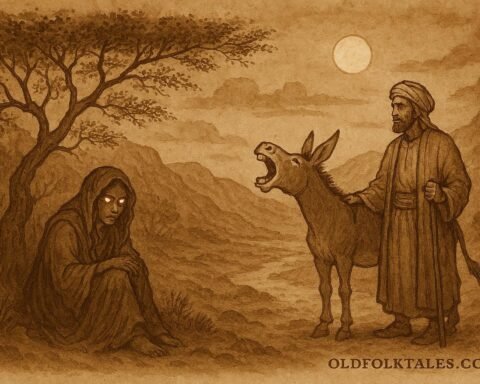
He travelled across deserts and through thick cedar forests, guided only by faith and determination. On his way, he met an old dervish sitting beneath a fig tree. The man warned him, “Many have sought the Shrieking Nightingale but few have returned. To find it, you must climb Mount Qor, where winds scream like spirits. But remember, the bird will not sing for the greedy or the cruel, it sings only for the pure of heart.”
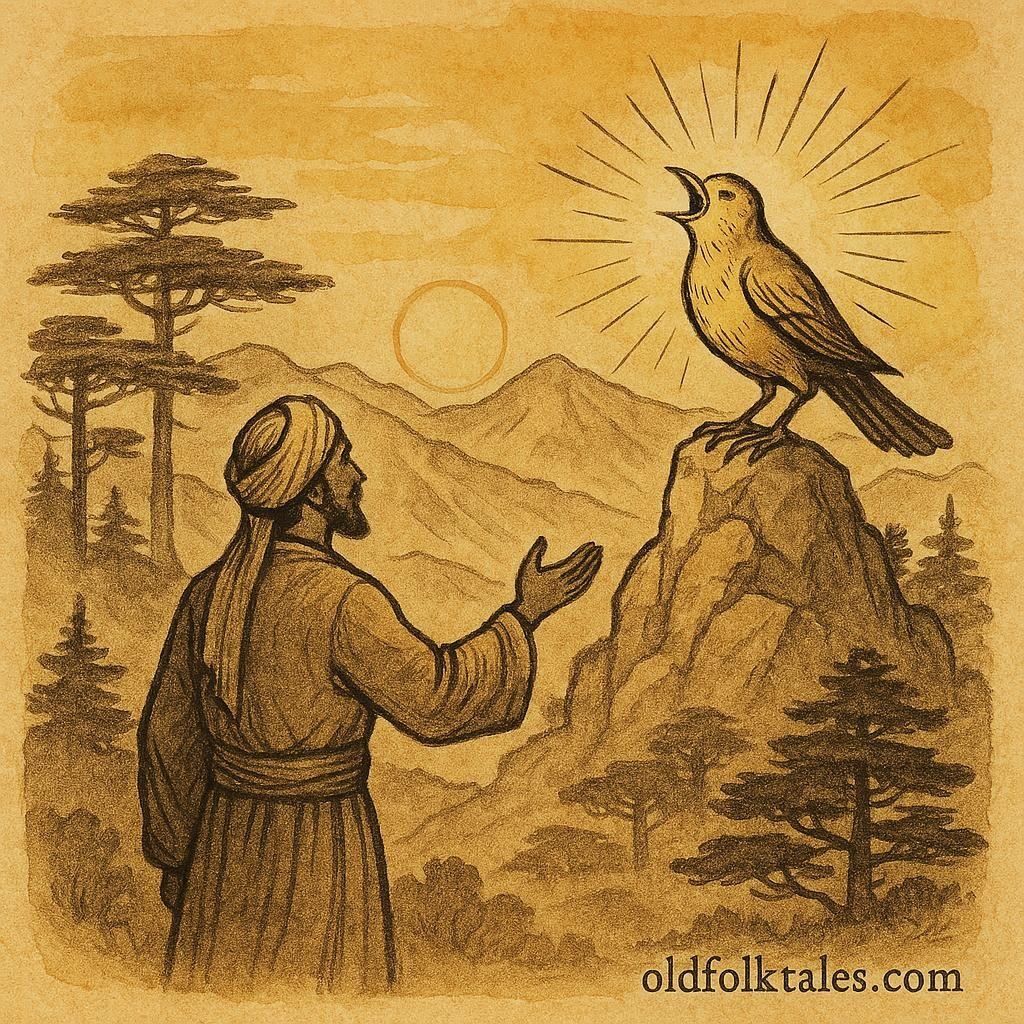
After days of hardship, Jamil reached the mountain peak. There, among ancient stones, he saw the shimmering bird perched on a branch of silver leaves. Its feathers glowed with hues of sapphire and gold. When Jamil approached, the Nightingale let out a piercing cry that echoed across the valleys.
“Son of a queen unjustly wronged!” it shrieked. “Your mother’s tears water the earth of sorrow. Return and let truth be seen!”
Stunned, Jamil fell to his knees. The bird fluttered onto his shoulder, whispering, “Take me to your father’s court, and justice shall be done.”
When Jamil entered the palace, the jealous co-wife trembled at the sight of him, his face mirrored the king’s youth. The bird began to shriek, its cry filling the hall with power. “Behold, O King! These twins are your blood, stolen by envy and deceit!”
The truth struck like thunder. The king’s face turned pale as the long-buried secret unfolded. He ordered the false co-wife and the midwife brought forth, and both confessed their wickedness. The palace resounded with cries of anger and relief.
At last, the queen was freed from her sorrow. She embraced her long-lost children, weeping with joy. The king knelt before her, begging forgiveness. Peace returned to the kingdom, and Jamil and Jamila were honoured as rightful heirs.
As for the Shrieking Nightingale, it soared into the clouds, its song echoing through Lebanon’s valleys, a sound that reminded all who heard it that truth, no matter how long silenced, always finds its voice.
Moral Lesson
The story of The Shrieking Nightingale teaches that truth may be hidden by deceit, but it can never be destroyed. In time, honesty and virtue will triumph over jealousy and lies.
Knowledge Check
1. Who are the main characters in “The Shrieking Nightingale”?
The royal twins Jamil and Jamila, their mother the queen, and the jealous co-wife.
2. What symbolizes truth in the story?
The Shrieking Nightingale, whose cry reveals hidden secrets.
3. How does jealousy influence the story’s events?
It drives the co-wife to replace the twins with animals, leading to the queen’s downfall.
4. What lesson does Jamil learn on his journey?
That perseverance, purity, and courage reveal one’s true destiny.
5. How is justice restored in the end?
The Nightingale exposes the deceit, and the queen regains her honour.
6. What cultural values are reflected in the tale?
Lebanese respect for truth, family unity, divine justice, and moral purity.
Source: Adapted from Abu Jmeel’s Daughter & Other Stories: Arab Folk Tales from Palestine and Lebanon by Jamal S. Nuweihed (Interlink Books, 2002).
Cultural Origin: Lebanon (Levantine folklore)