In the fortified city of Kabul, a mighty malek ruled over lands rich with orchards and flowing rivers. His palace stood beside a winding stream, surrounded by almond groves that bent low to kiss the water. Among all his treasures, his daughter was the most precious, renowned throughout the region for her beauty and wisdom. It was said that “her radiance outshone the moonlight upon the snows of the Hindoo-Koosh.”
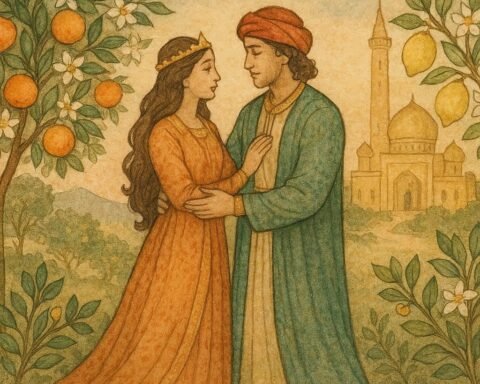
Princes and warriors from faraway realms, Ghazni, Balkh, and Kandahar, journeyed to seek her hand. Yet she turned them all away, declaring proudly, “I shall wed no man who seeks me for my face, but him whose heart is stainless and whose word is true.” Her father, the malek, was both intrigued and vexed by her resolve, for he desired a son-in-law of noble birth, not a man of humility.
The Test of Worth
The malek decided to test the courage and truth of all who claimed to love his daughter. He announced three tasks, so perilous that only one blessed by Heaven could hope to succeed.
The first task was to retrieve a jewel guarded by unseen spirits in the Cave of Shibar.
The second, to draw water from the Well of the Sun, whose flames would burn any vessel daring to touch its surface.
The third, to subdue the Black Horse of the Pass, a wild and ungovernable steed said to belong to demons.
One by one, princes and noble warriors set out to prove themselves, and one by one, none returned. The city mourned them, and hope dimmed. Then came a humble young man named Mirza. He was no prince, but the son of a learned scribe, known for his honesty and gentle heart. The courtiers mocked him for his plain clothes and lack of lineage, but the princess saw something different in his calm eyes—a quiet strength untouched by pride.
The Hero’s Quest
Mirza set forth alone, carrying only a staff and a prayer in his heart. Along his journey through mountains and valleys, he met a wandering dervish, whose eyes glowed with the light of wisdom. The old man spoke: “The trials before thee are not of might, but of the spirit. Seek not the jewel of stone, but the jewel of truth.”
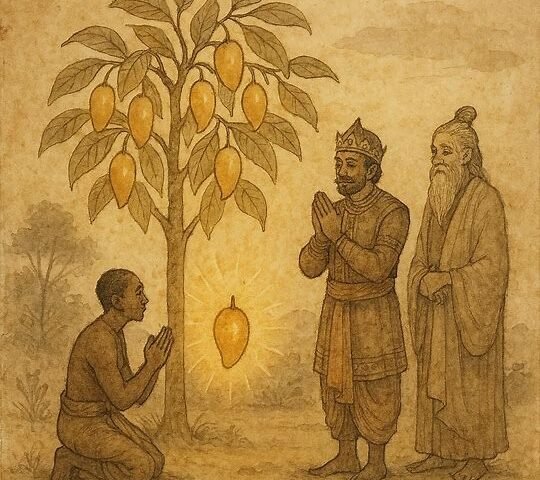
At the mouth of the Cave of Shibar, Mirza felt voices whisper temptations of gold and glory. Shadows danced along the walls, urging him to take what was not his. Closing his eyes, he uttered a prayer for purity, and when he opened them, a single glowing jewel lay at his feet, untouched by greed.
He next came to the Well of the Sun, whose waters burned with blinding light. He lowered a vessel, but it melted instantly. Remembering the dervish’s words, he knelt and cupped his hands. Miraculously, the searing water cooled to gentle warmth, filling his palms with the purest liquid he had ever seen.
His final trial awaited him on a desolate mountain pass. There, the Black Horse thundered out of the mist, its eyes red with fury, its mane ablaze like fire. Mirza stood firm, whispering the name of God. The beast halted, trembling, then bowed its head. Mirza mounted it, and together they rode triumphantly back toward Kabul.
The Return and the Betrayal
When Mirza returned, the people hailed him as a hero. The malek, however, was consumed by jealousy and shame that a commoner had succeeded where princes failed. Outwardly, he praised Mirza and promised him his daughter’s hand, but in secret, he plotted the young man’s death.
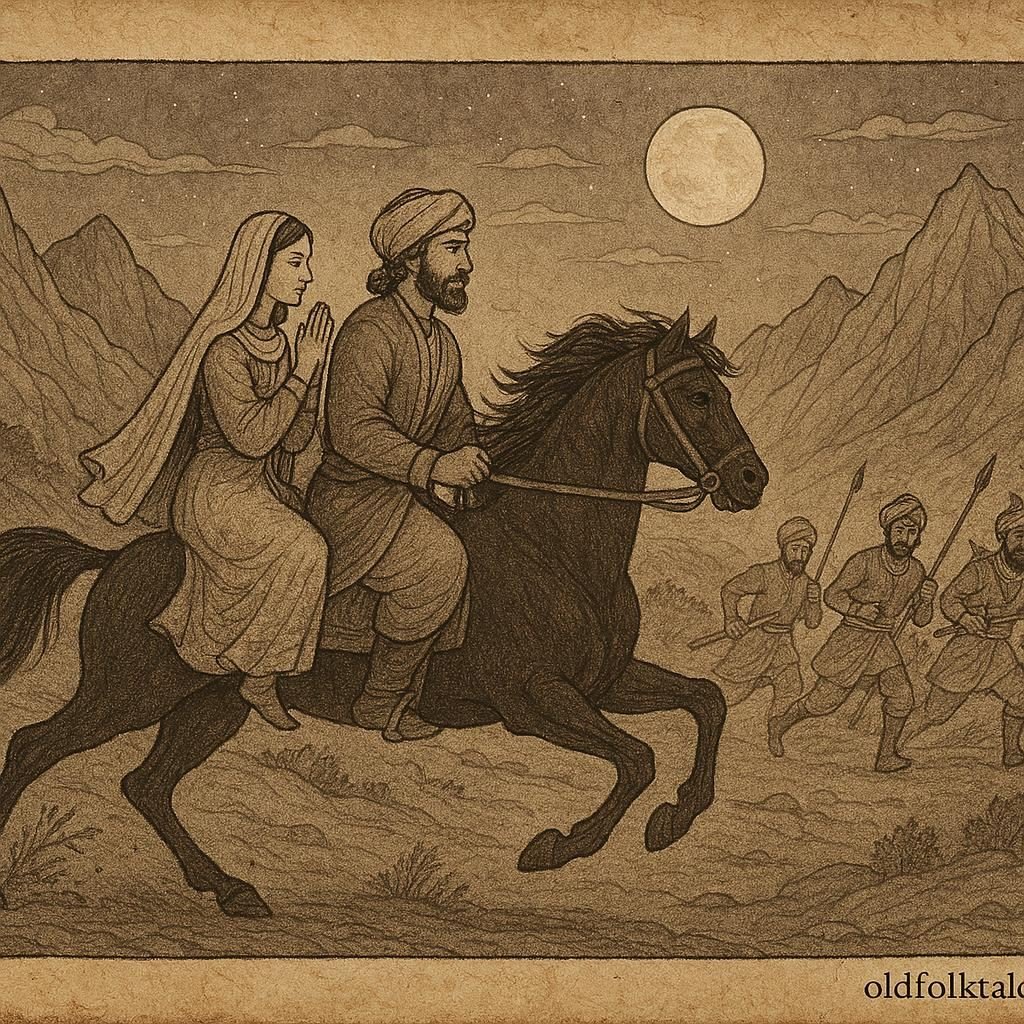
That night, the princess overheard her father’s plan. Horrified, she fled to warn Mirza. They escaped together under the cover of moonlight, riding through narrow mountain trails toward the distant valleys beyond Kabul. Behind them, the malek’s soldiers pursued relentlessly.
The Lake of Loyalty
At dawn, the lovers reached a narrow ravine, where the soldiers surrounded them. Mirza, though weary, stood his ground and prayed for deliverance. The earth trembled, and the cliffs shook. With a mighty roar, the ravine collapsed, burying the soldiers beneath rock and dust. When the ground stilled, a lake shimmered in their place. From that day, it was called Ab-i-Wafa, “The Water of Loyalty.”
The Lovers’ Fate
Safe at last, Mirza and the princess found shelter in a quiet valley. But Mirza’s wounds from battle were deep. As the sun set over the hills, he held her hand and whispered, “Truth is the jewel, and love its light.” With those words, he breathed his last. The princess built a small shrine over his resting place and lived in solitude beside it until her own death.
The villagers who later found the site said the air was fragrant with almond blossoms all year, and that the water of the lake never ran dry. They believed the spirits of the lovers blessed travelers who passed by in faith.
Moral Lesson
The tale of The Malek’s Daughter teaches that purity of heart and truth in spirit outweigh noble birth or power. Mirza’s courage came not from sword or lineage, but from inner faith and humility. True love, bound by loyalty and truth, becomes eternal, stronger than tyranny, deeper than death.
Knowledge Check
1. Who was the main hero of “The Malek’s Daughter”?
Mirza, a humble youth known for his honesty and faith.
2. What were the three trials set by the malek?
Retrieving the jewel of Shibar, drawing water from the Well of the Sun, and taming the Black Horse of the Pass.
3. What moral quality helped Mirza succeed in his quests?
Purity of heart and trust in divine truth, rather than strength or wealth.
4. What does the lake Ab-i-Wafa symbolize?
It represents loyalty and divine justice, born from love and faith.
5. What message does the princess’s vow teach?
True love must be guided by integrity and virtue, not appearance or status.
6. How does the story reflect Afghan cultural values?
It celebrates courage, humility, spiritual devotion, and moral truth—core ideals in Afghan folklore.
Source: Charles Masson, Legends of the Afghan Countries, in Verse (1848), pp. 61–86.
Region of Origin: Kabul and surrounding valleys.