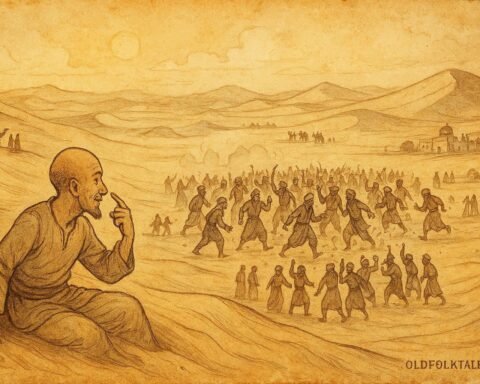
In a quiet riverside village in Uzbekistan, where the Fergana waters gleamed like threads of silk beneath the morning sun, there lived a poor fisherman named Hasan. His days were spent casting his worn net into the river, hoping for a modest catch to feed himself and his wife. Though poor, Hasan’s heart was full of peace. He never took more than he needed and often gave a portion of his catch to those hungrier than himself.
One misty dawn, Hasan set out before sunrise. The air smelled of wet reeds and earth, and the world was still, save for the soft hum of insects waking by the riverbank. He cast his net into the calm current and waited. When he pulled it back, it felt unexpectedly heavy. His breath caught as he drew it in, for inside, shimmering brighter than any treasure, was a golden fish.
Explore ancient tales from Thailand, Cambodia, and the Philippines in Southeast Asian Folktales.
The fish was unlike any creature Hasan had seen. Its scales glowed like molten sunlight, and its eyes were soft yet full of wisdom. To his astonishment, the fish spoke in a voice clear and gentle.
“Good fisherman,” it said, “spare my life, and I shall repay your mercy a hundredfold.”
Hasan stood frozen in wonder. Though amazed, his heart was guided by compassion, not greed. He carefully lifted the fish from the net and said, “Go, little one. Return to your home in peace. I seek no reward but your freedom.” Then he released the fish into the river, and it disappeared in a swirl of gold beneath the rippling surface.
That night, Hasan returned to his small hut, weary but calm. Yet as he stepped inside, he stopped short, the place no longer looked the same. The cracked walls and straw roof had transformed into a fine cottage with smooth clay floors and bright lamps. A steaming meal awaited him on a wooden table, fragrant with rice and herbs. His wife gasped in delight and asked how such a miracle had come to pass. Hasan told her about the golden fish, speaking humbly of its promise.
At first, they lived happily and gratefully. But as days passed, Hasan’s wife began to crave more. “If the fish could give us this,” she said, “surely it can make us rich. Go back and ask for gold and silver, Hasan. We deserve comfort after all these years of struggle.”
Hasan hesitated, but his wife’s words troubled him. The next morning, he went to the river. The water shimmered faintly as he called out, “Golden Fish! Golden Fish! My wife sends her greeting.”
The golden fish appeared, rising like sunlight through water. “What troubles you, Hasan?” it asked kindly.
“My wife wishes for gold and silver,” Hasan said reluctantly.
The fish’s eyes dimmed slightly, but it replied, “Go home, Hasan. What she asks shall be given.”
When Hasan returned, he found their cottage filled with chests of glittering coins and fine cloths. His wife clapped her hands in joy, but Hasan’s heart grew uneasy.
Days turned into weeks, and once again, greed stirred in her heart. “Why should we live as villagers?” she complained. “Go ask the fish to make us nobles, with servants and fine horses.”
Against his better judgment, Hasan returned to the river. The water was no longer bright and calm, it had turned darker, the waves restless. Still, he called out. The golden fish appeared again, its light faint this time. “Your wife is restless,” it said. “But her wishes shall be granted.”
When Hasan came home, he found his wife dressed in silk, surrounded by servants. Their home had become a grand mansion. Yet her heart, now heavy with pride, was far from satisfied. “If the fish can do this much,” she said one night, “why should I not be Queen of the Land? Go, Hasan. Tell it so.”
Hasan’s heart sank. “That is too much,” he pleaded. “We were blessed already. Why risk angering what is sacred?”
But she scolded him sharply. “Go! Or I shall go myself.”
With a heavy heart, Hasan trudged to the river once more. The sky was grey, the wind sharp. The river foamed and roared as he called out, “Golden Fish! Forgive me, but my wife wishes to become Queen of the Land.”
For a long time, there was no answer. Then the golden fish rose one last time, its light nearly gone. “Go home, Hasan,” it said, voice echoing like distant thunder. “She has taken more than her share. Let her learn what it means to lose what she never cherished.” With that, the fish vanished into the dark storm.
Hasan returned to find his fine house gone. The servants, the silks, the gold, all had disappeared. Only their old hut remained, cracked and leaking under the rain. His wife wept bitterly, but it was too late.
From that day on, Hasan continued to fish humbly by the river, never calling upon the golden fish again. The river ran calm once more, yet its depths seemed to guard a quiet reminder, that blessings gained through kindness endure, but greed turns them into dust.
Moral Lesson
This Uzbek folktale teaches that kindness and humility bring lasting happiness, while greed and discontent destroy even the greatest blessings.
Knowledge Check
1. Who was the main character in “The Golden Fish”?
Hasan, a humble fisherman from an Uzbek riverside village.
2. What made the golden fish special?
It could speak and had the power to grant wishes as a reward for mercy.
3. What was the first gift given by the fish?
The fisherman’s poor hut was transformed into a fine cottage with food and comfort.
4. How did Hasan’s wife’s greed affect their fortune?
Each new demand darkened the river and eventually caused all blessings to vanish.
5. What moral does the story teach?
True wealth lies in gratitude and humility, while greed leads to loss and sorrow.
6. Where does this folktale originate from?
Traditional Uzbek folklore, collected in the Fergana and Tashkent regions of Uzbekistan.
Source: Traditional Uzbek folktale, Uzbekistan.
Adapted from Folk Tales from the Soviet Union: Central Asia and Kazakhstan (Moscow: Raduga Publishers, 1983).