In the western lands of Israel, where the desert wind sighs softly through endless dunes, there once lived a humble woman whose deepest sorrow was her childlessness. Years passed as she watched other mothers cradle their infants while her own arms remained empty. One day, her desperate prayers reached the heavens, and a divine whisper answered her longing, though not as she expected. Soon after, she gave birth not to a child of flesh and form, but to a camel, whose eyes gleamed with a strange, human intelligence.
This miraculous camel grew swiftly, gentle toward his mother and wise beyond any ordinary beast. Despite his strange form, he spoke with the tongue of men and possessed a noble spirit. His mother loved him dearly, though she often wept, fearing others might mock his difference. Yet the camel was untroubled by such thoughts; his gaze remained fixed on a destiny that shimmered far beyond the dunes, the hand of a princess.
One morning, as the sun spilled gold upon the sand, the camel spoke: “Mother, I wish to marry the king’s daughter.”
His mother gasped. “My son, such thoughts are madness! You are no prince but a camel! The king will laugh at us.”
But the camel’s eyes shone with calm resolve. “Go to the palace and ask for her hand. Tell the king my heart is pure and my intentions noble.”
Fearful yet obedient, the poor woman made her way to the grand court. Before the king, she trembled as she delivered her son’s wish. The hall erupted with laughter, yet the king, curious and cunning, replied, “If your camel-son can bring me the rarest treasures of the world, he shall have my daughter’s hand.”
Thus began a series of impossible trials. The first task demanded a carpet woven from the rays of dawn. The second required a pearl as large as the moon. The third, a palace made of gold that could appear overnight beside the royal court.
The woman, distraught, returned to her son. “These tasks will destroy you, my child,” she wept.
But the camel only smiled. “Do not fear, Mother. Heaven’s hand guided my birth; it shall guide my deeds.”
That night, the desert trembled with unseen power. When dawn broke, the king awoke to behold a carpet glowing like sunrise itself laid before his gates. The next day, a pearl brighter than moonlight gleamed upon his throne. And by the third morning, a palace of pure gold stood beside his own, its walls glinting with celestial fire.
Astonished and uneasy, the king murmured, “Perhaps there is more to this camel than meets the eye.” Yet, unwilling to yield, he devised one last test, a banquet for his daughter’s suitors, where the camel must appear before all.
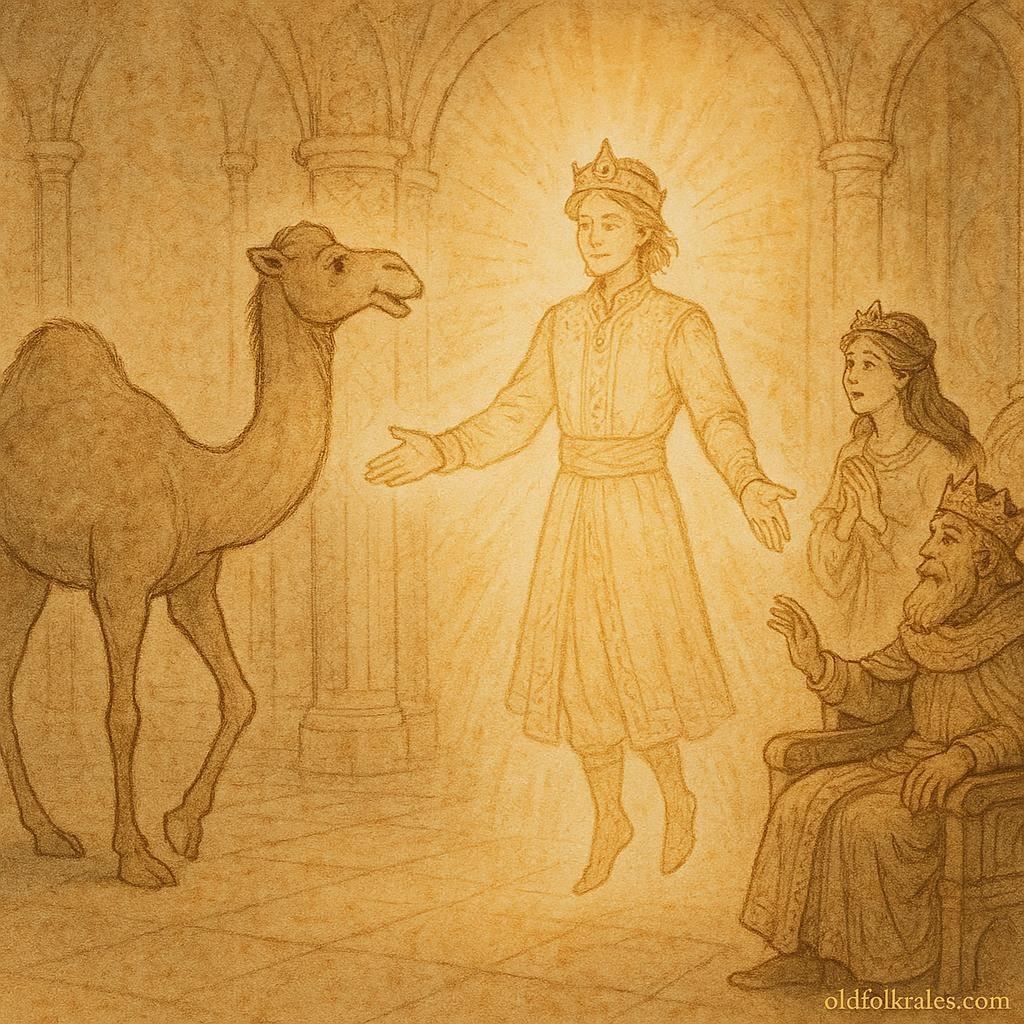
When the day arrived, nobles filled the grand hall with whispers and sneers. Then the camel entered, his steps measured, his form regal. Suddenly, as the music rose, his skin shimmered, and from the coarse hide emerged a radiant youth, more handsome than any prince. Gasps filled the air. The princess herself, awed by his grace, felt her heart stirred with wonder.
The king, overcome with astonishment, cried out, “Surely this is a sign from the Almighty! Take my daughter, noble one, for you have proved your worth.”
Thus the camel, once scorned for his form, wed the princess in a feast that lasted seven days and seven nights. His mother, honoured and rejoicing, sat beside them, tears of gratitude glistening in her eyes. In time, the prince ruled wisely, his tale a lasting reminder that greatness often hides beneath humble or strange beginnings.
Moral Lesson
True worth is not found in appearance but in character and courage. Faith, perseverance, and purity of heart can overcome every barrier and reveal the hidden beauty within.
Knowledge Check
1. Who is the main character in “The Camel Who Sought a Princess”?
The story centres on a miraculous camel born to a barren woman in Israel who later seeks to marry a princess.
2. What is the main theme of this Israeli folktale?
The tale explores faith, perseverance, and the triumph of inner virtue over outward form.
3. What challenges did the camel face before marrying the princess?
He had to complete impossible royal tasks, including finding rare treasures and building a golden palace.
4. What cultural lesson does the folktale teach?
It reflects Jewish-Oriental values of humility, divine justice, and the idea that miracles often arise from faith.
5. How does the camel transform at the end of the story?
During the banquet, he sheds his camel form and becomes a handsome prince, revealing his true nature.
6. What does the king’s reaction symbolise in the story?
The king’s awe represents the human recognition of divine mystery and the acceptance of destiny beyond reason.
Source
Adapted from a Jewish–Oriental folktale, “The Camel’s Wife” (tale type AaTh 425*Q “Marvelous Being Woos Princess”), collected in the Israeli Folktale Archives (IFA).
Cultural Origin: Israel (Jewish–Oriental folklore)