Long ago, when the world was younger and magic still flowed freely through the ancient seas of Southeast Asia, there existed a legendary mountain unlike any other. This was no ordinary peak of stone and earth, it was the Golden Mountain, a magnificent wonder that roamed the oceans seeking a worthy home.
The mountain gleamed beneath the tropical sun, its slopes covered entirely in pure gold that caught the light and sent it dancing across the waves. Precious gems studded its surface like stars in the night sky, rubies red as dragon’s blood, emeralds green as jungle leaves, sapphires blue as the deepest ocean. Veins of silver ran through its golden flesh like rivers, and caves within its heart overflowed with treasures beyond imagination: chests of pearls, bolts of the finest silk, jade carvings, and ancient coins from forgotten kingdoms.
Click to read all Southeast Asian Folktales — featuring legends from Thailand, Indonesia, Vietnam, and the Philippines.
But the Golden Mountain was more than mere wealth, it possessed consciousness, wisdom, and a deep understanding of human nature. The elders who had heard tales of this wandering marvel whispered around their cooking fires that when the Golden Mountain chose to anchor at a nation’s shore, that land would be blessed beyond measure. Its people would become powerful, prosperous, and wise, their civilization flourishing like lotus flowers in perfect conditions.
Yet the mountain was discerning and proud. It would only offer its gifts to those who proved themselves worthy, people who governed justly, who worked diligently, who treated one another with respect and kindness. And if conditions changed for the worse, if greed corrupted hearts or laziness infected the community, the Golden Mountain would depart without warning, leaving behind only empty harbors and the bitter taste of lost opportunity. Once it left, it never returned, and the civilization it abandoned would slowly crumble into ruin, a cautionary tale for future generations.
So the Golden Mountain roamed the vast waters of the Indonesian archipelago, its keen eyes watching the islands and coastal villages, searching always for people worthy of its magnificent gifts.
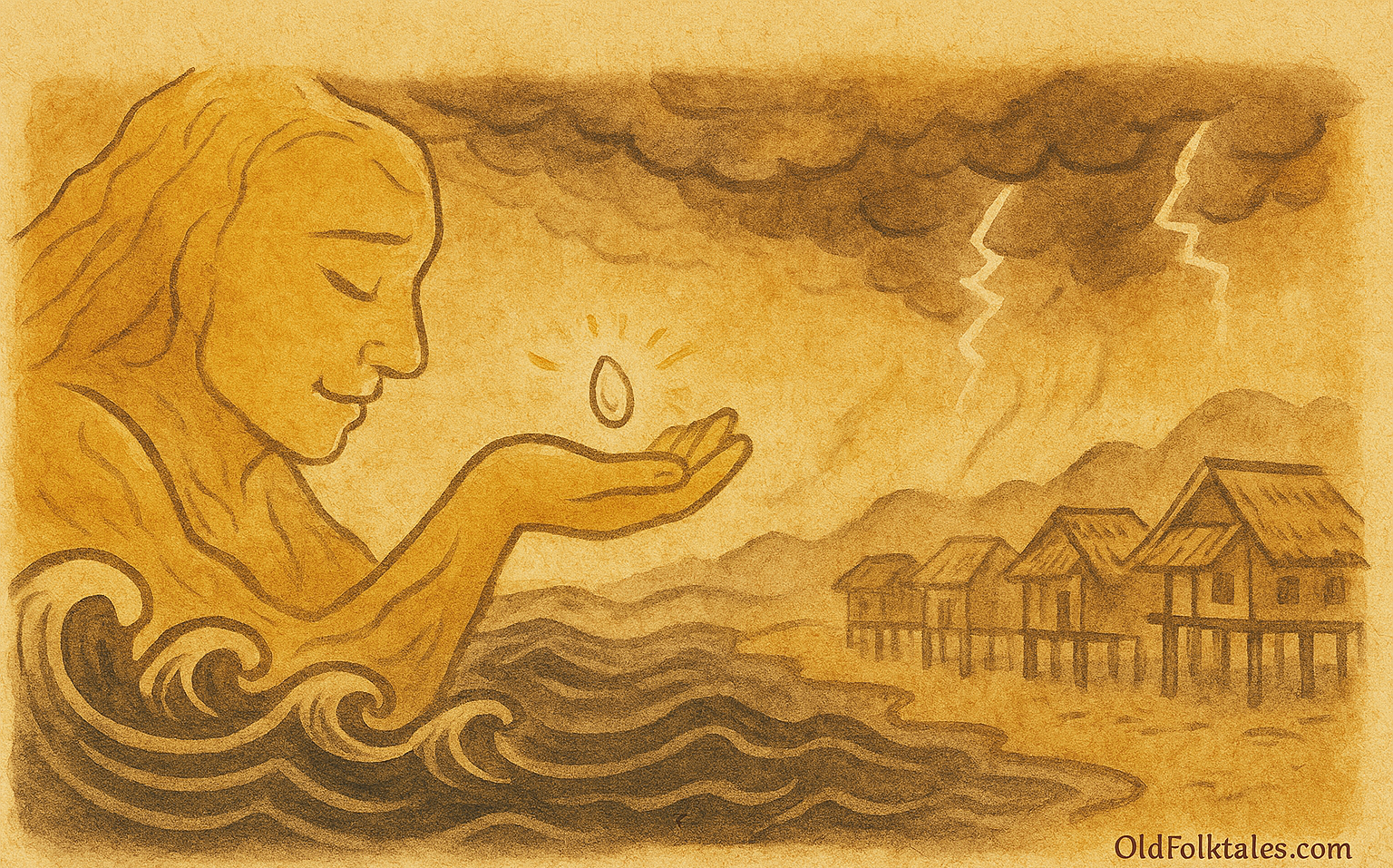
One day, as it drifted through the warm currents near the great island of Borneo, the mountain’s attention was captured by a small water village nestled along the coast. The settlement was built on wooden stilts that rose above the tide, connected by narrow walkways that swayed gently with the rhythm of the waves. Neat rows of houses with thatched roofs lined the waterways, and fishing boats bobbed peacefully in the morning light.
The Golden Mountain observed the village with growing interest. The scene before it was one of industrious life and simple contentment. Strong men worked together to build new trading ports, their muscles glistening with sweat as they hammered posts deep into the seabed and lashed bamboo platforms together with rattan rope. Their voices rang out with working songs, the rhythm helping them coordinate their efforts.
Along the wooden walkways, mothers cradled infants while preparing the day’s meals. They pounded rice in wooden mortars, ground spices on stone slabs, and stirred pots of fragrant fish curry over small charcoal braziers. Children played nearby, their laughter like music drifting across the water.
In the village’s floating market, elderly grandparents sat in their small sampans, traditional wooden boats carved from single tree trunks displaying their wares. Fresh vegetables from inland farms created colorful pyramids: purple eggplants, green chilies, golden pumpkins, and bundles of morning glory greens. Bananas hung in heavy clusters, and baskets overflowed with coconuts, their husks still green and fresh.
The Golden Mountain felt a warm stirring in its ancient heart. Here was a community that worked together, that honored both youth and age, that built for the future while respecting the past. After careful consideration, watching the village through several cycles of sunrise and sunset, the mountain made its momentous decision: it would share its golden wealth with these worthy people.
Slowly, majestically, the Golden Mountain began to move toward the settlement, its approach creating gentle swells that rocked the sampans and sent ripples spreading across the calm water. The fish in the shallows scattered before it, and seabirds circled overhead, sensing that something extraordinary was about to occur.
But just as the mountain drew near enough that the villagers might have noticed its gleaming approach, a sound pierced the air, a small, pitiful crying that seemed to come from the water itself.
The Golden Mountain paused and looked down. There, floating on the surface, tiny and alone, was a single grain of rice. It bobbed on the gentle waves, and its weeping was the sound of something that knew it had been discarded and forgotten.
“Why are you sad, my little friend?” the Golden Mountain asked, its voice like distant thunder, gentle yet powerful.
The grain of rice looked up at the magnificent mountain through its tears. “Oh, mighty one, I have not been eaten. The villagers have thrown me away. But I am still good! I am still edible and nourishing!”
The rice grain’s voice trembled with sorrow and indignation. “I was cooked with care, steamed until tender and perfect. But when the meal was finished, I remained in the bowl, overlooked. Instead of saving me for another time or feeding me to the chickens, I was simply discarded, tossed into these waters as if I had no value at all. And here I float now, weeping and slowly dissolving, wasted when I could have provided sustenance.”
The Golden Mountain fell silent, and that silence was more terrible than any storm. The water around it grew still. The breeze died away. Even the birds stopped their calls.
Then the mountain’s voice rang out, no longer gentle but filled with righteous thunder. “This is very bad indeed! Any community that does not appreciate small wealth surely does not deserve great wealth at all! Those who waste what is precious in its smallness have no right to treasures that are grand!”
The sky, which had been clear and blue, suddenly darkened as if a curtain had been drawn across the sun. Heavy clouds gathered from nowhere, roiling and churning with supernatural speed. The wind rose to a shriek, whipping the water into whitecaps and tearing at the thatched roofs of the village houses.
Lightning split the heavens, illuminating the Golden Mountain in brilliant flashes of white fire. Thunder crashed so loudly that the wooden pilings of the village trembled. Rain began to fall, not the gentle tropical rain that nourished the crops, but a punishing deluge that turned the air to water and the water to chaos.
The villagers abandoned their work and rushed to their homes, calling their children and securing their boats. They huddled inside, confused and frightened by the sudden storm. Grandparents whispered prayers to the ancestors and made offerings to the sea spirits. Mothers held their crying babies close. The men stood at the doorways, watching the unusual fury of the weather and wondering what had angered the spirits.
Through the storm, through the driving rain and the crashing thunder, the Golden Mountain gently lifted the single grain of rice from the water. It cradled the tiny morsel as tenderly as a mother holds her child, protecting it from the wind and waves.
“You are appreciated, little one,” the mountain murmured. “You have value, and I will not let you be wasted.”
Then, as the storm reached its peak and the village cowered in fear and confusion, the Golden Mountain turned away. It moved back toward the open sea, carrying with it all its gold, all its gems, all its promises of prosperity and power. The rain hammered down, washing away any trace of the mountain’s approach, erasing the moment when fortune had nearly touched the village’s shore.
The Golden Mountain swam away into the vast ocean, never to return to that place. The storm eventually passed, leaving the villagers bewildered, their lives continuing as before, unaware that they had been judged and found wanting, that immeasurable wealth had been within their grasp and had slipped away because of a single wasted grain of rice.
And the Golden Mountain? It continued its eternal journey across the ancient seas, still searching for a people who understood that those who honor small blessings are the only ones worthy of great ones.
Journey through enchanted forests and islands in our Southeast Asian Folktales collection.
The Moral of the Story
The tale of the Golden Mountain and the Rice Grain teaches us that gratitude and appreciation for small blessings are the foundation of deserving greater ones. Wastefulness and carelessness with what seems insignificant reveals a character flaw that makes one unworthy of abundance. The villagers appeared industrious and harmonious, but their casual discarding of a single grain of rice, still perfectly good, showed a lack of true appreciation for their blessings. This story reminds us that how we treat the smallest gifts reflects our character and determines whether we deserve larger fortunes. Respect for resources, no matter how small, is essential for prosperity and wisdom.
Knowledge Check
Q1: What is the Golden Mountain in this Borneo folktale?
A1: The Golden Mountain is a magical, sentient mountain covered in gold, precious gems, and treasures that roams the ancient seas seeking a worthy community to bless with prosperity, power, and wisdom. It only anchors where people prove themselves deserving.
Q2: What condition must a community meet to receive the Golden Mountain’s blessing?
A2: The Golden Mountain only shares its wealth with communities that prove themselves worthy through just governance, hard work, kindness, and respect for all blessings. If conditions worsen or the people become unworthy, the mountain leaves and never returns.
Q3: Why was the Golden Mountain initially impressed by the Borneo water village?
A3: The mountain was impressed by the villagers’ industrious nature, community cooperation, and respect for all ages. It observed men building trading ports, mothers caring for children, and grandparents selling produce from their sampans, showing a thriving and harmonious community.
Q4: What small thing caused the Golden Mountain to reject the village?
A4: The Golden Mountain rejected the village after finding a single grain of rice crying in the water. The rice was still edible but had been carelessly discarded by the villagers, showing their lack of appreciation for small blessings and resources.
Q5: What does the wasted rice grain symbolize in this Indonesian legend?
A5: The rice grain symbolizes the importance of appreciating small blessings and resources. Its waste represents ingratitude, carelessness, and lack of respect for what one has. The story teaches that those who cannot value small things don’t deserve great wealth.
Q6: What is the cultural significance of this folktale from Borneo?
A6: This Indonesian folktale from Borneo emphasizes the cultural value of gratitude, resourcefulness, and respect for all gifts, especially food. In rice-dependent Asian cultures, wasting even a single grain is considered deeply disrespectful and shows poor character unworthy of prosperity.
Source: Indonesian folktale from Borneo, Indonesia