In the heart of Palestine, where olive trees whisper to the wind and village stories echo across the hills, there once lived a poor woman who owned little more than a clay pot and her faith. Each day, she cooked lentils over a humble fire, her pot bubbling with both hunger and hope. One morning, while she washed her dishes by the well, she heard a strange sound, “Tunjur, tunjur, tunjur…” The rhythm was cheerful, like laughter on a sunny day. Looking around, she saw her cooking pot rolling on its own, spinning merrily across the ground.
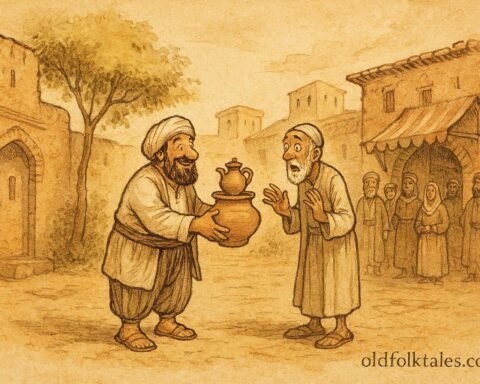
“Stop, you silly thing!” she cried. But the pot kept rolling, chanting, “Tunjur, tunjur, tunjur!” until it disappeared down the dusty road. The woman ran after it, shouting for help. The villagers came out to watch as the enchanted pot rolled toward the marketplace. When it stopped at the merchant’s stall, they all stared in amazement.
The merchant laughed. “So this is your magic pot? Then let us see what it can do!” He dropped a few coins into it, joking that perhaps the pot would return the money doubled. But when the woman took the pot home and opened it, she found it full of silver coins. She gasped, crossed herself, and whispered, “Praise be! My tunjur brings blessings!”
Word of the miraculous pot spread quickly through the village. The poor woman grew rich; her hut became a fine house, her torn shawl replaced by silk. Yet the pot’s rolling mischief continued. Each time she left it alone, it would roll away again, “Tunjur, tunjur, tunjur…”, visiting other houses, markets, and gardens. Some treated it kindly; others tried to take advantage of it.
One day, the governor of the town heard about the talking pot and sent his guards to fetch it. “Bring me that thing that makes the sound of coins,” he ordered greedily. When the pot arrived, he filled it with gold and demanded, “Now, magic pot, bring me more!” But when he opened the lid, the pot spat ashes and soot into his face. Furious, he kicked it away, but the pot rolled off, laughing in its metallic voice, “Tunjur, tunjur, tunjur!”
It rolled back to its true owner, bumping gently against her door. The woman smiled through tears. “Ah, my faithful tunjur, you have learned that greed brings no joy.” From that day, she placed the pot high on a shelf, where it gleamed like gold in the afternoon light. She no longer asked it for riches. The pot, content and silent, never rolled away again.
Generations later, the villagers still tell of the pot that spoke in song and taught a lesson without words, that contentment is richer than treasure, and greed turns gold into dust.
Moral Lesson
True wealth lies not in possessions but in gratitude and humility. The enchanted pot of Tunjur, tunjur reminds us that greed brings ruin, while a grateful heart brings peace.
Knowledge Check
1. Where does the folktale “Tunjur, Tunjur” originate?
It originates from Palestine, collected from the oral storytelling tradition of Galilee villages.
2. What does the sound “Tunjur, tunjur” represent in the story?
It mimics the rolling sound of a metal pot, symbolising movement, curiosity, and fate.
3. What moral lesson does the story teach?
It teaches that greed and discontent destroy blessings, while gratitude sustains happiness.
4. Who collected this version of the tale?
The tale was narrated by Fatme, a housewife from the village of Arrabe in Galilee.
5. Why did the governor suffer misfortune?
Because he acted out of greed, attempting to exploit the pot’s powers for selfish gain.
6. How does the story reflect Palestinian village life?
Through its domestic setting, humour, and rhythm of oral tradition, it mirrors the warmth and wit of Palestinian rural culture.
Source: Adapted from Tunjur, Tunjur (Tale 1), narrated by Fatme of Arrabe, in Palestinian Folktales Anthology (CHwB, 2015).
Cultural Origin: Palestine (Galilee Folklore)