In the heart of ancient Palestine, where olive trees whispered to the wind and the desert horizon glowed like gold, there once lived a poor family blessed with three children, two sons and a daughter. Though their home was humble, it was filled with laughter, love, and the songs of a thousand birds that gathered near their window each dawn. Among those songs, one name echoed in local legend, Little Nightingale the Crier, a bird said to possess a voice so powerful that it could heal the sorrow of the world.
One evening, as the brothers sat before the flickering glow of their hearth, an old traveller stopped by their home. Between sips of cool water, he spoke of a wondrous bird that lived in a land far beyond the mountains, a bird whose song could bring honour and fortune to whoever captured it. The eldest brother’s eyes shone with ambition. “I will bring Little Nightingale the Crier home,” he declared. The next morning, he set out with courage in his heart and a small bundle of bread tied at his side.
For days he journeyed, crossing rocky plains and sleeping beneath starlit skies. One afternoon, he reached a dark forest where shadows slithered like serpents. There, from the mist, appeared a ghoul, half-human and half-beast, with eyes burning like coals. “Where are you going, traveller?” the creature hissed.
“To find the bird called Little Nightingale the Crier,” the young man replied boldly.
The ghoul smiled, showing sharp, blood-red teeth. “Then stay with me for the night,” it said, “and I shall show you the way.”
But when the eldest awoke, he was not in a bed of straw but in a pit of bones. The ghoul had devoured him, his courage silenced forever.
When weeks passed with no word, the second brother decided to follow. “Our brother must be in danger,” he told their sister. “I will bring him home, and the bird, too.” With the same determination, he journeyed across the plains, found the same dark forest, and met the same ghoul. And just as before, he vanished without a trace.
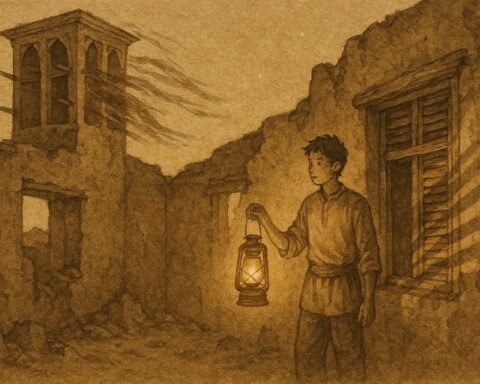
Their sister, who was as clever as she was brave, wept for her brothers but refused to give in to despair. “If they have not returned,” she said, “then I must go myself.” She disguised herself in men’s clothing, tied her hair beneath a scarf, and carried only a staff and a small lamp. Her heart trembled, yet she walked with steady steps through the valleys until she reached the cursed forest.
When the ghoul appeared, the sister bowed politely and said, “Peace be upon you, traveller. I seek Little Nightingale the Crier.”
The ghoul laughed, for it thought she was another foolish youth. “Then stay the night,” it said, “and I will show you the way.”
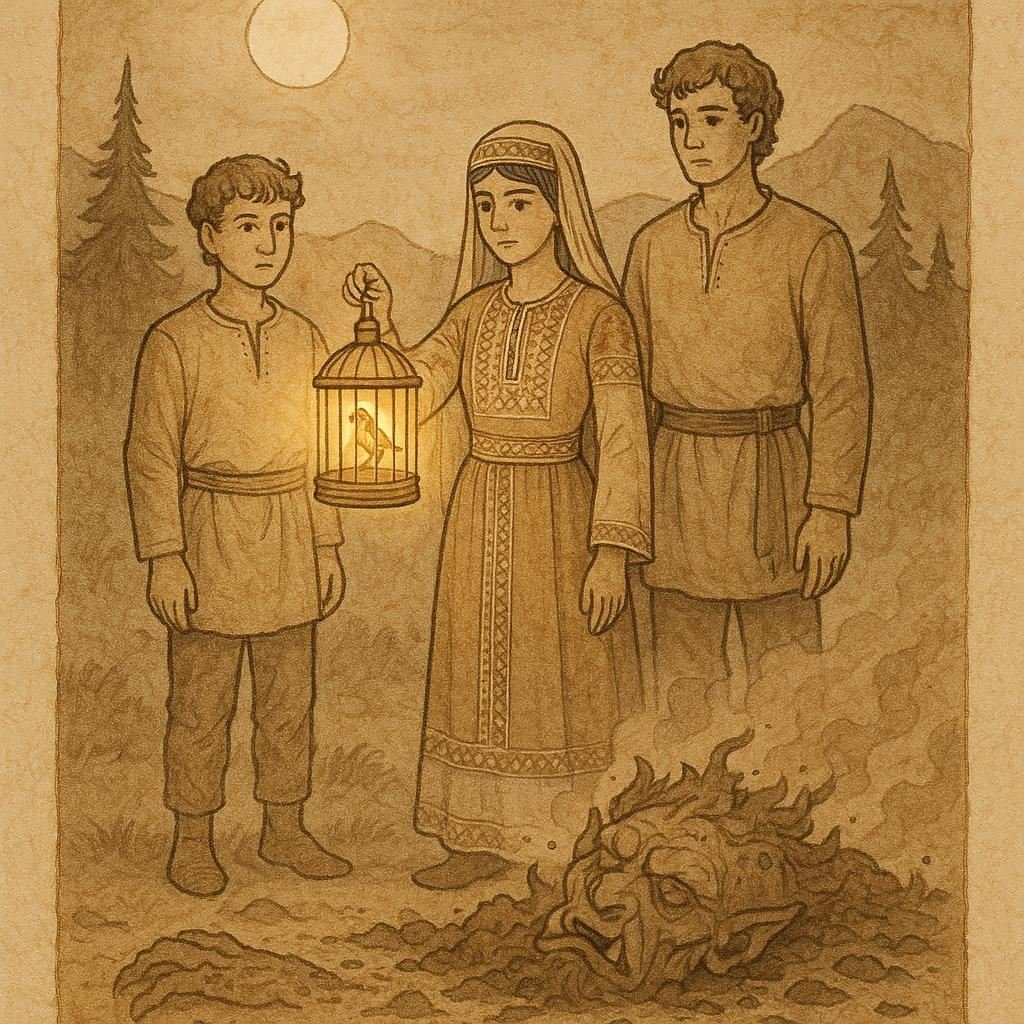
But the girl was wise. She watched carefully and noticed that the ghoul carried a ring made of human hair, and inside it shimmered the trapped souls of her brothers. Waiting until it slept, she seized a burning stick from the fire and struck the ghoul’s heart. The forest roared with cries as the creature turned to ash.
When dawn came, the sister searched through the ruins and found her brothers’ bones beside the ghoul’s ring. She touched them with her tears and sang softly, and by the mercy of Heaven, they stirred to life.
Together they travelled to the high mountains where the Little Nightingale the Crier lived in a golden cage guarded by winds and flames. “Only one with a pure heart may touch the cage,” said a voice from the air. The sister stepped forward. Her brothers tried to stop her, but she smiled. “You have suffered enough,” she said gently. “Let me finish what we began.”
She wrapped her scarf around her arm, reached through the fire, and lifted the bird’s cage. Her skin burned, but she did not flinch. The bird began to sing, a melody so beautiful that the flames died and the winds bowed. The heavens cleared, and light filled the mountains.
The siblings returned home, the bird’s song echoing behind them like a blessing. Their parents wept with joy, for the daughter had not only rescued her brothers but restored their family’s honour and peace. From that day on, whenever the Little Nightingale the Crier sang, the whole village would stop to listen, for its song told the story of a sister’s love that conquered evil and fear.
Moral Lesson
The tale of Little Nightingale the Crier teaches that courage and love can triumph over even the darkest trials. True strength lies not in physical power but in compassion, wisdom, and sacrifice.
Knowledge Check
1. Who are the main characters in “Little Nightingale the Crier”?
The story centres on two brothers, their brave sister, and the magical bird known as Little Nightingale the Crier.
2. What does the Little Nightingale symbolise?
It represents truth, honour, and the power of hope that restores harmony within families.
3. How does the sister defeat the ghoul?
She uses intelligence and courage, striking its heart with a burning stick while it sleeps.
4. What moral value is most important in this folktale?
Courage, loyalty, and self-sacrifice for family and loved ones.
5. Where does this Palestinian folktale originate?
It comes from traditional oral storytelling in the Arrabe region of Palestine.
6. Why is this story significant in Palestinian folklore?
It reflects cultural values of family unity, bravery, and faith in divine justice against evil.
Source: Adapted from the Palestinian folktale “Little Nightingale the Crier” (Tale 10) collected from the Arrabe tellers in Palestinian Arab Folktales (Institute for Palestine Studies).
Cultural Origin: Palestine (Arab folklore)