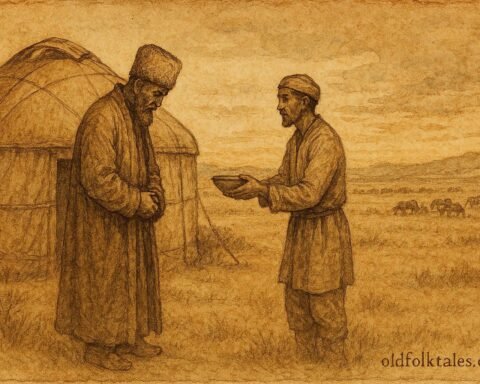
Once upon a time, in the golden steppes of southern Kazakhstan, where the wind danced across endless fields of swaying grasses and the scent of sage and earth filled the air, there lived a gentle herdsman named Nurali. Though his home was humble and his flocks modest, his heart overflowed with kindness. Travelers found shelter under his roof, and anyone in need could always rely on his generosity.
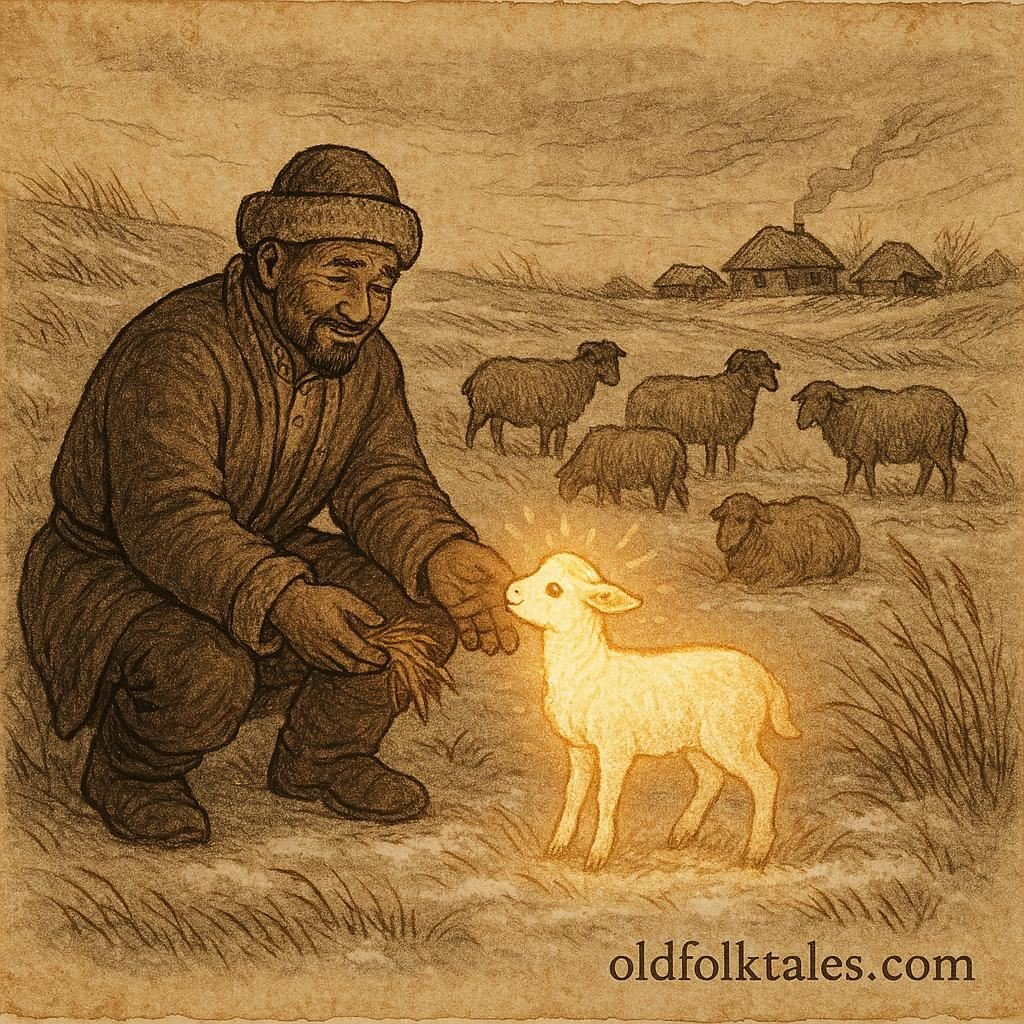
One autumn morning, as the horizon burned with the pale orange of dawn, Nurali noticed a lone lamb wandering along the dusty trail. Its wool shimmered faintly, almost as if kissed by sunlight, and its eyes held a curious intelligence. He approached slowly, speaking softly, and the lamb followed him without hesitation. Nurali brought it home, washed it in warm water, fed it grain and grass, and made a small pen beside his own modest flock. He treated the creature as if it were his own child, unaware that this lamb was a spirit in disguise, sent to test human kindness.
Explore desert legends and palace tales in our Western Asian Folktales archive.
As the weeks passed, Nurali’s generosity became a quiet legend. Villagers often passed by, watching him with a mixture of amusement and mild disapproval. “Why waste your food on a wandering lamb when our own flocks barely suffice?” they whispered. Nurali simply smiled and offered them a handful of grain. “Kindness is never wasted,” he would reply.
Winter came with a sudden ferocity. Snow blanketed the steppe, rivers froze along their banks, and biting winds tore across the villages. Many herds perished under the relentless storm, leaving families with empty pens and hungry mouths. Yet Nurali’s small flock, including the mysterious lamb, remained unharmed. Each animal was warm, healthy, and calm, huddled in the shelter he had built and fed daily. The villagers, who had mocked his gentle nature, could hardly believe their eyes.
One dawn, the lamb was gone. In its place lay a small note, glowing faintly as if written with liquid sunlight. Nurali picked it up carefully and read aloud:
“Generosity shelters those who give shelter. Mercy and compassion are stronger than the fiercest storm.”
The villagers, humbled by the sight, approached Nurali with awe and newfound respect. They had learned that true wealth was not measured in gold or livestock alone but in the care and kindness one extended to others. Nurali’s simple acts of compassion had not only protected his own flock but inspired the entire community to embrace generosity, forging a harmony between humans, animals, and the land itself.
Nurali continued to live among the steppes, tending his herds and sharing what he could. Travelers who passed through the villages would often hear the story of the Generous Herdsman and recall the lesson written in the glowing script: that mercy and hospitality can shelter the heart even in the harshest winters.
Discover the wisdom of ancient India and the Silk Road in South & Central Asian Folktales.
Moral Lesson
The moral of the story is clear: generosity and compassion, when offered sincerely, are never in vain. True kindness, even to the smallest or weakest, carries a reward that transcends material wealth.
Knowledge Check
-
Who is the main character of the folktale?
-
Nurali, a humble and kind herdsman from southern Kazakhstan.
-
-
What is the significance of the lamb in the story?
-
The lamb is a spirit in disguise, testing human kindness and generosity.
-
-
What natural event tests Nurali’s virtue?
-
A fierce winter storm that destroys much of the village’s herds.
-
-
What lesson does the glowing note convey?
-
Generosity and mercy protect those who offer them, showing kindness brings reward.
-
-
How do the villagers’ attitudes change by the end?
-
They move from mockery to respect, learning the value of compassion and hospitality.
-
-
What themes are emphasized in this Kazakh folktale?
-
Compassion, generosity, harmony with nature, and moral reward.
-
Source & Cultural Origin
Source: Folk Tales from the Soviet Union: Central Asia and Kazakhstan (Raduga Publishers, 1983).
Cultural Origin: Southern Kazakhstan, collected near Almaty and Semey.