A careless woman’s disregard for warnings leads to a deadly confrontation with an angry alligator
In a small village nestled along a winding river in the Philippines, where the water flowed dark and slow beneath overhanging vines, two women set out one morning on a familiar errand. They walked along the muddy banks, their eyes scanning the thick vegetation that grew wild at the water’s edge. They were searching for a particular vine, one that bore sweet, juicy fruit that the villagers loved to eat.
The vine they sought was no ordinary plant. Everyone in the village knew it belonged to the alligator who lived in the depths of the river. The great creature was territorial and watchful, and though the people sometimes dared to take his fruit, they did so with caution and respect, always careful to leave no trace of their theft.
Click to read all Southeast Asian Folktales — featuring legends from Thailand, Indonesia, Vietnam, and the Philippines.
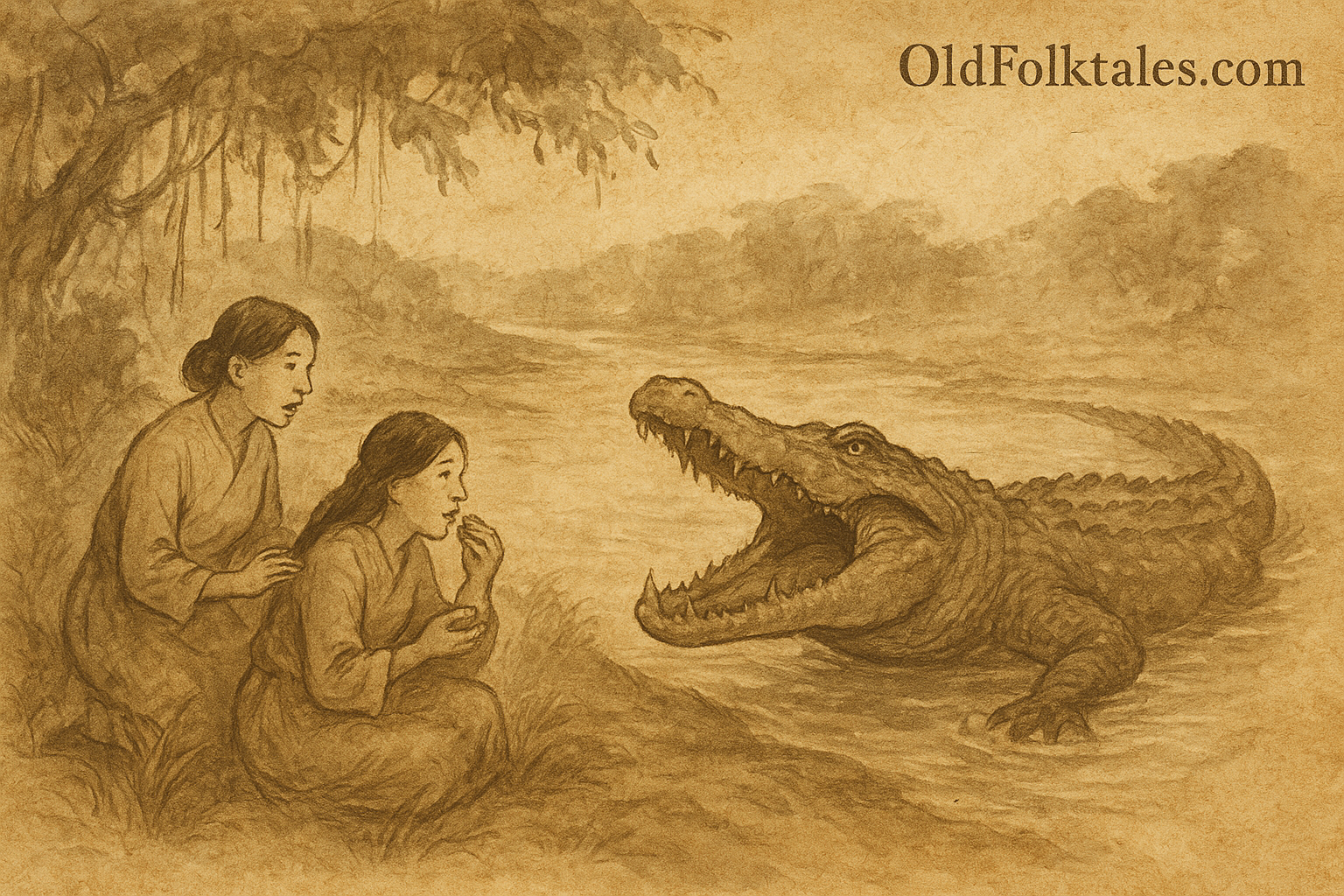
The two women found the vine heavy with ripe fruit, its branches drooping with the weight of the harvest. They plucked the fruit eagerly, their fingers working quickly to gather as much as they could carry. The fruit was delicious sweet flesh that melted on the tongue, encased in a thick rind that had to be bitten through to reach the treasure inside.
As they sat together on the riverbank, eating their prize, the elder of the two women turned to her companion with a serious expression. Her voice was low and urgent as she offered a warning that had been passed down through generations.
“You must be very careful not to throw the rind where the alligator can see it,” she said, holding up a piece of the discarded peel. “Especially not the pieces with your teeth marks on them. The alligator will know who has taken his fruit if he sees the marks of your teeth.”
The younger woman nodded absently, but she was too busy enjoying the sweet fruit to pay much attention to the warning. The taste was so delicious, the morning so pleasant, that caution seemed unnecessary. What harm could there be in a few discarded rinds?
Without thinking, she tossed a piece of rind, clearly marked with the impressions of her teeth, into the river. It floated on the surface for a moment before drifting downstream, bobbing gently on the current.
Deep below the surface, in his dark lair among the river roots and stones, the alligator saw it. His ancient eyes, which missed nothing in his domain, immediately recognized what it was. Someone had stolen his fruit. And the teeth marks told him exactly who the thief was.
Rage filled the great creature. His fruit was precious, and this woman had shown him no respect, no fear. She had taken what was his and left evidence of her crime floating in his very home. The alligator’s powerful tail thrashed in the water as fury consumed him. He would have his revenge.
The alligator rose from the depths and made his way to the village. His massive body dragged through the mud, leaving deep furrows in the earth. Villagers scattered at the sight of him, their faces pale with terror. An alligator coming to the village meant death, everyone knew this.
The great beast positioned himself in front of the woman’s house and called out in a voice that seemed to shake the very ground. His words were clear and terrible, spoken with the authority of a creature who had ruled the river since before anyone could remember.
“Bring out the woman that I may eat her!” he roared. “She has eaten my fruit without permission. She has shown me no respect. Bring her out now, or I will come in and take her myself!”
Inside the house, the woman trembled with fear. She knew she should have listened to her companion’s warning. Now the alligator had come for payment, and the price would be her life. The other villagers gathered around, their faces grim. They could not allow the alligator to simply take one of their own, but they also understood the creature’s rage was justified. The woman had been careless and foolish.
The village elders conferred quickly, speaking in hushed voices. Then one of them stepped to the door and called out to the waiting alligator, keeping his voice calm and respectful.
“Very well,” he said. “We will bring her out to you. But sit down and wait a little while. We must prepare her properly for you.”
The alligator, satisfied that justice would be done, settled himself to wait. His great jaws opened slightly, showing rows of sharp teeth. He could afford to be patient now. The woman would soon be his.
Inside the house, the villagers worked quickly. They built up the cooking fire until it roared hot and bright. Then they took the iron soil-turner, a heavy tool used for working the earth and placed it directly in the flames. They waited, watching as the iron slowly began to glow, first dull red, then brighter and brighter until it shone like a piece of captured sun.
When the iron was red hot, glowing with terrible heat, the men carefully lifted it from the fire using thick cloths to protect their hands. They carried it to the door, moving slowly and deliberately so as not to alert the alligator to their plan.
They opened the door and stood before the great beast. The alligator raised his massive head, his jaws opening wide in anticipation of the meal he had been promised.
“Here,” one of the men said, holding out the glowing iron. “Eat this first.”
The alligator, thinking this was some sort of offering or preparation ritual, opened his enormous mouth even wider. His throat was exposed, a dark cavern leading down into his belly.
With all their strength, the men thrust the red hot iron deep down the alligator’s throat. The creature tried to roar, tried to thrash and escape, but the searing iron had done its work. The alligator collapsed, his body convulsing once, twice, then lying still. The great beast was dead.
The villagers stood in silence, looking at the fallen creature. There was no joy in the victory, only relief and a sobering lesson learned. The woman emerged from the house, her face wet with tears of shame and gratitude. She knew how close she had come to death, and she knew it had been her own carelessness that had brought the danger to her village.
From that day forward, the people of the village were even more careful when they took fruit from the alligator’s vine. And whenever anyone was tempted to be careless or to disregard a warning, they remembered the woman who had thrown the rind into the river, and the terrible price that had nearly been paid.
Journey through enchanted forests and islands in our Southeast Asian Folktales collection.
The Moral of the Story
The tale of the Alligator’s Fruit teaches us the importance of heeding wise counsel and respecting boundaries. The younger woman’s carelessness, disregarding her companion’s warning about the teeth-marked rind, brought deadly consequences not just to herself but to her entire village. The story reminds us that seemingly small acts of disrespect or carelessness can lead to serious danger, and that warnings from those with experience should never be dismissed. It also illustrates that cleverness and cooperation can overcome even the most fearsome threats when a community works together to protect its own.
Knowledge Check
Q1: Why did the alligator become angry in this Philippine folktale?
A1: The alligator became angry because a woman stole fruit from his vine and carelessly threw a rind with her teeth marks into the river. When he saw the teeth-marked rind, he knew exactly who had taken his fruit and felt disrespected.
Q2: What warning did the older woman give her companion when gathering the alligator’s fruit?
A2: The older woman warned her companion to be very careful not to throw the fruit rind with teeth marks where the alligator could see it, because the alligator would be able to identify who had taken his fruit from the teeth impressions.
Q3: What did the alligator demand when he came to the village?
A3: The alligator demanded that the people bring out the woman who had eaten his fruit so that he could eat her as punishment. He threatened to come into the house himself if they did not comply with his demand.
Q4: How did the villagers defeat the alligator in this Filipino legend?
A4: The villagers heated an iron soil-turner in the fire until it was red hot. When the alligator opened his mouth expecting to eat the woman, they thrust the glowing iron down his throat, killing him instantly.
Q5: What does the iron soil-turner represent in this Philippine folktale?
A5: The iron soil-turner represents the resourcefulness and cleverness of the community. A simple farming tool became a weapon that saved the woman’s life, showing how ordinary people can use their wits and available resources to overcome powerful threats.
Q6: What cultural lesson does The Alligator’s Fruit teach about respecting warnings and boundaries?
A6: The story emphasizes that warnings from experienced people should be taken seriously, as carelessness can have deadly consequences. It also teaches respect for boundaries, even when taking something that doesn’t belong to you, showing disrespect or leaving evidence can bring severe punishment.
Source: Philippine folktale, Philippines