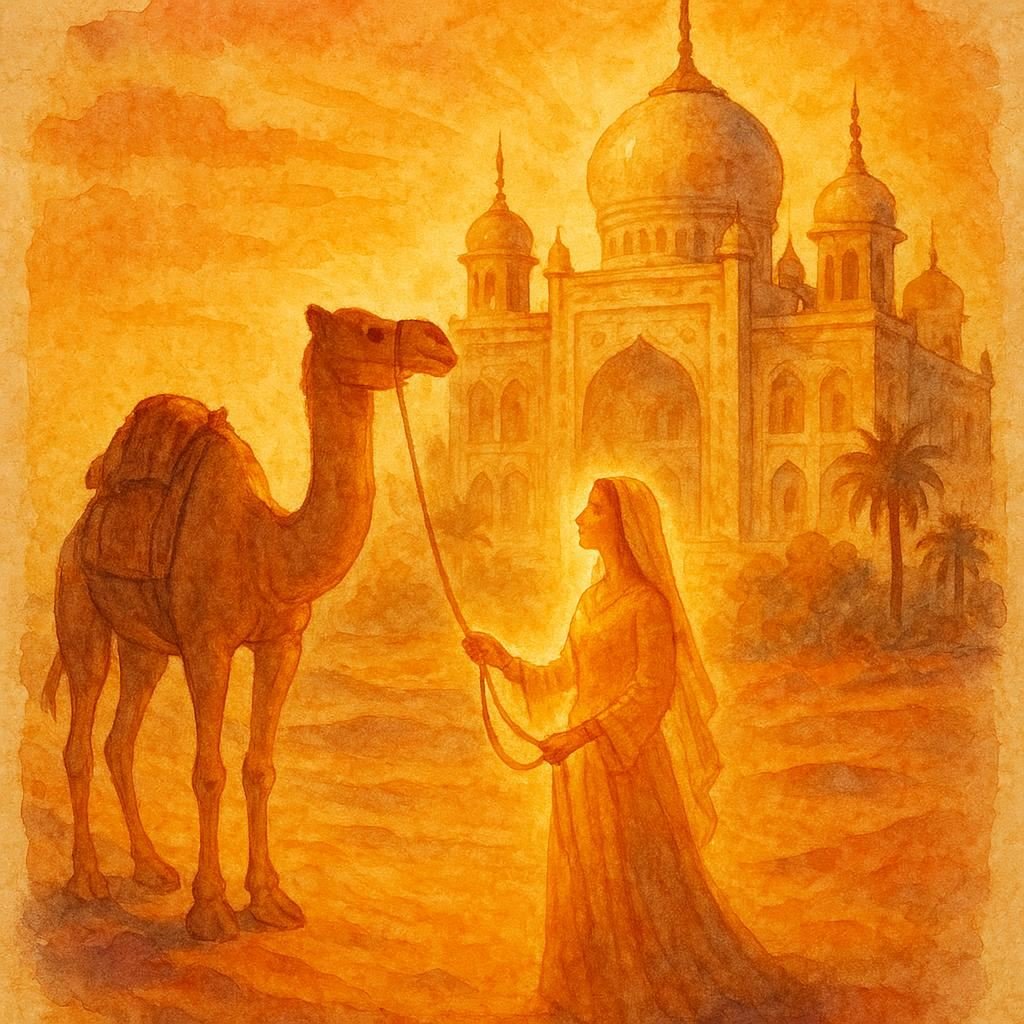
In the boundless deserts of Jordan, where the wind sings through the dunes and the sun melts into gold at twilight, there once lived a woman who longed for a child. One night, she prayed beneath the stars, her voice trembling with hope: “O Lord, grant me a son, even if he is no more than a camel in form.” Her wish was answered, but in a way she could never have imagined.
Months later, she gave birth to a camel, small yet strong, its eyes glimmering with human understanding. Though shocked, the mother loved her strange child dearly and raised him with kindness and devotion. The camel grew swiftly, tall and majestic, with a coat as pale as desert sand and a gait that echoed with quiet pride. Yet, inside that animal form beat the heart of a man.
One day, the camel spoke.
“Mother,” he said softly, “I wish to marry the princess.”
The poor woman was stricken with fear. “My son,” she whispered, “you are a camel, how could a princess ever accept you?”
But the camel would not yield. He knelt before her and said, “The heart knows no shape, and love asks no permission.”
So, the mother carried her son’s request to the king. The court erupted in laughter. A camel asking for the hand of a princess? The king, hiding his scorn, decided to set impossible tasks to silence this bold creature.
“If your son wishes to marry my daughter,” said the king, “he must build me a palace finer than any on earth, by sunrise tomorrow.”
The mother returned to her son, her eyes full of tears. But the camel only nodded and said, “Do not weep, Mother. Sleep peacefully.” That night, the desert trembled. Winds swirled, and unseen hands, the helpers of fate, built a palace of white marble and blue glass. When dawn came, its towers shimmered like mirages, and the king stood speechless.
Still unwilling to yield, the king set another task. “Let the camel fill my storehouses with gold and silver by tomorrow’s dawn.”
Once again, the camel bowed, and by morning, the storehouses overflowed with treasure, coins gleaming like the rising sun, jewels flashing with desert fire. The king’s laughter faded to disbelief. Yet he tried once more. “Bring me the crown of the mighty serpent who rules beneath the earth.”
The camel bowed low and journeyed into the wilderness. For days he wandered until he reached a mountain that groaned like thunder. There, the serpent-king coiled around a cavern of glowing stones. The camel spoke humbly: “Great one, I seek your crown not for greed but for love.” Moved by his courage, the serpent-king said, “Your heart is pure. Take the crown, and may love restore what the world denies.”
When the camel returned, bearing the serpent’s crown, the king could delay no longer. He consented to the marriage.
On the wedding day, the princess stood before her groom. Though startled by his form, she saw gentleness in his eyes. She bowed her head and said, “If my heart accepts you, your form matters not.”
As she spoke, a light flared through the hall. The camel’s skin shimmered and split, and before her stood a handsome young man, radiant as morning. His mother wept with joy, and even the king bowed his head in wonder.
Thus, the camel-husband became a prince, and the princess his bride. Their union was a song of faith, patience, and the truth that worth lies not in form but in spirit.
Moral Lesson
True worth is not measured by appearance but by heart and virtue. The Camel-Husband teaches that love and faith can dissolve even the hardest curses, and that every soul, no matter its form, carries divine purpose.
Knowledge Check
-
Who is the main character in “The Camel Who Sought a Princess”?
The central character is a camel born to a human mother who later seeks to marry a princess. -
What challenges does the camel face before winning the princess’s hand?
He must build a palace overnight, fill storehouses with treasure, and retrieve the serpent-king’s crown. -
How does the Camel-Husband symbolize transformation in Jordanian folklore?
He represents inner purity, resilience, and the triumph of spirit over outward form. -
What is the key moral of this Jordanian folktale?
The story teaches that love and faith reveal true beauty, beyond appearances. -
Where does “The Camel Who Sought a Princess” originate?
It is a Jordanian folktale told among Bedouin and desert communities in the southern Levant. -
Why is the serpent-king important in the story?
The serpent-king symbolizes divine wisdom and rewards the camel’s courage and humility.
Source
Adapted from the Jordanian Bedouin folktale “The Camel-Husband” (Animal Bridegroom Motif), as referenced in Jordanian oral heritage and Bedouin folktale surveys.
Cultural Origin: Jordan (Bedouin / Levantine folklore)