A dying crocodile transforms into an island to repay a boy’s kindness in this creation legend from East Timor
Many years ago, in a time when the world was still young and taking shape, a small crocodile lived in a murky swamp in a far away place. The swamp was remote and isolated, cut off from the abundance of the sea. Life there was hard, and food was desperately scarce.
The little crocodile had dreams, grand dreams of growing large and powerful like the ancient crocodiles his elders spoke of, creatures with backs like mountain ridges and jaws strong enough to crush stone. But as the days passed and hunger gnawed at his belly, these dreams seemed more and more impossible. The crocodile grew weaker instead of stronger, his scales becoming dull, his movements sluggish. Sadness settled over him like a heavy fog. He could feel his life slowly draining away in that stagnant, lifeless swamp.
Click to read all Southeast Asian Folktales — featuring legends from Thailand, Indonesia, Vietnam, and the Philippines.
One day, summoning the last reserves of his strength, the crocodile made a desperate decision. He would leave the swamp and journey to the open sea, where he had heard that food was plentiful and the waters were rich with life. Perhaps there he could eat his fill and finally grow into the magnificent creature he was meant to become. Perhaps there his dreams could be realized.
The little crocodile dragged himself from the swamp and began the long, arduous journey toward the distant ocean. He could smell the salt on the wind, calling to him, promising salvation. But the path was longer and harder than he had imagined. The tropical sun climbed higher and higher in the sky, beating down mercilessly on his exposed body. Crocodiles are creatures of water, and without it, they dry out quickly under the sun’s relentless heat.
As the day wore on, the little crocodile’s skin began to crack. His mouth hung open, desperate for moisture. His legs could barely carry him forward. The seashore, which had seemed so close when he started, now appeared impossibly far away. His vision blurred. His strength failed. Finally, unable to take another step, the little crocodile collapsed on the dry earth, certain that he would die there, alone and far from the water that was his home. His dreams of the sea, of growing strong, of becoming mighty, all of it would end here in the dust.
But fate had other plans.
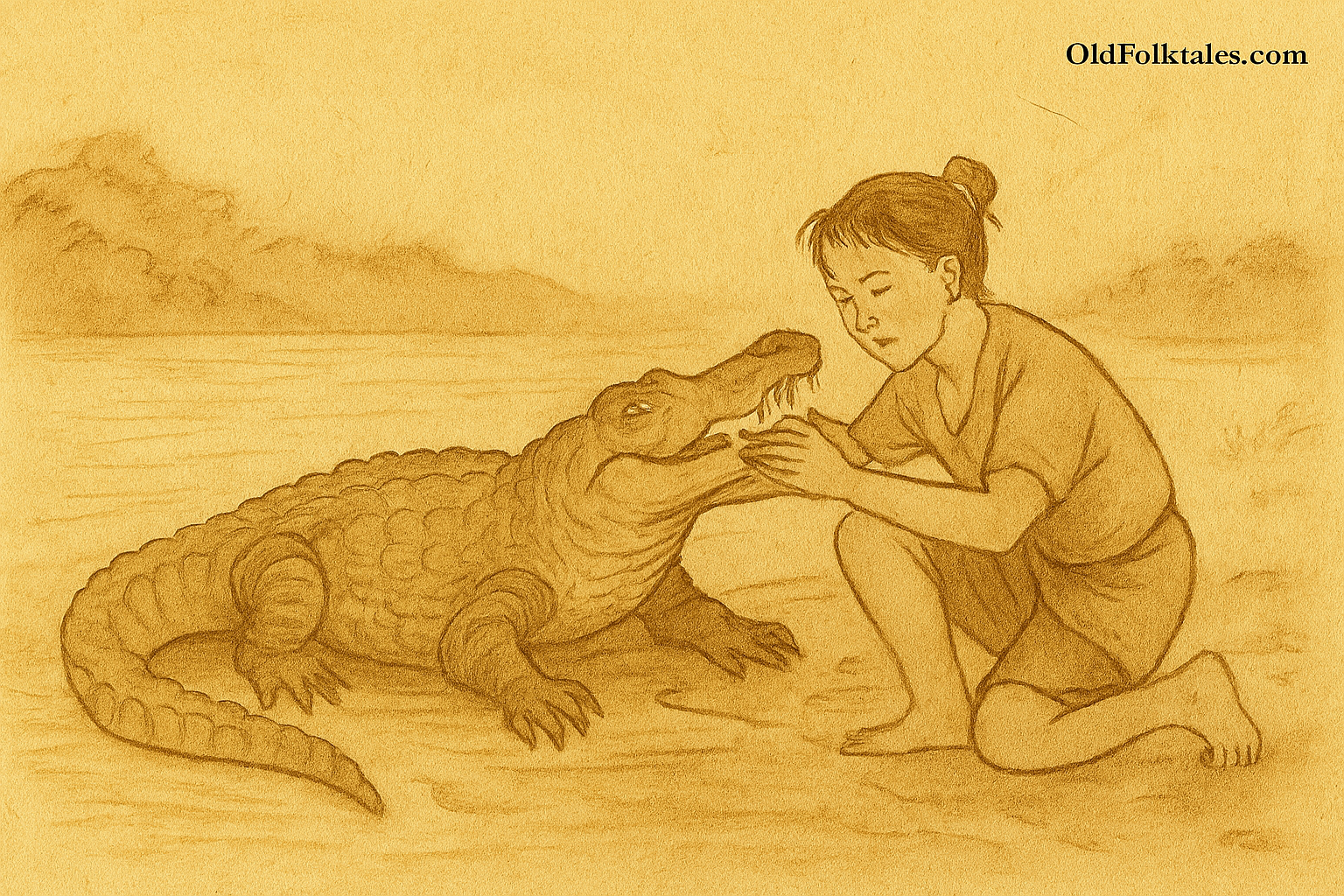
A small boy was walking along the path when he came upon the dying crocodile. Another child might have been frightened or simply passed by, but this boy had a compassionate heart. He looked at the suffering creature and felt deep pity stirring within him. The crocodile’s eyes, glazed with approaching death, seemed to plead silently for help.
The boy knew what he had to do. Though the crocodile was heavy and the sun was hot, he bent down and carefully lifted the creature into his arms. Step by step, struggling under the weight, the boy carried the crocodile toward the sea. His arms ached. Sweat poured down his face. But he did not stop until he reached the water’s edge and gently placed the crocodile into the cool, life-giving waves.
The transformation was immediate and miraculous. As the salt water washed over his dried scales, the crocodile was instantly revived. Strength flooded back into his limbs. His eyes cleared. Life surged through his body once more. He had been saved from certain death.
The crocodile turned to look at the boy standing on the shore, and gratitude filled his ancient heart. “Little boy,” he said, his voice rumbling like distant thunder, “you have saved my life when I was ready to die. I will never forget this kindness. If I can ever help you in any way, no matter when or where, please call me. I will be at your command, for you are now my brother.”
The boy nodded solemnly, and the crocodile swam away into the deep water to hunt and feed and grow.
Years passed. The boy grew into a young man, and the crocodile, well-fed in the abundant sea, grew large and powerful beyond measure. His back became ridged and mighty, his scales thick as armor, his jaws strong enough to snap a tree trunk in half. He had achieved his dream, he was magnificent.
One day, the young man stood at the edge of the sea and called out across the waves. “Brother Crocodile! I need you!”
From the depths rose the enormous crocodile, now bigger than any boat, his eyes still holding the memory of that small boy who had saved him. “Brother,” rumbled the great creature, “I have not forgotten my debt. How may I help you?”
The young man’s eyes sparkled with the same spirit of adventure that had once driven the crocodile from his swamp. “Brother Crocodile,” he said, “I too have a dream. I want to see the world beyond these shores. I want to know what lies beyond the horizon.”
“Then climb upon my back,” said the crocodile, “and tell me which direction calls to your heart.”
The young man climbed onto the crocodile’s broad, ridged back and pointed toward the rising sun. “Follow the sun,” he said simply.
And so they set off toward the east, the mighty crocodile swimming through the endless oceans with the young man riding upon his back. They traveled for years, seeing wonders beyond imagining, islands that rose like emeralds from azure waters, shores where mountains touched the clouds, places where the sea glowed with strange lights at night. The young man saw the world he had dreamed of, and the crocodile was happy to give him this gift.
But eventually, as must happen to all living things, the crocodile began to feel the weight of age settling upon him. His powerful strokes grew slower. His ancient heart grew tired. One day, as they drifted on calm waters, the crocodile spoke.
“Brother,” he said quietly, “we have been traveling together for a long time, and it has been a joy to repay your kindness. But now the time has come for me to die. My strength is fading, and soon I will sink beneath these waves forever.”
The young man’s eyes filled with tears, for he had grown to love his crocodile brother deeply.
The crocodile continued, his voice gentle but firm. “Do not grieve, brother. Instead, let me give you one final gift, the greatest gift I can offer. In memory of your kindness so many years ago, when you saved a dying creature you had no reason to help, I will turn myself into a beautiful island. There you and your children and your children’s children can live until the sun itself sinks into the sea at the end of days. You will never be without a home.”
As the crocodile spoke these words, a great transformation began. The massive creature grew and grew, expanding beyond all natural size. His body rose up from the water, no longer flesh but becoming earth and stone. His great ridged back transformed into mountains that reached toward the sky. His thick, armored scales became the rolling hills and valleys. His head became the eastern peninsula, and his tail stretched out to the west. Where there had been a crocodile, there was now an island, beautiful and fertile, ready to support life.
This is how the island of Timor was born, created from the body of a grateful crocodile who never forgot a small boy’s kindness.
To this day, the people of East Timor remember this ancient bond. When they enter the ocean to swim or fish, they speak respectfully to the waters, saying the traditional words: “Don’t eat me, crocodile. I am your relative.” For they are indeed related, they live upon the very body of their crocodile ancestor, and his spirit still protects them from the sea’s dangers.
The mountains of Timor, with their distinctive ridges, are said to be the crocodile’s spine. The hills and valleys are his scales. And the people who call Timor home are the descendants of the compassionate boy who once saved a dying creature, proving that even the smallest act of kindness can change the world forever.
Journey through enchanted forests and islands in our Southeast Asian Folktales collection.
The Moral of the Story
The tale of the Crocodile and the Boy teaches us the profound power of compassion and the enduring nature of gratitude. The boy’s simple act of kindness, carrying a dying creature to water when he could have easily walked past, saved not just one life but ultimately created a home for countless generations. The crocodile’s unwavering gratitude, spanning years and never forgotten, reminds us that true kindness is always remembered and often repaid in ways we cannot imagine. The story emphasizes that no act of mercy is too small to matter, and that compassion toward all living things, even those that seem dangerous or unimportant, can yield blessings that echo through eternity.
Knowledge Check
Q1: Why was the small crocodile dying at the beginning of this Timorese folktale?
A1: The small crocodile was dying because food was scarce in the isolated swamp where he lived, leaving him weak and sad. When he tried to reach the sea to find food, the hot sun dried him out as he traveled, and he collapsed before reaching the water.
Q2: What act of kindness did the boy perform for the crocodile in this East Timor legend?
A2: The boy took pity on the dying, dried-out crocodile lying in the sun and carried him to the sea. This act of compassion saved the crocodile’s life, as the water instantly revived him and allowed him to grow strong.
Q3: What promise did the crocodile make to the boy after being saved?
A3: The crocodile promised that if he could ever help the boy in any way, the boy should call him and he would be at his command. The crocodile considered the boy his brother because of the life-saving kindness he had shown.
Q4: How did the crocodile help the boy achieve his dream of seeing the world?
A4: When the boy called him years later, the crocodile, now large and strong, allowed the boy to climb on his back and traveled the oceans with him for years, following the sun eastward so the boy could see the world.
Q5: How did the island of Timor come into existence according to this creation myth?
A5: When the crocodile’s time to die came, he transformed himself into the island of Timor as a final gift to the boy. His ridged back became the mountains, his scales became the hills, and the island provided a home for the boy’s descendants forever.
Q6: What cultural practice do the people of East Timor maintain based on this folktale?
A6: When entering the ocean, the people of East Timor say “Don’t eat me crocodile, I am your relative” to honor their ancestral connection to the crocodile who became their island home. This shows respect for the sacred bond between the people and the crocodile ancestor.
Source: Timorese folktale, East Timor