In the villages nestled among the lush green hills of East Timor, where tall trees reached toward the heavens and morning mist clung to the valleys like silk veils, there lived two sisters. They were young women of beauty and spirit, the elder and the younger, neither yet bound to a husband. They lived simply in their small house at the edge of the forest, where the songs of birds mingled with the whispers of wind through leaves.
One fine morning, when the sun hung low and golden in the eastern sky, both sisters sat beneath the eaves of their roof, basking in the warm light that spilled across their home. The air was fresh and cool, and they chatted gaily about matters both trivial and profound, their laughter rising like smoke into the morning air.
Click to read all Southeast Asian Folktales — featuring legends from Thailand, Indonesia, Vietnam, and the Philippines.
Suddenly, a sound cut through their conversation, a clear, melodious whistle echoing from somewhere in the nearby trees. The sisters fell silent, their eyes widening with curiosity and perhaps a touch of mischief. The younger sister turned to the elder and said with a playful smile, “Sister, suppose the one who whistles so beautifully is a man. I would take him for myself and make him my husband.”
The elder sister laughed and replied, “I am just like you, dear sister, I too have no husband. Perhaps we should see who this whistler might be.”
They looked around eagerly, searching to the right and to the left, peering into the dappled shadows of the forest. Their eyes finally settled on a magnificent sight: King Civet Cat himself, perched regally at the very top of a towering tree, his sleek coat gleaming in the sunlight.
King Civet Cat called down to them, his voice smooth and charming: “Ahoi, you noble young ladies! Is it true what you said there? If so, then perhaps I am the husband you seek?”
The sisters exchanged glances, their hearts beating with excitement. The elder sister called back, “Please come down here, sir, that we may chew betel-nut together and become better acquainted.”
King Civet Cat descended gracefully from his high perch, moving with the fluid elegance for which his kind was known. When he reached the ground, he approached the two women with confidence and charm. They talked together for a long while, their conversation flowing as easily as the nearby stream. By the time the sun climbed higher in the sky, it was decided: King Civet Cat would take both sisters as his wives. Rather than bringing them to his own village, he chose to settle permanently in theirs, content to make their home his own.
Life proceeded peacefully for a time. Each morning, King Civet Cat would rise early and gently awaken his wives. On one such morning, he announced, “Today I shall go out to the field over there.” His wives immediately responded, “We shall follow you, husband.”
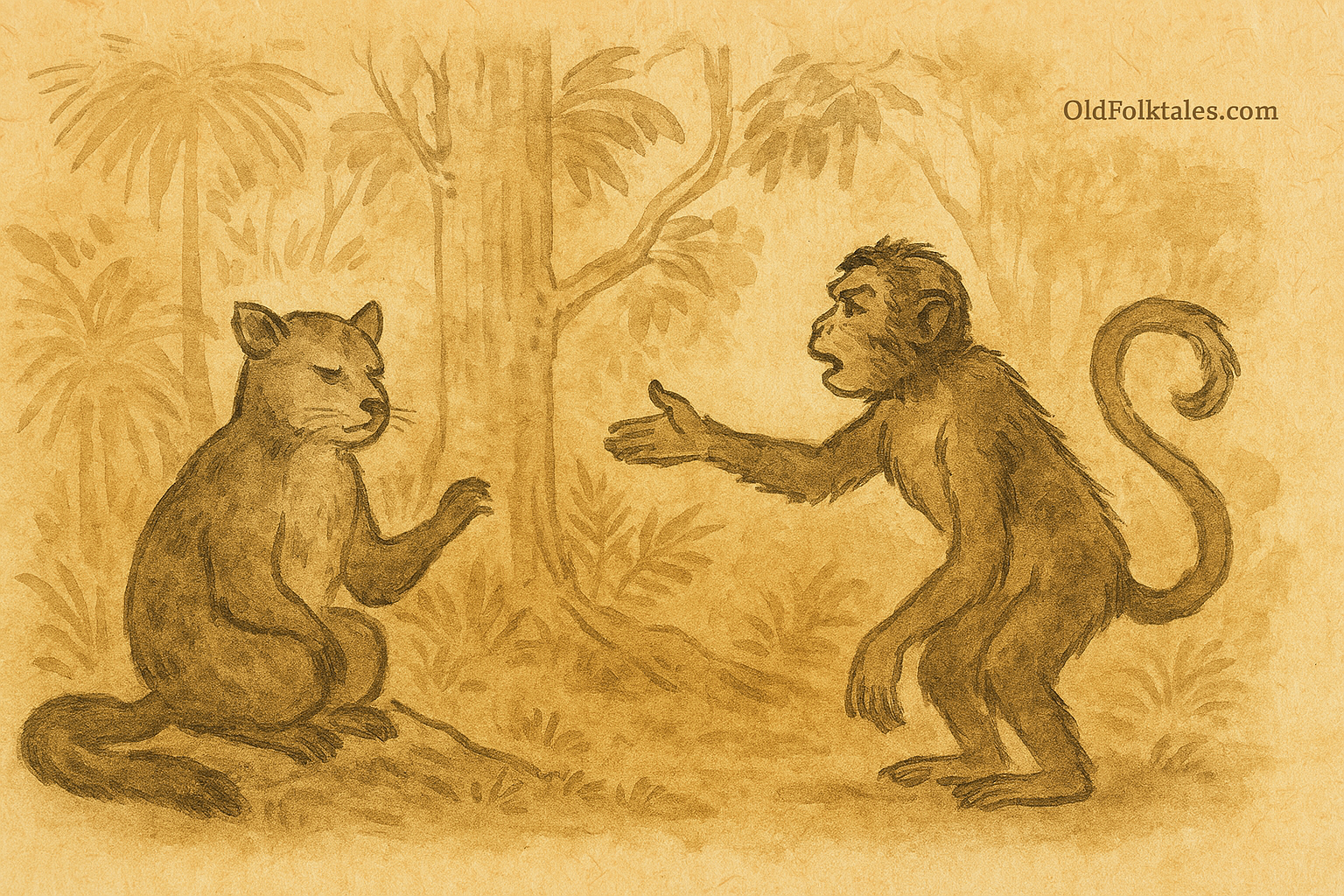
But King Civet Cat grew serious, his eyes sharp with concern. “Listen carefully,” he said. “On the way to the field, you will pass a crossroads. You must pay close attention so that you don’t go astray. When you arrive at that crossroads, sniff the air well. The road that smells pleasant and clean, that is my road. Follow that one. The road that carries a foul stench belongs to King Monkey, and you must avoid it at all costs.”
He continued with even greater emphasis: “Look carefully at the ground. The droppings of King Monkey are like flux, wet and unpleasant. But my droppings are dry and firm. This is how you will know the correct path.”
Unknown to King Civet Cat, King Monkey himself lurked quite nearby, hidden among the thick foliage. He had overheard every word of these instructions, and a wicked plan began to form in his cunning mind. He watched King Civet Cat depart for the fields, and then he sprang into action.
Moving quickly and quietly, King Monkey went to his own road and carefully gathered up all his droppings. He carried them to the Civet Cat’s road and placed them there. Then he returned to the Civet Cat’s road, collected those dry droppings, and placed them on his own path. Satisfied with his deception, he scampered away to wait.
Later that morning, the two sisters set out to join their husband in the fields. They walked together through the forest, chatting pleasantly, until they came to the crossroads their husband had warned them about. Remembering his instructions, they stopped and sniffed the air carefully. They examined the ground, looking at the droppings on each path.
But because of King Monkey’s trickery, everything was reversed. The pleasant-smelling road with the dry droppings now led to King Monkey’s village, not their husband’s field. Believing they were following their husband’s path, the two sisters took the wrong road.
They walked for hours, the path growing stranger and wilder as they went. The afternoon sun began its descent toward the western hills, casting long shadows through the trees. Finally, just as dusk approached, they arrived at a strange village, King Monkey’s home.
Suddenly, King Monkey appeared before them, and both women recoiled in fright and trembling. This was not their husband! King Monkey threw back his head and laughed, a loud, booming laugh that echoed through the trees. “Ha ha ha ha ha ha!” he roared, clearly delighted with himself. He called to his mother, “Such good luck has come to us! Bring a mat for these ladies so they may sit down!”
King Monkey’s mother shuffled forward and picked up some large tree leaves, laying them on the ground for the sisters to sit upon. The elder sister spoke up indignantly: “In the village of our husband, King Civet Cat, we are accustomed to sit on fine mats ornamented with beautiful patterns, not on mere leaves!”
“That’s right, that’s right!” King Monkey said with mock sympathy. “Mother, bring them betel-nut to chew!” His mother brought forward some hard tree fruits and offered them to the sisters. Again they protested: “In our husband’s house, we are accustomed to chew fresh betel-nut together with sirih-fruit, properly prepared!”
“That’s right, that’s right!” King Monkey repeated, grinning. “Bring them food to eat!” His mother then produced the fruits of the bubuk tree and klamat plant from the jungle, coarse, wild foods. She placed them before the sisters, but they refused them utterly. “In our husband’s house, we are used to eating rice and pig’s meat, not this jungle fare!” they declared.
As evening deepened into night, it came time to sleep. King Monkey announced boldly, “I want to sleep with both of you.” The sisters had no choice but to comply, fearful of what might happen if they refused. They all three lay down, with King Monkey positioned between the two women.
The sisters lay awake, their minds racing with plans of escape. They waited patiently, listening as King Monkey’s breathing grew slow and heavy. When midnight came and he was fast asleep, they moved with careful silence. They took a heavy rice-mortar and a piece of wood, placing them on either side of King Monkey where their bodies had been. Then, moving as quietly as shadows, they rose and stole away into the darkness.
They fled through the forest, guided by moonlight and memory, until they reached the fateful crossroads again. This time they chose correctly, following the true path of King Civet Cat. They walked through the remainder of the night, and as dawn broke, they finally reached their husband’s village.
King Civet Cat was waiting, and his face was dark with anger. He scolded them sharply for their foolishness. But the sisters quickly explained everything, how King Monkey had deceived them by switching the droppings, how they had been tricked and held captive, and how they had barely escaped.
Upon hearing this, King Civet Cat’s anger transformed into cold fury, not at his wives, but at the one who had deceived them. He called to his wives, “Climb up! Come to my place!” He directed them to climb a tremendously tall fir tree, up and up until they reached his dwelling place at its very top. From this great height, they could see for miles across the forest canopy.
Before long, King Monkey arrived with all his people, a whole troop of monkeys, chattering and screeching, demanding the return of the two women. They gathered at the base of the great fir tree, and King Monkey called up mockingly, “Ahoi, King Civet Cat! Come down, or let us come up so we may settle this matter!”
King Civet Cat called back smoothly, “Why should I come down? You come up instead! But you’ll need a ladder. Wait, and I shall lower one for you.”
King Civet Cat then cut a long bamboo reed and lowered it down the side of the tree. King Monkey, confident in his own cleverness and strength, began to climb. His people followed behind him, one after another, scrambling up the bamboo ladder toward the heights where King Civet Cat waited.
At the base of the tall fir tree lay a large, deep pond, its dark waters still and quiet. King Civet Cat watched patiently as King Monkey and his followers climbed higher and higher. When they were all clinging to the bamboo reed, suspended over the pond, King Civet Cat suddenly released his grip on the ladder.
The bamboo reed swung free and all the monkeys, King Monkey and his entire company, plummeted down through the air. They fell with terrible splashes into the pond below, and the waters closed over them. None could swim well enough to escape, and one by one they drowned in the deep pond.
Only when silence had returned to the forest did King Civet Cat climb down from his high perch, his wives following carefully behind him. They went to the edge of the pond and ensured that all the monkeys had perished. King Civet Cat crushed the heads of any that still stirred, making certain that King Monkey’s deception would bring no further trouble.
From that day forward, King Civet Cat and his two wives lived in peace, and the memory of King Monkey’s trickery served as a warning throughout the land.
Journey through enchanted forests and islands in our Southeast Asian Folktales collection.
The Moral of the Story
This tale teaches us that deception and trickery, no matter how clever they may seem, ultimately lead to one’s own downfall. King Monkey’s scheming brought him temporary satisfaction, but his wickedness ended in his destruction and the death of his followers. The story reminds us that those who deceive others and interfere in matters not their own will face consequences. It also shows that cleverness used for good, as King Civet Cat demonstrated in defending his family, will triumph over cleverness used for selfish and harmful purposes. Trust, once betrayed, can lead to a reckoning.
Knowledge Check
Q1: Who were the main characters in this East Timorese folktale, and what were their roles?
A1: The main characters were two sisters (elder and younger) who became wives of King Civet Cat, King Civet Cat himself who was their chosen husband, and King Monkey who acted as the antagonist and deceiver. King Monkey tricked the sisters to try to steal them away from King Civet Cat.
Q2: What clever deception did King Monkey use to mislead the two sisters in this Timorese legend?
A2: King Monkey overheard King Civet Cat’s instructions about following the pleasant-smelling road with dry droppings. He then switched the droppings on both paths, placing his own wet droppings on King Civet Cat’s road and King Civet Cat’s dry droppings on his own road. This caused the sisters to follow the wrong path and end up at King Monkey’s village instead of the fields.
Q3: How did the two wives escape from King Monkey’s village?
A3: The sisters waited until midnight when King Monkey was fast asleep between them. They carefully placed a rice-mortar and a piece of wood on either side of him to replace their bodies, then quietly stole away in the darkness. They returned to the crossroads and this time followed the correct path to King Civet Cat’s village.
Q4: What was King Civet Cat’s method of dealing with King Monkey and his followers?
A4: King Civet Cat invited King Monkey and his people to climb up to his dwelling at the top of a tall fir tree. He lowered a long bamboo reed as a ladder. When all the monkeys were climbing on it, suspended over a large pond at the base of the tree, he released the bamboo, causing them all to fall into the water where they drowned.
Q5: What does this East Timorese folktale teach about the consequences of deception?
A5: The story teaches that deception and trickery ultimately lead to one’s own downfall. King Monkey’s clever scheme to steal King Civet Cat’s wives brought him only temporary satisfaction but ended in his death and the death of all his followers. The tale shows that wickedness and interference in others’ lives will bring a reckoning.
Q6: What cultural values are reflected in this Timorese legend about King Civet Cat and King Monkey?
A6: This folktale reflects values of loyalty in marriage, the importance of cleverness used for righteous purposes, the consequences of breaking social bonds, and the idea that justice will prevail against those who deceive. It also emphasizes the importance of listening to warnings and following proper paths in life, both literally and metaphorically.
Source: East Timorese folktale, East Timor (Timor-Leste)