In a small village lived a blind Brahman and his equally blind wife, who depended entirely on their son for survival. Each day, the young man would venture out into the streets with his begging bowl, gathering whatever scraps of food or coins kind souls would offer. This existence weighed heavily on his spirit until finally, he could bear it no longer. He decided to seek his fortune in a neighboring kingdom, where perhaps better opportunities awaited.
Before departing, he spoke earnestly to his wife. “Care for my parents while I am gone,” he instructed. “Work hard and keep them fed, so they will not grow angry and curse me. I will return within a few months with enough to sustain us all.”
Click to read all South & Central Asian Folktales — home to stories from India, Nepal, Afghanistan, and Sri Lanka.
The young Brahman walked for days under the burning sun, his meager bundle of food growing lighter with each passing mile. Eventually, he arrived at a grand city, its marketplace bustling with merchants and traders. Exhausted, he sat down beside a prosperous merchant’s shop and extended his hand for alms.
The merchant, a kind-hearted man, studied the stranger carefully. “Where have you come from, and what brings you here?” he asked.
“I am a Brahman,” the young man replied humbly. “I wander seeking a livelihood for myself, my wife, and my blind parents.”
Moved by compassion, the merchant’s eyes lit up with an idea. “Come with me,” he said. “Our king is a generous man, and he has just completed building a magnificent golden temple. He seeks a trustworthy Brahman to serve as its guardian.”
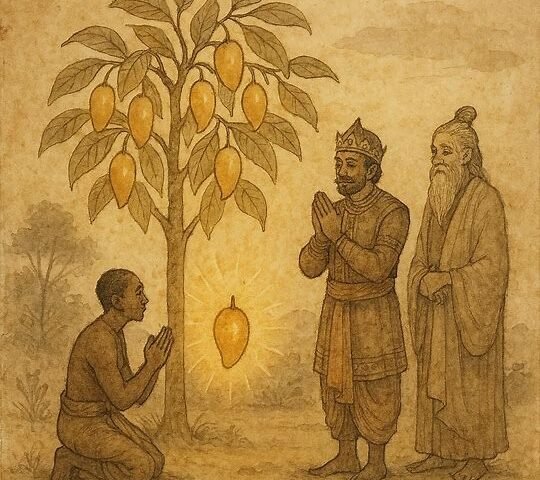
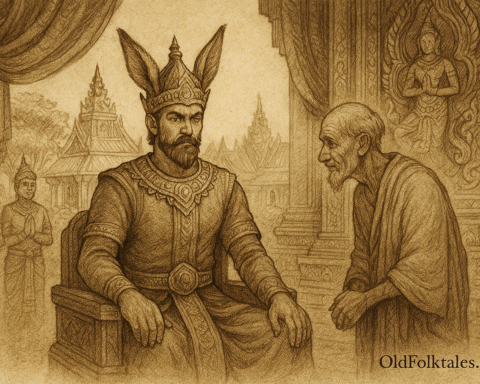
Together they went to the palace, where fortune smiled upon the wandering Brahman. The king, impressed by his honest demeanor, immediately appointed him temple guardian. The wages were generous, fifty kharwars of rice and one hundred rupees annually. The young Brahman could hardly believe his good fortune.
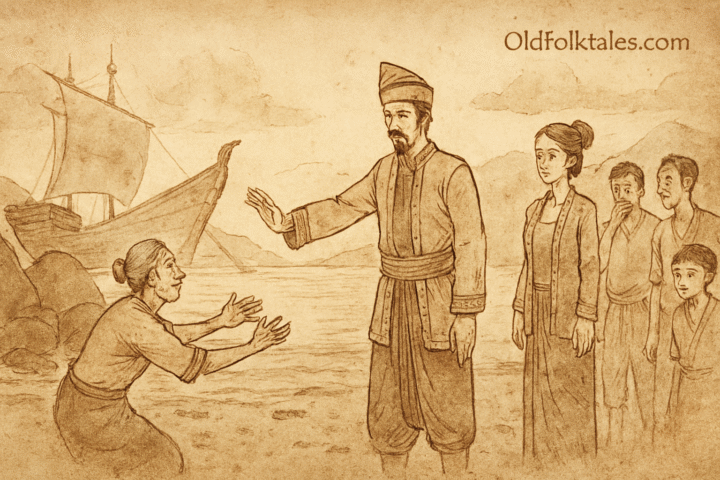
Two months passed, and back in the village, the Brahman’s wife grew increasingly anxious. No word had come from her husband, and the household’s provisions had dwindled to nothing. The blind parents-in-law grew thin and weak. Unable to wait any longer, she set out to find him, following the same road he had taken.
By great fortune, she arrived at the very city where her husband now lived. There she heard wonderful news, each morning at the golden temple, the king’s charity provided a golden rupee to any beggar who came. Her heart leaping with hope, she went to the temple the next morning.
When her husband saw her standing in the charity line, his face darkened with alarm. “Why have you come here?” he demanded, pulling her aside. “Have you abandoned my parents? Do you want them to curse me and bring about my death? Return home immediately!”
“I cannot,” she said desperately, tears streaming down her cheeks. “There is not a single grain of rice left in the house. Your parents are starving, and so was I. What was I to do?”
The Brahman’s anger melted into anguish. “O Bhagawant!” he cried out to heaven. Then, thinking quickly, he took a scrap of paper and scribbled something upon it. “Take this to the king,” he said, pressing it into her trembling hands. “He will give you a lac of rupees for it. Now go, and may God protect you all.”
On this precious paper were written three pieces of advice: First, when traveling and reaching a strange place at night, be careful where you lodge, and do not close your eyes in sleep lest you close them in death. Second, if you have a wealthy married sister and visit her in poverty, she will disown you; but come in prosperity, and she will welcome you warmly. Third, whatever work must be done, do it yourself with all your might and without fear.
The Brahmani returned home and told her blind in-laws about meeting their son and receiving this mysterious paper. Though she did not understand its value, she knew she must present it to the king. Being too humble to approach the palace herself, she sent a relation to deliver it.
The king read the paper, grew furious at what he considered nonsense, had the messenger flogged, and sent him away empty-handed.
Undeterred, the Brahmani decided to go herself. The next morning, as she walked toward the darbar reading the paper aloud, the king’s own son rode past on his magnificent horse. Hearing her mutter about advice worth a lac of rupees, the curious prince stopped.
“What are you reading, good woman?” he asked kindly.
She explained about her husband’s gift and the wisdom it contained. The prince read it thoughtfully, and to everyone’s astonishment, immediately issued her a parwana, a written order, for the full lac of rupees. The poor Brahmani wept with joy and rushed home to purchase provisions enough to last for months.
That evening, the prince proudly told his father about his purchase, expecting praise for his generosity and wisdom. Instead, the king exploded with rage. “You foolish boy! You’ve wasted a lac of rupees on meaningless scribblings!” In his fury, he banished his own son from the kingdom.
Heavy-hearted, the prince bid farewell to his weeping mother and rode off into the unknown. As darkness fell, he came upon a house where a man graciously invited him to stay. The host spread fine matting, served an excellent dinner, and treated him like royalty.
As the prince lay down to rest, the first piece of advice echoed in his mind: Be careful where you lodge at night, and do not sleep. Something felt wrong. He remained awake, his hand near his sword.
Sure enough, at midnight his host crept toward him with a raised blade, intending murder and robbery. The prince sprang up. “Wait!” he cried. “What profit is there in my death? You will regret this deed, like the merchant who killed his faithful dog.”
“What merchant? What dog?” the would-be murderer asked, curiosity overcoming his bloodlust.
“Give me that sword, and I will tell you,” the prince said. The man agreed.
The prince then recounted how a merchant, fallen on hard times, pawned his beloved dog for five thousand rupees. When thieves later robbed his creditor’s shop, the loyal dog tracked them to their hiding place and tried to lead his new master there. The merchant followed, recovered all the stolen goods, and sent the dog back with a letter canceling the debt and offering five thousand rupees more as thanks. But the original owner, seeing the dog return and fearing his debt was being called, killed it in panic, only to discover the letter moments later. His grief was inconsolable.
“Beware,” the prince warned, “lest you do something you’d give your life to undo.”
Dawn was breaking. The would-be murderer, moved to tears, thanked the prince and let him go with gifts.
The prince next visited his brother-in-law’s kingdom in disguise as a jogi, a holy ascetic. He sat beneath a tree near the palace in deep meditation. Word of this pious man reached the king, whose wife had been mysteriously ill despite all the hakims’ treatments. Desperate, the king brought the queen to the jogi, who instructed her to prostrate herself for three hours. When she rose, she was miraculously cured.
But that evening, the queen’s pearl rosary went missing. It was found where she had lain before the jogi. Accused of theft, the prince barely escaped execution by bribing his guards, confirming the second piece of advice his sister, learning he came in poverty and disgrace, had shown him no loyalty.
Wandering further, the prince encountered a potter and his family laughing and crying simultaneously. When asked why, the potter explained miserably: the king’s daughter was cursed every man who married her died on their wedding night. Nearly all the young men had perished, and soon it would be the potter’s son’s turn.
“Let me take his place,” the prince offered. “I will marry the princess.”
Dressed in fine clothes, the prince was wed to the princess that very day. Remembering the third piece of advice, do what must be done yourself, with might and without fear he stayed awake with sword in hand. At midnight, two deadly serpents emerged from the sleeping princess’s nostrils. The prince struck swiftly, killing both snakes.
Morning came, and the king was astonished to find his daughter and her husband alive and cheerful. “You must truly be her destined husband!” he declared joyfully. Learning the prince’s royal identity, he made him heir to the throne.
After more than a year, the prince requested permission to visit his homeland. The king loaded him with elephants, horses, jewels, and wealth beyond measure.
On his journey home, the prince again passed through his brother-in-law’s kingdom. This time, arriving in splendor, he was received with the greatest honor. The king himself came with rope-tied hands in humble greeting. The prince’s sister welcomed him with smiles and kisses proving the second advice true. He forgave them and gave them generous gifts.
Finally reaching his own kingdom, the prince found his elderly parents blind from weeping over his loss. “Let him touch our eyes,” the old king said hopefully. When the prince laid his hands upon them, their sight was miraculously restored.
The prince recounted his entire adventure, explaining how the three pieces of advice had saved his life repeatedly. The old king, overcome with remorse for banishing his son over what seemed like foolishness, embraced him. The kingdom rejoiced, and peace and joy reigned once more.
The Moral Lesson
This tale teaches that wisdom and good advice are priceless treasures worth far more than gold. The prince’s willingness to pay dearly for knowledge and his humility in heeding that wisdom saved his life multiple times and brought him great fortune. The story also reminds us not to judge the value of something by its appearance; what seems foolish may contain profound truth. Additionally, it shows that acts of generosity and respect for wisdom, even when others mock them, will ultimately be rewarded. Parents and rulers should not act rashly in anger, for hasty decisions can separate us from those we love most.
Knowledge Check
Q1: Why did the young Brahman write three pieces of advice on paper for his wife?
A: The Brahman, working as guardian of the king’s golden temple, wanted to help his starving family back home but couldn’t send money directly. He wrote down three pieces of wisdom he had learned or understood and told his wife the king would pay a lac of rupees for it, an enormous sum that would sustain his blind parents and wife for years. This showed his cleverness in creating something valuable from his own understanding when he had no material wealth to send.
Q2: What is the significance of the first piece of advice about not sleeping in strange places?
A: The first advice, to stay awake when lodging in unfamiliar places at night, literally saved the prince’s life when his seemingly hospitable host attempted to murder him for his possessions. This represents vigilance and caution when in vulnerable situations. It teaches that appearances can be deceiving and that prudence, not paranoia, is wisdom. By staying alert, the prince not only survived but also transformed his would-be murderer through the story of the merchant’s dog, showing that wisdom can reform evil.
Q3: How does the second piece of advice about the married sister prove true in the prince’s experience?
A: The prince tested this advice by visiting his brother-in-law’s kingdom twice, first in poverty as a disguised jogi (holy man), then later in prosperity with elephants and riches. During his first visit in humble disguise, he was falsely accused of theft and nearly executed, with no protection from his sister. During his second visit in royal splendor, the same brother-in-law greeted him with rope-tied hands in deepest respect, and his sister welcomed him with affection. This demonstrated how material circumstances often affect family loyalty and social relationships.
Q4: What do the two serpents emerging from the princess’s nostrils symbolize?
A: The two Shahmars (serpents) that emerged each night to kill the princess’s husbands represent a curse or supernatural affliction that required courage and action to overcome. They symbolize hidden dangers that cannot be defeated through passivity or fear. The prince’s willingness to stay awake with sword in hand embodying the third piece of advice to do necessary work himself with might and without fear allowed him to confront and destroy the curse, winning both the princess and a kingdom.
Q5: Why did the king initially reject the three pieces of advice but his son valued them?
A: The old king saw only simple, obvious statements on paper and judged them as worthless, reacting with anger when asked to pay such a large sum. His son, however, recognized deeper wisdom in the advice and understood that practical wisdom applicable to life’s real dangers has immense value. This contrast represents the difference between superficial judgment and true discernment. The young prince’s humility and openness to learning made him wise, while his father’s pride and snap judgments nearly cost him his son. The story validates the son’s perspective when the advice repeatedly saves his life.
Q6: What cultural elements make this distinctly an Indian folktale?
A: This story contains numerous distinctly Indian elements: the central role of Brahmans (the priestly caste) and the importance of their blessings or curses; the concept of dharma (duty) toward elderly parents; the figure of the jogi (ascetic holy man); references to hakims (traditional healers); the practice of arranged royal marriages; the king’s darbar (court); parwana (royal written orders); kharwars of rice as payment; and the belief in miraculous cures through holy people. The setting of golden temples, the merchant class, rupees as currency, and the value placed on written wisdom all reflect traditional Indian society and values.
Source: Indian folktale, India