
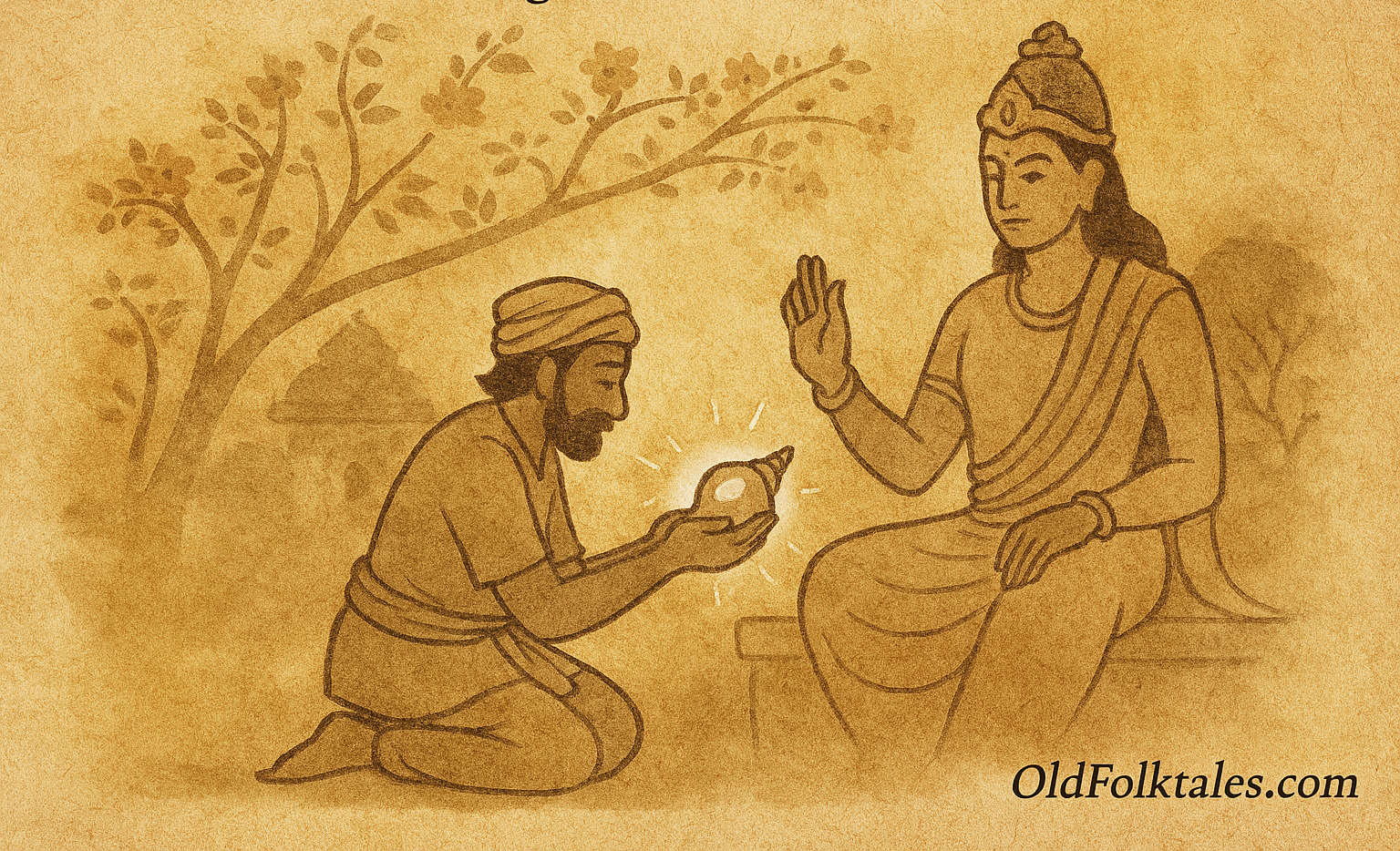
In a small village nestled among dusty fields and narrow lanes, there lived a hardworking farmer whose life was a river of endless toil flowing into the deep pockets of a money-lender. Season after season, whether the monsoon rains blessed the earth or the sun scorched it mercilessly, the pattern never changed, the farmer remained poor as temple dust, while the money-lender grew fat and prosperous as a well-fed merchant.
The farmer tilled his land from dawn until the stars appeared, yet the coins he earned seemed to evaporate like morning mist. Every harvest meant new debts, every payment spawned fresh interest, until finally the day arrived when the farmer possessed nothing, not a single farthing remained to his name.
Click to read all South & Central Asian Folktales — home to stories from India, Nepal, Afghanistan, and Sri Lanka.
With empty pockets and desperate heart, the farmer walked to the money-lender’s imposing house and stood before him with simple honesty. “You cannot squeeze water from a stone,” he said, his voice steady despite his poverty. “Since there is nothing more you can extract from me, perhaps you might share the secret of becoming rich. How is it that you prosper while I, who work without rest, remain destitute?”
The money-lender stroked his well-oiled beard and replied with practiced piety, his words dripping like honey from a spoon. “My dear friend, riches come from Ram, the divine provider. You should ask him directly.”
The farmer’s eyes widened with innocent hope. “Thank you! I shall do exactly that!”
And so, with the sincerity that only the truly simple-hearted possess, the farmer prepared three girdle-cakes, round, flat breads that would sustain him on his journey and set forth to find Ram himself. His feet carried him along dusty roads, through villages and past temples, searching for the divine presence.
The first person he encountered was a Brahman, dressed in fine cloth with sacred marks upon his forehead. The farmer bowed respectfully and offered him one of his precious cakes. “Holy sir, could you point me toward Ram?” he asked. But the Brahman merely accepted the cake without a word and continued on his way, leaving the farmer standing alone.
Next, the farmer met a Jogi, a wandering devotee with matted hair and ash-smeared skin. Again, the farmer offered a cake and the same question. The Jogi too took the food and walked away in silence, offering neither thanks nor guidance.
Finally, footsore and hungry, the farmer came upon a poor man sitting beneath the spreading branches of a banyan tree. The man’s clothes were simple, his appearance humble, and when the farmer discovered he was hungry, his kind heart could not refuse. He gave away his last cake and sat down beside the stranger to rest his weary feet.
They talked of many things, the weather, the crops, the state of the world. Eventually, the poor man asked, “Where are you traveling, friend?”
“Oh, I have a long journey ahead,” the farmer replied with a sigh. “I am searching for Ram himself! You wouldn’t happen to know which way I should go?”
The poor man’s face broke into a gentle smile, and his eyes suddenly shone with an otherworldly light. “Perhaps I can help you,” he said softly, “for I am Ram. What is it you seek from me?”
The farmer’s mouth fell open in astonishment. Then, gathering his wits, he poured out his entire story, the endless poverty, the money-lender’s greed, the crushing weight of a life spent working for another’s gain.
Ram listened with compassion. When the tale was finished, he reached into his simple garments and produced a conch shell, smooth and spiraled, gleaming with an inner radiance. He placed it in the farmer’s calloused hands and showed him a particular way to blow it, a specific breath, a certain angle.
“Remember this carefully,” Ram instructed. “Whatever you wish for, you need only blow the conch in this exact manner, and your wish will be fulfilled. But heed my warning well, have a care of that money-lender, for even divine magic is not proof against their cunning wiles!”
The farmer returned to his village with a spring in his step and joy radiating from his face like sunlight. The money-lender noticed immediately. “Some good fortune has befallen that stupid fellow,” he muttered to himself, watching the farmer’s confident stride. “Otherwise, why would he hold his head so high?”
Cunning as a fox, the money-lender visited the farmer’s humble home, wearing a mask of friendly concern. He offered congratulations on the farmer’s apparent good luck, pretending to have heard rumors of some windfall, weaving his words so cleverly that before long, the simple farmer found himself telling the entire story. Almost the entire story for even with all his simplicity, the farmer was not quite fool enough to reveal the secret method of blowing the conch.
But the money-lender was a villain who did not hesitate at trifles. He waited for the right moment, crept into the farmer’s house like a shadow, and stole the magic conch.
For hours, the money-lender blew into that shell until his face turned purple and his cheeks ached. He tried every angle, every breath, every possible combination but nothing happened. The conch remained stubbornly silent, its magic locked away from his greedy grasp.
Finally, swallowing his pride, the money-lender returned to the farmer with a proposal. “Look here,” he said coolly, as if discussing the price of grain, “I have your conch, but I cannot use it. You don’t have it, so you cannot use it either. Business is at a standstill. Let us make a bargain, I will return your conch and never interfere with your using it, on one simple condition: whatever you gain from it, I shall receive double.”
“Never!” the farmer cried out, his heart sinking. “That would be the old misery all over again!”
“Not at all,” replied the wily money-lender, smooth as silk. “You will have your share! Don’t be a dog in the manger, if you get everything you want, what does it matter if I am rich or poor?”
The argument continued, back and forth like shuttle on a loom, until at last the farmer yielded. The agreement was struck, and from that day forward, no matter what the farmer wished for and received, the money-lender received twice as much. The knowledge gnawed at the farmer’s peace like termites in wood. Day and night it troubled him, robbing him of satisfaction and filling his mouth with bitterness.
Then came a season of terrible drought. The sky turned to brass, the sun beat down mercilessly, and the farmer’s crops withered like old parchment. In desperation, he blew the conch and wished for a well to water his dying plants. Instantly, a beautiful well appeared in his field, but the money-lender received two magnificent wells!
This was more than any farmer could bear. The injustice of it festered in his mind, consuming his thoughts day and night. He brooded and pondered, turned the problem over like a stone, until suddenly, like lightning splitting a dark sky, a brilliant idea illuminated his mind.
He seized the conch, placed it to his lips, blew with all his might, and cried out: “Oh, Ram! I wish to be blind of one eye!”
In a twinkling, his wish was granted. One eye went dark, but the farmer smiled grimly, for he knew that the money-lender, by the terms of their bargain, was now blind in both eyes.
The money-lender, stumbling about in his sudden darkness, tried to navigate between his two new wells. He staggered, lost his bearings, and with a terrible splash and cry, fell into one of those very wells and drowned.
And so the village learned that a farmer had finally gotten the better of a money-lender but only by sacrificing one of his own eyes.
The Moral of the Story
This tale teaches us that revenge and justice often come at great personal cost. While the farmer succeeded in defeating greed and exploitation, his victory required him to harm himself. The story warns against making deals with the unscrupulous and reminds us that sometimes the price of defeating evil is measured in our own sacrifice. It also reveals that cleverness and desperation can lead to extreme solutions—but we must ask ourselves whether such victories are truly worth the price we pay.
Knowledge Check
Q1: What is the significance of the magic conch shell in this Indian folktale?
A1: The magic conch shell represents divine blessing and the power to change one’s destiny. Given directly by Ram (a major deity in Hindu tradition), it symbolizes that true wealth and power come from divine sources, not from exploitation. However, the story shows that even divine gifts can be corrupted by greed and cunning.
Q2: Why does the farmer give away all three of his cakes on his journey?
A2: The farmer’s generosity demonstrates his pure heart and simple faith. He gives to the Brahman and Jogi out of respect and hope, and finally to the poor man (Ram in disguise) out of pure compassion without expecting anything in return. This selfless kindness is what makes him worthy of Ram’s help, teaching that true divinity rewards genuine generosity over empty religious displays.
Q3: What does the money-lender represent in this story?
A3: The money-lender represents systemic greed, exploitation, and the corrupt power structures that keep poor people trapped in cycles of poverty. His character reflects the historical reality of usurious lending practices in rural India, where farmers were often kept perpetually indebted. His cunning and lack of moral boundaries show how greed corrupts even when confronted with divine magic.
Q4: Why does the farmer ultimately choose to blind himself in one eye?
A4: The farmer chooses self-harm as the only way to defeat the money-lender within the terms of their bargain. Since anything the farmer gains, the money-lender receives double, the farmer realizes that by wishing for something harmful to himself, he inflicts twice that harm on his enemy. This desperate solution shows how exploitation can drive good people to extreme measures.
Q5: What is the cultural meaning of Ram appearing as a poor man in this folktale?
A5: Ram appearing as a humble, poor man reflects an important theme in Hindu philosophy that the divine can manifest in any form, often in the most unexpected guises. It teaches that we should treat everyone with kindness and respect, for we never know when we might be in the presence of the sacred. The Brahman and Jogi, despite their religious status, fail to help, while the “poor man” is actually God himself.
Q6: What lesson does this Indian folktale teach about the cost of justice?
A6: The story presents a sobering lesson that defeating evil often requires personal sacrifice. The farmer achieves justice but loses an eye in the process, a permanent reminder that victory over corruption may demand a piece of ourselves. It questions whether such pyrrhic victories are truly victories at all, and whether revenge, even justified, leaves everyone diminished.
Source: Indian folktale, India








