In the wild scrublands where thorny bushes grew between scattered rocks and the earth shimmered with heat, there lived a jackal like any other, crafty, quick, and always searching for his next meal. His fur was the color of dried grass, dusty and unremarkable, perfect for slinking through shadows and blending into the landscape where he belonged.
One scorching afternoon, hunger gnawed at the jackal’s belly like a persistent rat. He ventured closer to the village than usual, his nose twitching at the scent of food drifting from the houses. His keen eyes spotted what he thought was an easy opportunity perhaps some scraps left unguarded, or a chicken wandering too far from its coop.
Click to read all South & Central Asian Folktales — home to stories from India, Nepal, Afghanistan, and Sri Lanka.
But in his eagerness and distraction, the jackal did not notice the large wooden tub sitting in a dyer’s courtyard, filled to the brim with brilliant blue dye the same vivid indigo used to color fine cloth for wealthy merchants and nobles. His paws skidded on the smooth stones, and before he could yelp in surprise, splash! He tumbled headfirst into the tub, the liquid closing over him like a cool, strange ocean.
He thrashed and scrambled, his legs kicking wildly, dye splashing everywhere in great blue waves. Finally, he managed to claw his way up the side of the tub and leap out, landing with a wet thud on the ground. He shook himself violently, droplets of blue flying in all directions, then paused to catch his breath.
When he looked down at his paws, his eyes widened in absolute shock. They were no longer the dusty brown-gray he had known all his life, they were bright, brilliant blue, the color of a clear afternoon sky! He twisted his head around, trying to see more of himself, and discovered that every bit of his fur, from the tip of his nose to the end of his bushy tail, had been transformed into this extraordinary, unnatural blue.
For a moment, he stood frozen, uncertain whether to be horrified or amazed. Then, as he gazed at his spectacular new appearance, a different feeling began to bloom in his chest not alarm, but pride. Oh, what magnificent pride! He was no longer ordinary. He was extraordinary! He was unique! He was… special.
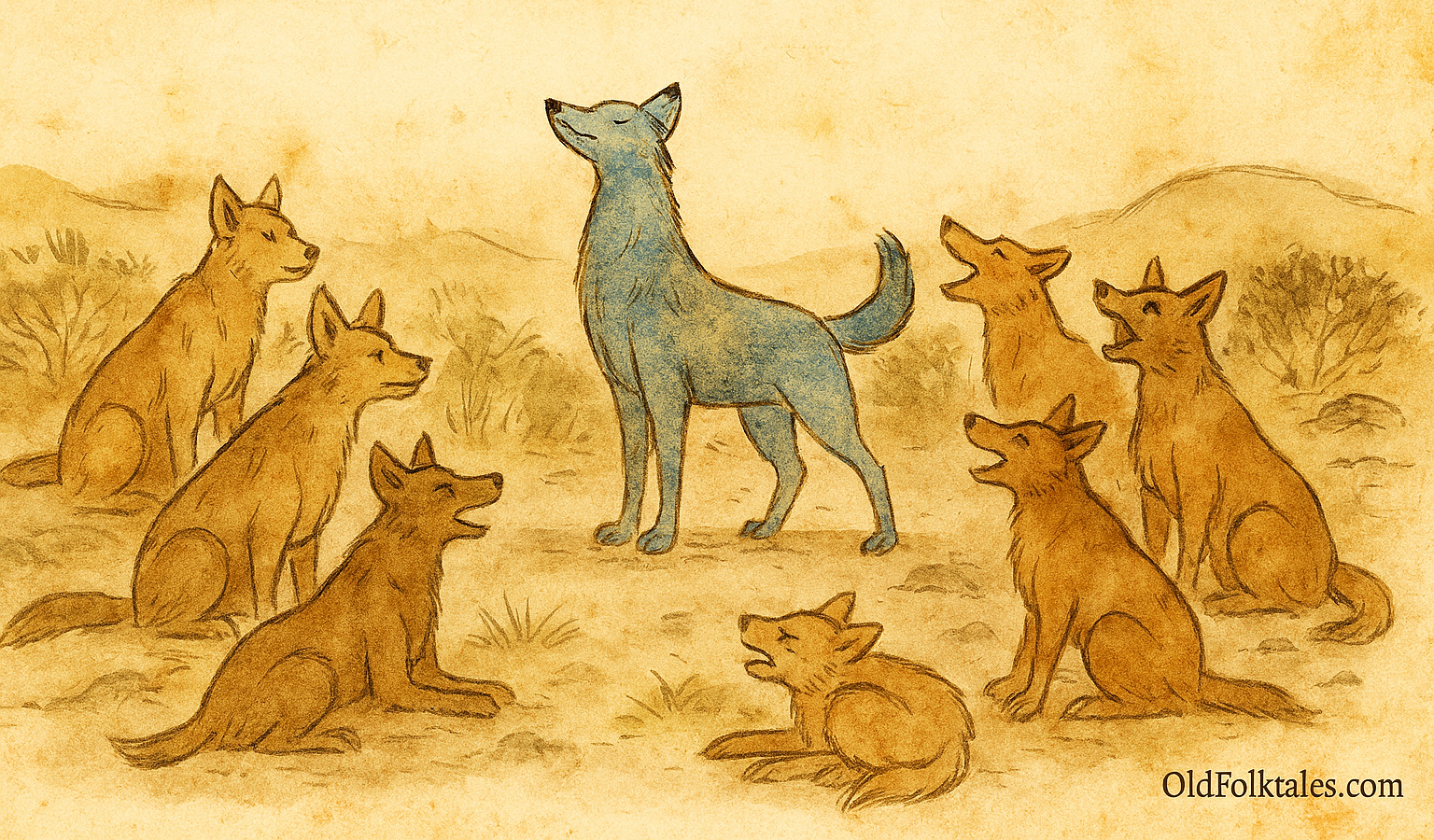
The jackal trotted back toward his territory, his blue tail held high, his steps taking on a peculiar prancing quality he had never employed before. When he emerged from behind a rocky outcrop, the other jackals who had been lounging in the shade of a scraggly tree all lifted their heads at once. Their mouths fell open. Their eyes grew round as full moons.
“What… what happened to you?” one of them finally managed to stammer, rising to his feet and approaching cautiously, as if the blue jackal might be contagious.
The blue jackal flicked his tail with exaggerated elegance and lifted his chin so high he nearly toppled backward. “Isn’t it obvious?” he said in a voice dripping with newfound superiority. “I’m not just any jackal anymore. Just look at me! I’m completely transformed! I’m special beyond measure! From this moment forward, I absolutely forbid any of you to call me a ‘jackal’ ever again.”
The other jackals exchanged confused glances. One bold female stepped forward and asked, “Well then, what should we call you, if not what you are?”
The blue jackal paused dramatically, as if considering this question for the first time, though in truth he had been rehearsing this moment in his mind throughout his entire journey home. He lifted his head even higher impossibly higher and declared with tremendous ceremony: “Call me Pearooster! Yes, that’s it! I am as magnificent and beautiful as a pearooster now!” He began strutting back and forth in front of them, showing off his blue fur from every conceivable angle, turning this way and that, practically spinning in circles.
The jackals watched this performance with growing skepticism. Their initial shock was wearing off, replaced by a more critical examination of their companion’s claims. One of the older jackals, grizzled and wise from many seasons of survival, narrowed his eyes thoughtfully.
“If you’re truly a pearooster,” he said slowly, his voice carrying the weight of logic, “then surely you can spread your tail feathers beautifully, the way a pearooster does when he wants to impress? Can you fan them out in that glorious display?”
The blue jackal stopped mid-strut. He looked back at his tail still just a tail, bushy and canine, no matter how blue it might be. He tried to spread it, to fan it out, but it simply hung there, doing nothing remarkable at all.
“Well…” he said, his voice losing some of its confidence, “no, I suppose I can’t do that particular thing.”
“And what about the cry?” another jackal chimed in, warming to the challenge. “Can you make that proud, special cry that a pearooster makes at dawn that triumphant call that wakes the whole village?”
The blue jackal opened his mouth, prepared to produce something magnificent, but all that emerged was his usual jackal sound, a sort of yip and howl, perfectly ordinary, perfectly canine, and decidedly un-pearooster-like. He closed his mouth quickly, his ears drooping despite his best efforts to keep them perked proudly.
“No,” he admitted quietly, looking down at his blue paws. “I can’t do that either.”
The old jackal nodded sagely, and a ripple of understanding passed through the entire pack. Several of them began to snicker. The snickers grew into chuckles, and the chuckles swelled into full-throated laughter that echoed across the scrubland.
“Then it’s perfectly clear!” they declared, their voices overlapping in gleeful agreement. “You’re certainly not a jackal anymore that much is true! But you’re definitely, absolutely, without question NOT a pearooster either!”
The laughter continued, rising and falling like waves against a shore. Some of the younger jackals rolled on the ground, clutching their sides. Others howled with mirth, their calls carrying far across the wilderness.
The blue jackal stood there, no longer strutting, no longer proud, feeling smaller and more foolish than he ever had in his entire life. His magnificent blue fur, which had seemed like such a gift only moments before, now felt like a curse, a mark of his absurdity, his pretension, his foolish attempt to be something he was not and could never be.
“Go away!” they told him, still laughing. “Go find wherever it is that blue not-jackals and not-pearoosters belong, because you certainly don’t belong here anymore!”
And so the blue jackal slunk away, his tail dragging in the dust, learning far too late that being painted a different color on the outside could never change what you truly were on the inside and that pretending to be something greater than yourself only makes you look smaller in the eyes of those who know you best.
The Moral of the Story
This timeless fable teaches us that pretending to be something we are not, no matter how impressive the disguise, ultimately leads to humiliation and rejection. True worth comes from accepting who we are authentically, not from false appearances or borrowed glory. The blue jackal’s vanity blinded him to a simple truth: external changes cannot transform our essential nature. When we deny our true selves and claim false superiority over others, we lose both our original identity and the respect of our community. Authenticity and humility are more valuable than any coat of paint.
Knowledge Check
Q1: What does the blue dye symbolize in this Indian folktale?
A1: The blue dye symbolizes superficial transformation and false appearance. While it changes the jackal’s external appearance dramatically, it cannot alter his true nature or abilities. This represents how people sometimes believe that outward changes, wealth, status symbols, or physical alterations, can fundamentally change who they are, when in reality, character and essence remain unchanged.
Q2: Why does the jackal choose to call himself “Pearooster” instead of admitting he’s still a jackal?
A2: The jackal chooses “Pearooster” because his vanity and pride make him believe his new blue appearance makes him superior to his fellow jackals. The peacock (pearooster) is traditionally associated with beauty and pride in Indian culture, so the jackal wants to claim this elevated status. His choice reveals how external changes can inflate ego and create delusions of grandeur.
Q3: What is the significance of the other jackals’ questions about spreading tail feathers and making the pearooster’s cry?
A3: The jackals’ questions cut through the pretense by focusing on actual abilities rather than appearance. They wisely recognize that being something requires more than just looking like it, it demands the authentic qualities, skills, and nature of that thing. Their questions expose the difference between superficial imitation and genuine identity, teaching that actions and abilities reveal truth more than appearances.
Q4: What does this story teach about community and belonging?
A4: The story shows that rejecting your community and claiming superiority leads to exile and loneliness. The blue jackal loses his place among his own kind by denying what he is and demanding special treatment. It teaches that community acceptance requires authenticity and humility, when we put ourselves above others based on superficial differences, we alienate ourselves and lose the belonging we once had.
Q5: How does this Indian folktale reflect Hindu philosophical concepts?
A5: This tale reflects important Hindu concepts including maya (illusion versus reality) and dharma (one’s true nature and duty). The blue jackal becomes trapped in maya, believing his false appearance over his true nature. He abandons his svadharma (own duty/nature as a jackal) to claim a false identity. The story teaches that one should accept and fulfill their true dharma rather than chasing illusory transformations.
Q6: What is the cultural significance of animal fables in Indian storytelling tradition?
A6: Animal fables like this one are central to Indian storytelling, particularly in collections like the Panchatantra and Jataka tales. Using animals as characters allows storytellers to critique human behavior, vanity, greed, foolishness, without directly attacking individuals. Animals represent universal human traits, making moral lessons accessible to all ages and social classes while being entertaining and memorable.
Source: Indian folktale, India