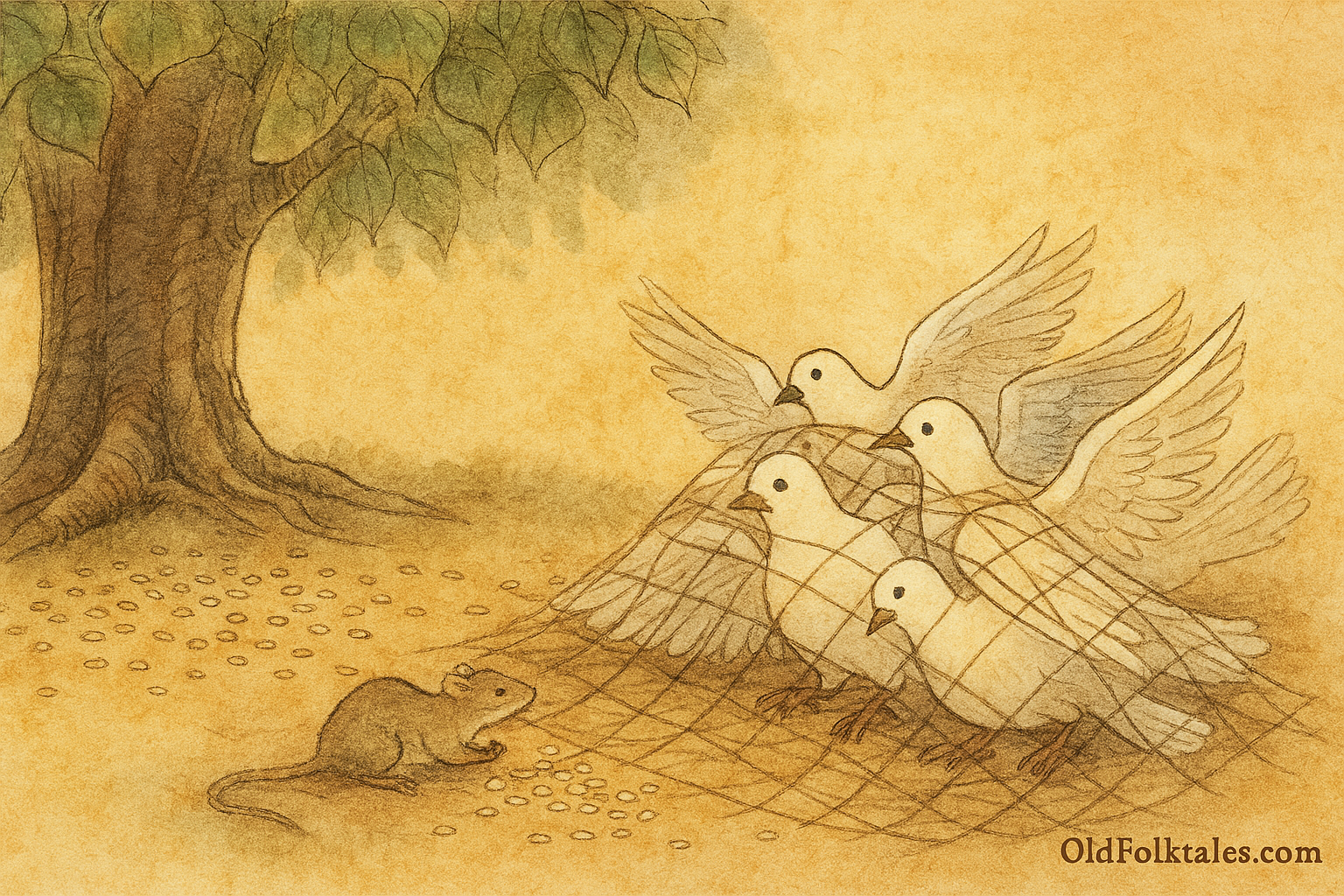
The sun was climbing high over the ancient city of Multan when King Badar and his flock of doves spotted something glittering on the ground below. Hundreds of grains of rice lay scattered beneath the spreading branches of an old tree, catching the morning light like tiny pearls. The doves had been flying since dawn, and their stomachs rumbled with hunger.
“Look!” cried one of the younger doves. “A feast awaits us!”
But King Badar, wise and experienced, felt a flutter of unease in his chest. “Wait,” he cautioned, circling lower to examine the scene more carefully. “Something feels wrong about this. Why would so much rice lie here, untouched by other birds?”
Click to read all South & Central Asian Folktales — home to stories from India, Nepal, Afghanistan, and Sri Lanka.
The younger doves, however, were too hungry to heed their king’s warning. One by one, they descended in a flutter of gray and white wings, landing eagerly among the scattered grains. Not wanting to leave his flock unprotected, King Badar sighed deeply and descended with them.
The moment their feet touched the ground, disaster struck. A heavy net, cleverly concealed beneath the rice, sprang up around them like a trap snapping shut. The doves beat their wings frantically, crying out in alarm, but the more they struggled, the more tangled they became in the thick cords.
“We’re caught!” wailed the younger doves, their voices filled with panic.
King Badar’s heart pounded, but he forced himself to remain calm. A leader must think clearly, even in the darkest moments. “Listen to me!” he called out, his voice cutting through the chaos. “Stop struggling! We must work together.”
The doves fell silent, their frightened eyes fixed on their king.
“If we all beat our wings at once, in the same direction, we can carry this net with us,” King Badar explained. “On my command, one, two, three, fly!”
As one body, the entire flock surged upward. The net rose from the ground, heavy and unwieldy, but their combined strength was enough. Higher and higher they flew, carrying their prison with them into the vast blue sky.
They flew for a long time, their wings growing heavier with each beat. The net seemed to grow more burdensome with every passing moment, and the sun beat down mercilessly upon their feathered backs. Some of the younger doves began to despair.
“We cannot go on much longer,” one gasped, his wings trembling with exhaustion.
But King Badar’s mind was already racing ahead. “We must find my friend Musak!” he announced, fresh hope rising in his voice. “The mouse of Multan, he lives beneath the great peepal tree near the city walls. He will help us. He must!”
With renewed determination, the flock changed direction, their wings cutting through the warm air as they made their way toward Multan. Finally, after what seemed like an eternity, they spotted the ancient peepal tree, its broad leaves rustling in the breeze. Beneath its gnarled roots was a small, neat burrow.
With their last reserves of strength, the doves descended, landing in an exhausted, tangled heap near the burrow’s entrance.
“Musak! Musak!” they called out together, their voices hoarse and desperate. “Come quickly, brother! We need you!”
For a moment, nothing happened. Then a tiny nose appeared at the burrow entrance, whiskers twitching. Out scurried Musak, a small brown mouse with bright, intelligent eyes. When he saw his dear friend King Badar trapped beneath the heavy net, along with all his flock, his whiskers quivered with concern.
“Say no more!” Musak squeaked, his voice high but determined. Without a moment’s hesitation, he darted forward, his sharp teeth already bared and ready.
The mouse worked with remarkable speed and precision. His tiny teeth, though small, were as sharp as razors. He gnawed through the thick cords one by one, the sound of snapping fibers filling the air. First, he freed King Badar, carefully chewing through the ropes that bound the royal dove most tightly.
“Thank you, dear friend,” King Badar said, shaking his wings free. “Now help the others!”
Musak needed no encouragement. He scurried from dove to dove, his teeth working tirelessly, until every single bird was free. The doves fluttered their wings experimentally, testing their newfound freedom. Joy spread through the flock like sunrise breaking over the horizon.
“A friend in need is a friend indeed!” cried King Badar, his voice ringing with gratitude and emotion. “We will never forget your kindness, Musak. You have saved our lives today.”
The mouse sat back on his haunches, his whiskers still twitching. “That is what friends are for,” he said simply.
One by one, the doves took flight, spiraling upward into the wide blue sky. They circled the peepal tree once, twice, three times, a gesture of thanks and farewell. Then they disappeared into the distance, free once more.
Below, Musak returned to his burrow, happily munching on the leftover rice that had fallen from the trap. It had been a good day, he thought. A very good day indeed.
The Moral of the Story
This timeless fable teaches us that true friendship knows no boundaries of size, status, or circumstance. King Badar, though mighty and royal, needed the help of humble Musak the mouse. When we cultivate genuine friendships and treat others with kindness, those bonds become our greatest strength in times of trouble. The story also reminds us that unity and cooperation can overcome even the most difficult challenges, and that helping others without hesitation is the mark of true nobility.
Knowledge Check
Q1: Who is the main character in “The Mouse of Multan” folktale?
A1: The main characters are King Badar, the wise leader of a dove flock, and Musak, a clever mouse who lives in Multan. While King Badar demonstrates leadership and wisdom, Musak exemplifies true friendship by saving the trapped doves.
Q2: What is the symbolic meaning of the net trap in this Pakistani fable?
A2: The net trap symbolizes life’s unexpected challenges and dangers that can ensnare us despite our caution. It represents how greed or lack of vigilance can lead to trouble, and how we sometimes need the help of friends to escape difficult situations.
Q3: What lesson does King Badar teach about teamwork in the story?
A3: King Badar teaches that unity and cooperation can overcome great obstacles. By having all the doves fly together in the same direction, they were able to carry the heavy net and escape, demonstrating that collective effort is more powerful than individual struggle.
Q4: Why is the friendship between King Badar and Musak significant?
A4: Their friendship is significant because it crosses boundaries of size, species, and social status. A royal king of doves maintains a genuine friendship with a humble mouse, teaching us that true friendship values character over status and that friends help each other regardless of differences.
Q5: What is the cultural significance of the peepal tree in this South Asian folktale?
A5: The peepal tree is sacred in South Asian culture and often represents shelter, wisdom, and life. In this story, it serves as Musak’s home and the place where friendship provides salvation, reinforcing its symbolic role as a protective and auspicious presence.
Q6: What does the phrase “a friend in need is a friend indeed” mean in the context of this story?
A6: This proverb means that true friends prove their loyalty and value during difficult times. Musak demonstrated genuine friendship by immediately helping the doves without hesitation or expectation of reward, showing that real friendship is tested and proven through actions during crisis.
Source: Pakistani folktale, Pakistan (Multan region)