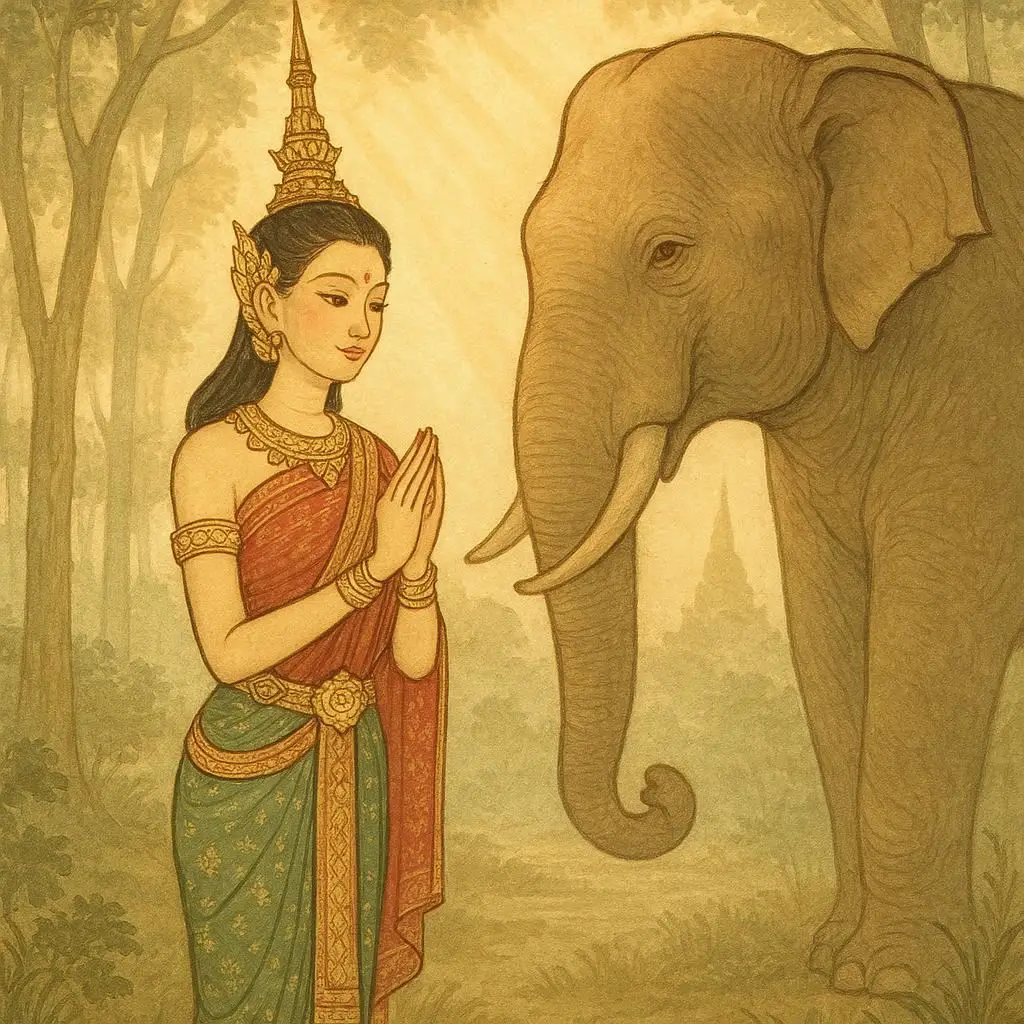
Long ago, in the emerald plains of Isan, northeastern Thailand, there lived a princess named Nang Sumontha. Her beauty was known far and wide, but her true greatness shone through her gentle heart. She was kind to the poor, respectful to the monks, and spoke softly even to the humblest of creatures. Her spirit, they said, was as clear and serene as the waters of the Mekong.
One bright morning, Nang Sumontha set out on a journey through a sacred forest to visit a distant temple. She was accompanied by her servants and guards, their footsteps quiet beneath the towering tamarind trees. Birds sang overhead, and the air carried the scent of jasmine and rain.
But as dusk fell, the forest grew darker and strangely silent. From the shadows emerged a towering figure, a giant with eyes like burning coals and a voice that shook the trees. He seized the princess and carried her deep into the mountains, to a cave hidden among the cliffs.
Explore desert legends and palace tales in our Western Asian Folktales archive.
The servants fled in terror, and the prince who loved her, Phra Wongsa, heard the dreadful news. Yet even in the darkness of the giant’s lair, Nang Sumontha did not weep or rage. She sat quietly, her hands folded in prayer. “May compassion touch even the hardest heart,” she whispered.
The giant watched her curiously. He had taken many travelers before, but none had spoken kindly to him. “Are you not afraid of me?” he rumbled.
“I fear only to lose my goodness,” she replied softly. “If you are hungry or angry, I can offer only understanding, not hatred.”
Her calm words pierced the giant’s loneliness. Day after day, he brought her food and listened as she spoke of mercy, patience, and the sacred balance between humans and nature. Slowly, his heart began to change.
One morning, as dawn painted the cave with gold, the giant spoke. “Your heart is stronger than my strength,” he said. “I have kept you here too long. Go, and live free.”
He led her to the forest’s edge, where Prince Phra Wongsa and his soldiers were searching tirelessly. When the prince saw Nang Sumontha, he ran to her and bowed before the giant. “You have done what few could,” he said. “You chose kindness over cruelty.”
The giant smiled sadly. “It was her purity that freed me, not my will.” And with that, he vanished into the forest mist, never to trouble humankind again.
The prince and the princess returned home in peace, and the people rejoiced. To honor her virtue and the forest spirits who had watched over her, they built a great temple at the foot of the sacred mountain. Even today, villagers say that Nang Sumontha’s spirit blesses those who journey through the old forest as long as they walk with respect in their hearts.
When the wind whispers through the tamarind leaves, the elders say it is Nang Sumontha’s voice, reminding all that true strength lies in compassion, not power.
Moral Lesson
The legend of Nang Sumontha teaches that courage, kindness, and spiritual purity can soften even the hardest hearts. Compassion is stronger than force, and harmony with nature brings true peace.
Knowledge Check
-
Who was Nang Sumontha?
-
A kind and virtuous princess from the Isan region of Thailand.
-
-
What happened to her in the sacred forest?
-
She was captured by a giant and taken to his cave.
-
-
How did she respond to the giant’s captivity?
-
She showed compassion and prayed for guidance instead of reacting with anger or fear.
-
-
What caused the giant to release her?
-
Her kindness and purity softened his heart.
-
-
How did the people honor her after her return?
-
They built a temple to celebrate her faith and virtue.
-
-
What does her legend teach us?
-
That forgiveness and purity can transform even darkness into light.
-
Source
Adapted from the folktale “Nang Sumontha” in Folktales of the Isan People, collected by Preecha Noonsuk (1987), Khon Kaen: Isan Cultural Center Press.
Cultural Origin: Thailand (Isan regional folklore, Northeastern Thailand)