In the rolling hills of Dhofar, where the warm desert winds carry whispers of ancient tales, there once lived a humble woman and her three beautiful daughters. Their mother loved them dearly, but she carried a quiet sorrow in her heart. Though her daughters were graceful and radiant, they all spoke in a peculiar way, their speech was halting and strange, making others mock them or avoid their company. This unusual silence soon became both their shield and their burden.
Fearing that talkative visitors might laugh at them or turn away in disgust, the mother instructed her daughters, “When guests arrive or strangers pass through our door, you must stay silent. Speak only when spoken to, and only if you must.” From that day on, their house became a place of quiet grace, the rustle of palm leaves, the bubbling of the clay water jar, and the low hum of the wind were the only sounds that filled their home.
Though the daughters obeyed faithfully, the mother often wept in secret. In those days, a woman’s worth was often measured by her ability to speak kindly, sing sweetly, or charm others with her voice. Her daughters, silent as moonlight, seemed destined to live unmarried. Yet destiny, as the people of Dhofar say, moves in its own mysterious way.
The King’s Search for a Bride
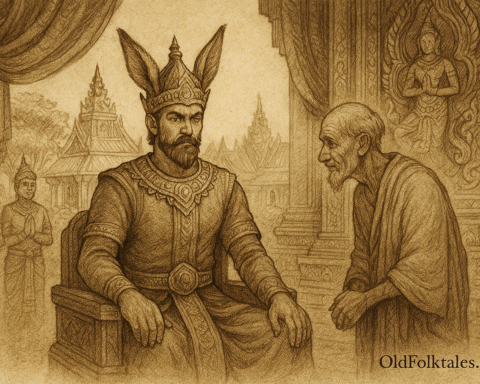
In a distant palace, the King of Dhofar was growing restless. He longed for a wife whose beauty and virtue would match the dignity of his throne. “Go,” he ordered his messenger, “and bring me news of the most beautiful maiden in my land. I will marry the one whose grace outshines the dawn.”
The messenger set out on horseback, travelling from village to village, visiting countless homes. He saw many young women, some bold, some shy, others eager to please. Yet none seemed to satisfy his quest. At last, weary from the long search, he passed by a quiet home on the edge of a green valley. He noticed a woman standing at the door, her eyes kind but cautious. Yet he did not stop, for he heard no laughter, no voices, and no songs from within. “Surely, no maidens of worth live here,” he thought, and rode away.
But when the messenger returned empty-handed, the king was displeased. “Have you searched every house?” he asked sternly.
“Every house but one,” the messenger admitted. “It was silent as a grave, no music, no sound of joy.”
The king frowned. “Then perhaps silence hides what noise cannot. Go back there.”
The Silent Daughters
The messenger obeyed. When he arrived again at the humble home, the mother welcomed him with trembling hands. “I come in the name of the king,” he announced. “He seeks a bride among the daughters of this land.”
The mother bowed deeply. “I have three daughters,” she said softly, “but they are shy and speak little. Still, they are good of heart.”
The messenger requested to see them. One by one, the daughters entered the room, modestly dressed, their eyes lowered. Their beauty shone like dawn breaking over the mountains of Dhofar. The messenger was struck speechless. Though none of the girls spoke, their grace filled the silence with meaning.
He returned to the palace and told the king of the three silent sisters. Intrigued, the king decided to see for himself. When he arrived at their home, he greeted them warmly. Each daughter bowed respectfully, but said nothing. The king, testing their manners, asked them simple questions, their names, their wishes, their thoughts. Only the youngest, her voice trembling like the first rain, whispered a few soft answers. Her words, though broken, were sincere and pure.
The king smiled. “A tongue that speaks less often may speak more truth,” he said. And so, he chose the youngest daughter to be his bride.
The Queen’s Quiet Wisdom
The palace soon buzzed with curiosity. Courtiers whispered, “How can a king marry a woman who can barely speak?” Yet the king stood firm. “Her silence brings peace,” he said, “and her presence calms my heart.”
Over time, the young queen’s quiet ways transformed the palace. Where once there was noise and quarrel, now there was harmony. Her attendants began to follow her example, to listen more, to speak less, and to choose words with care. When the king faced difficult decisions, it was her calm silence that gave him strength to think clearly.
One day, the kingdom faced a great drought. People quarreled over water and the farmers grew desperate. While the ministers argued, the silent queen took the king’s hand and led him to the palace gardens. There, she knelt and dug her fingers into the dry earth, showing him the roots that still held traces of moisture beneath the surface. Her action spoke louder than words, and the king understood. He ordered new wells to be dug in the valleys, saving his people from famine.
The Blessing of Silence
Years passed, and the queen bore a son. The kingdom rejoiced, and songs of blessing echoed through Dhofar. Yet even as music filled the land, the people remembered how it had all begun, with a quiet girl who once could barely speak, but whose silence had brought good luck, wisdom, and peace to the realm.
Moral Lesson
True strength often lies not in speech, but in silence. Patience, humility, and quiet understanding can reveal wisdom far greater than words.
Knowledge Check
1. What is the central theme of “When Silence Brought Good Luck”?
The story highlights the power of silence, patience, and inner wisdom over outward charm or speech.
2. Where does this Omani folktale originate?
It originates from Dhofar, a culturally rich region in the Sultanate of Oman.
3. What moral lesson does the story teach?
That silence and humility can lead to success and fortune when guided by sincerity and virtue.
4. How does the silent queen help during the drought?
Through her silent action, she shows the king that water can still be found beneath the earth, saving the kingdom.
5. Why did the king choose the youngest daughter?
Because her quiet honesty and modest nature reflected true wisdom and purity.
6. What cultural values of Oman does the story reflect?
It reflects Omani respect for modesty, patience, family honour, and the belief that destiny rewards virtue over pride.
Source: Adapted from “Good Luck” in My Grandmother’s Stories: Folktales from Dhofar, collected by Mohammed bin Musallam Al Mahri, reprinted from Kids Magazine #44, Sultan Qaboos Cultural Center (rop.gov.om).
Cultural Origin: Oman (Dhofari Folklore)