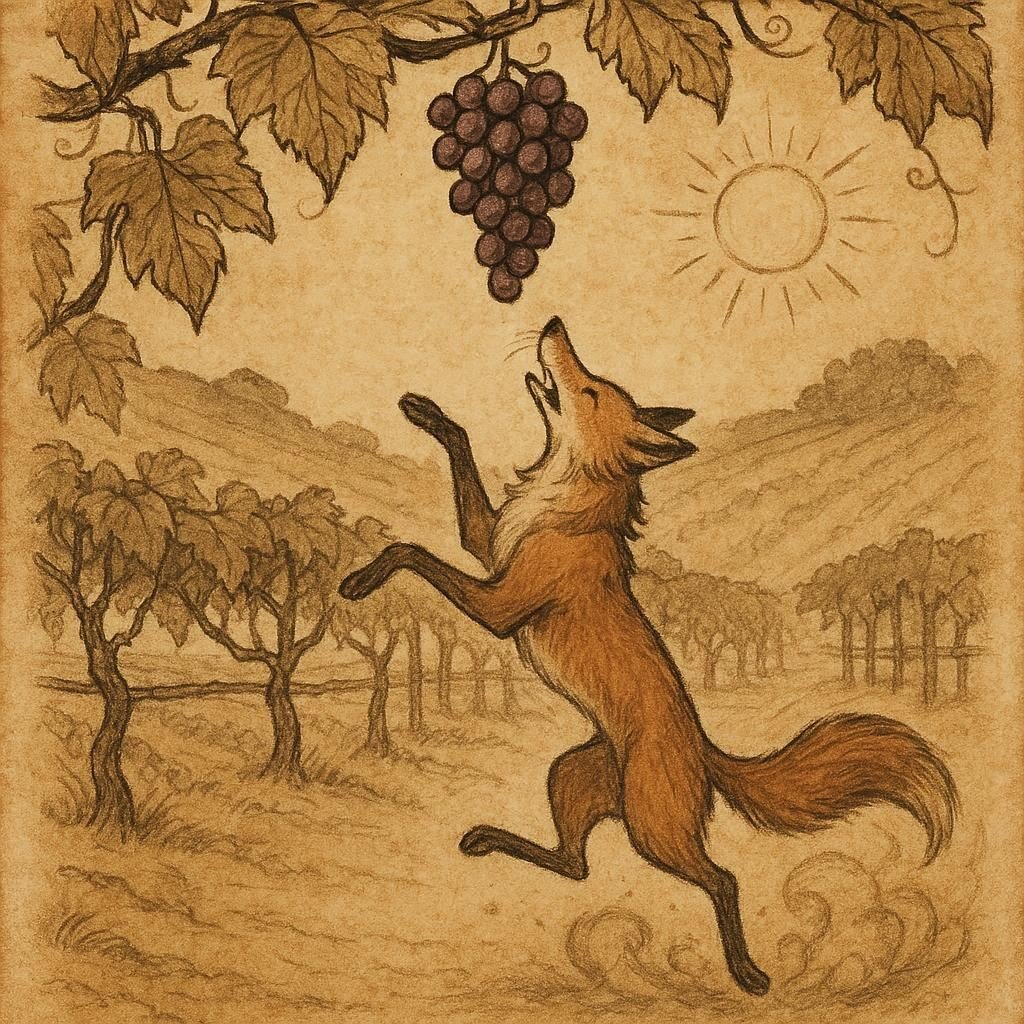
Under the bright summer sun, a sly fox wandered along the edge of a quiet village vineyard. The air was heavy with the scent of ripening fruit, and the green leaves of the grapevines shimmered gently in the breeze. Clusters of grapes hung like glistening gems, plump, full, and radiant under the light.
The fox, who had been roaming since dawn, was weary and terribly hungry. His paws ached from the rocky path, and his empty stomach growled like distant thunder. Then, as if fortune had finally smiled upon him, his sharp eyes caught sight of a beautiful bunch of grapes hanging from a high trellis. Their deep purple skins gleamed temptingly, promising sweetness and cool refreshment.
“Ah, just what I need,” the fox said, licking his lips eagerly. He crouched low, gathered his strength, and sprang upward. His jaws snapped in the air, but the grapes were just beyond his reach. He landed with a soft thud, panting in frustration.
He circled the vine, examining it closely. “Perhaps from another angle,” he muttered. Taking a few steps back, he dashed forward again and leaped as high as he could. His claws brushed the lower leaves, yet the grapes remained untouched, swaying teasingly above his head.
Determined not to give up, the fox tried again and again. Each attempt left him more tired than before. Dust clung to his fur, his breath came in short gasps, and his tail flicked restlessly behind him. Still, the grapes dangled far above, shimmering in the afternoon sun as if laughing at his efforts.
Finally, exhausted and humiliated, the fox sat beneath the vine. His mouth watered just looking at the fruit. He stared for a long moment, pride and hunger battling within him. Then, with a dismissive snort, he turned away.
“Bah! Those grapes are probably sour anyway,” he muttered, lifting his head high. “Who would want such bitter fruit?”
And with that, the fox trotted off, pretending he had never wanted the grapes at all. Though his stomach remained empty, he consoled himself with pride, convincing his heart that it was better not to taste failure.
As the vineyard grew still once more, the untouched grapes swayed gently in the warm wind—a silent reminder of how easily pride blinds us to truth.
Moral Lesson
This Kyrgyz folktale teaches that pride can make us deny our true desires. When we fail to achieve what we want, we may deceive ourselves rather than admit our limits. True wisdom lies in humility, acknowledging defeat without losing honesty or self-respect.
Knowledge Check
1. What is the main moral of “The Fox and the Grapes”?
It teaches that pride leads to self-deception and that it is wiser to accept our failures honestly.
2. Why couldn’t the fox reach the grapes?
They were hanging too high from the vine, beyond the fox’s reach despite his repeated efforts.
3. What emotion made the fox claim the grapes were sour?
Frustration and wounded pride caused him to rationalize his failure.
4. Which culture does this folktale come from?
It originates from Kyrgyz folklore, part of Central Asia’s rich storytelling heritage.
5. What human behavior does the fox’s reaction represent?
It illustrates cognitive dissonance—how people justify disappointment by pretending not to care.
6. What lesson can readers apply to modern life?
That accepting failure with honesty is more admirable than masking it with excuses or pride.
Source: Adapted from Kyrgyz Folk Tales (1998 Edition).
Cultural Origin: Kyrgyzstan (Central Asia).