Once upon a time, across the green pastures and snow-capped mountains of Kyrgyzstan, where shepherds’ songs echoed through the valleys and eagles soared against the blue sky, there once lived a great and wise king. His kingdom was rich in beauty and bounty, and his people respected him for his fairness and strength. Yet, despite his many blessings, the king had one wish left unfulfilled, he longed to find a worthy husband for his beloved daughter, a princess known for her grace, intelligence, and kindness.
One day, as he looked out over his blooming orchards, the king announced a challenge that would test not wealth or power, but courage and virtue. “Whoever brings me a golden apple,” he proclaimed, “shall have the hand of my daughter in marriage.”
The word spread quickly across the land. Noblemen, merchants, and proud warriors came forward, each certain that he could win the prize. The promise of marrying the princess and sharing the king’s throne filled many hearts with greed and ambition. Yet no one knew where such a golden apple could be found.
Among those who heard the king’s decree was a humble gardener’s son. He lived on the edge of the royal gardens, tending flowers and trees with his father. Though poor, he was known for his gentle heart and thoughtful nature. When he heard of the king’s challenge, he said quietly, “Father, perhaps I can try.”
His father smiled, though his eyes held worry. “My son, many strong men have already failed. But if you believe in your heart, then go with honesty and courage. That will be your strength.”
With his father’s blessing, the young man set out on his journey. He had no fine horse, no golden armor, and no servants to guide him. Only his walking stick, a small pouch of bread, and his faith accompanied him. He traveled across meadows and rivers, through forests and rocky paths, asking everyone he met if they had seen a golden apple.
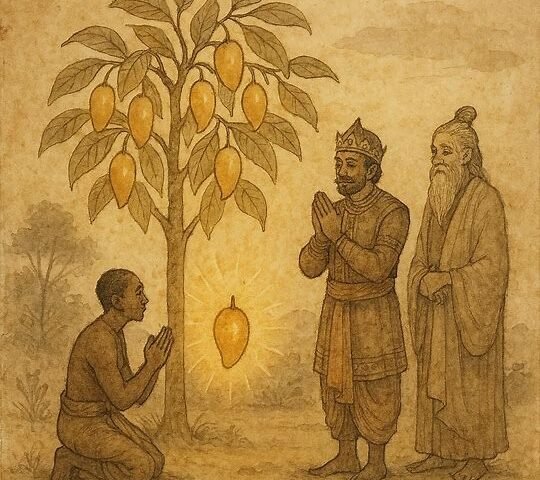
Days turned into weeks, and his feet grew sore, but he never lost hope. One evening, as he rested beneath a tree by a shimmering stream, he noticed a faint glow reflected in the water. Looking up, he saw a branch heavy with fruit, and among them, one apple shone brighter than the rest. Its skin gleamed like polished gold.
The boy climbed the tree carefully, picked the apple, and held it close. It was warm to the touch, as if alive with sunlight. Just then, a frail old man appeared on the path. “Good boy,” the man said softly, “I have traveled far and am faint with hunger. Could you spare something to eat?”
The gardener’s son did not hesitate. He broke his bread in half and offered it with both hands. “Please, take this, grandfather. It is little, but it is all I have.”
The old man smiled kindly. “You have shared your last meal with me. May this apple bring you not only the king’s favor, but also a lifetime of blessings.” And with that, he vanished, leaving the boy in quiet wonder.
When the young man returned to the palace, the courtyard was crowded with suitors. Many had brought false treasures, apples of painted gold or polished metal. The king examined each one, frowning at their deception. Then the gardener’s son stepped forward. He bowed humbly and placed the glowing apple in the king’s hands.
A warm light spread through the hall, and the apple shone with a purity that silenced the crowd. The king’s eyes softened. “Young man,” he said, “tell me, how did you come by this apple?”
The boy told his story truthfully, from his long journey to the kindness he had shown the old traveler. When he finished, the king was silent for a long moment. Then he nodded slowly. “Many have come seeking my daughter with pride and greed. But you, a simple gardener’s son, have shown patience, humility, and compassion. You have found not only the golden apple but the golden heart.”
True to his word, the king honored his promise. The young man and the princess were wed in a grand celebration that filled the kingdom with joy. The people rejoiced, for they saw that the king valued virtue over wealth, and goodness over glory.
The gardener’s son, now a prince, remained humble and kind. Together with his wife, he ruled with wisdom and fairness, never forgetting the lesson that had led him to fortune, the power of kindness and the worth of a good heart.
Moral Lesson
This Kyrgyz folktale teaches that true worth is not measured by riches or appearance but by the goodness of one’s heart. Acts of kindness, humility, and honesty shine brighter than any treasure, winning honor and respect that endure beyond all else.
Knowledge Check
1. What challenge did the king give to find a husband for his daughter?
He promised her hand in marriage to anyone who could bring him a golden apple.
2. Who succeeded in finding the golden apple?
A humble gardener’s son, known for his kindness and honesty.
3. How did the gardener’s son find the golden apple?
He discovered it on a glowing tree after showing kindness to a hungry old man.
4. Why did the king choose the gardener’s son as his daughter’s husband?
Because of his humility, courage, and pure heart—qualities more valuable than wealth.
5. What does the golden apple symbolize in this folktale?
It represents virtue, goodness, and the reward of a kind spirit.
6. What moral lesson does this Kyrgyz story teach?
That kindness and integrity are greater treasures than gold or power.
Source: Adapted from Kyrgyz Folk Tales (1998 Edition).
Cultural Origin: Kyrgyzstan (Central Asia).