In the heart of the Tajik mountains, where green valleys stretch beneath snow-capped peaks and villages cling to the edges of sunlit fields, there lived a poor farmer. His name was Karim, and though his hut was small and his land modest, he worked faithfully each day, sowing, tending, and harvesting with quiet endurance. Karim had no gold, no servants, and no riches, only his honesty, his hands, and a heart that sought peace more than profit.
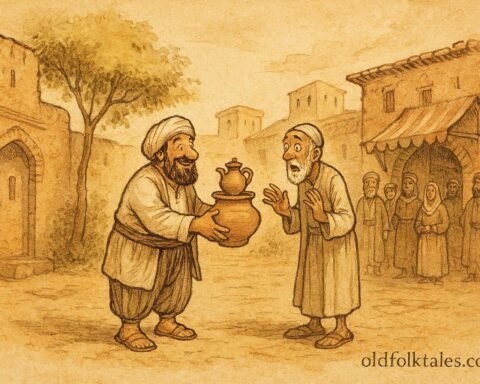
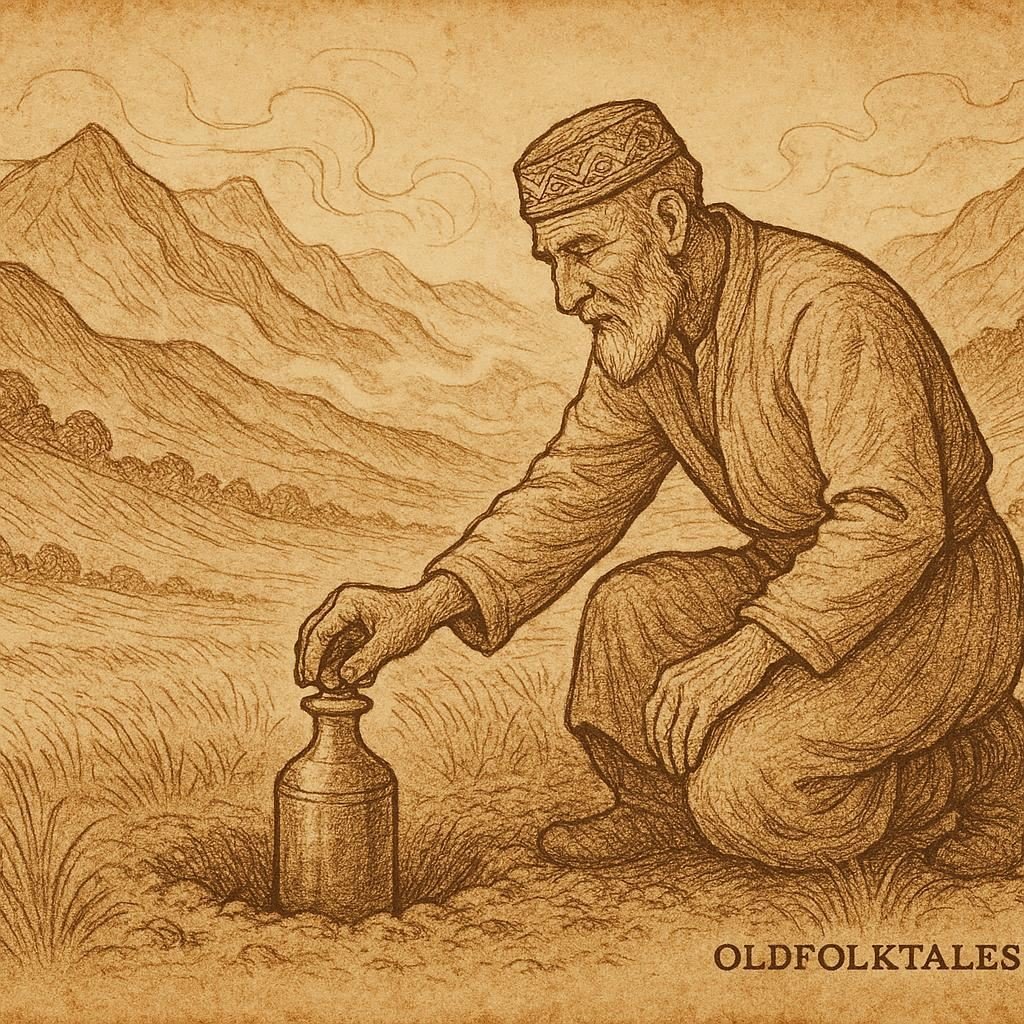
One dry afternoon, Karim labored beneath the blazing sun, digging a new irrigation ditch to water his crops. His spade struck something hard buried in the soil. Curious, he knelt and brushed the dirt aside to reveal a strange copper bottle sealed tightly with a blackened cork. It was covered in old inscriptions, written in an ancient tongue he could not read.
Journey through enchanted forests and islands in our Southeast Asian Folktales collection.
“What could this be?” he murmured, turning it in his hands. “Perhaps it once held oil or medicine.”
But when he pulled out the cork, the ground trembled beneath him, and a great cloud of smoke burst from the bottle. The smoke rose and twisted into the shape of a giant, fierce-looking figure, the Genie of the Bottle. His form towered above the fields, his eyes like burning coals and his voice like rolling thunder.
“Who has freed me from my prison?” the Genie roared.
Karim stumbled back in fear. “It was I, O mighty one. I meant no harm!”
The Genie’s laughter shook the earth. “For centuries I have been trapped within that bottle! At first, I swore to reward whoever released me. But as time passed and no one came, my heart filled with bitterness. Now I promise to destroy the one who sets me free!”
The farmer’s heart raced. “Destroy me? I did you no wrong! I released you from captivity!”
But the Genie raised his hands, the air crackling with power. “Your pity comes too late. Prepare to die!”
Karim, though poor, was clever. He bowed respectfully and said, “Before you take my life, grant me one final request.”
The Genie frowned. “Speak quickly.”
Karim pointed to the bottle. “I do not believe such a great being as you could truly fit into such a small vessel. If you can show me that, I will accept my fate.”
The Genie’s pride was stirred. “You doubt my power? Watch and see!”
In an instant, he dissolved into a whirlwind of smoke and poured himself back into the bottle. The moment the last wisp vanished inside, Karim snatched the cork and sealed it tightly.
“Ah,” he said with a smile, “better to trap a dangerous spirit than to argue with one.”
The Genie’s muffled voice thundered from within the bottle. “Wait! Foolish man, listen! If you release me once more, I will truly reward you this time. Three wishes, whatever you desire!”
Karim hesitated. His heart was honest, not greedy, and he wondered if the Genie spoke the truth. “You swear it by your magic?” he asked.
“I swear!” boomed the Genie.
Slowly, Karim removed the cork again. The Genie emerged, less fearsome than before, his fiery eyes softened. “Ask your three wishes,” he said, “and they shall be granted.”
Karim thought carefully. He could ask for endless gold or vast lands, but what good would that bring if it turned his heart to stone? So, he said humbly, “For my first wish, give me enough food and water so that my family will never go hungry again.”
The Genie nodded, and before the farmer’s eyes, his small storehouse filled with sacks of grain, fruit, and jars of clear, fresh water.
“For my second wish,” said Karim, “make my soil rich and fertile so that my farm may yield good harvests each season.”
The Genie waved his hand, and the land shimmered. When Karim touched the soil, it was dark and moist, the mark of abundance.
The Genie smiled. “And your final wish?”
Karim looked around at his fields and thought of the mountain wind that brushed against his face. “Give me contentment in my heart,” he said softly, “so that I may never envy the wealth of others.”
The Genie paused, surprised by the wisdom of such a wish. “Few men ask for peace when they may command power,” he said. “You are truly wise, farmer.” With a final gesture, the Genie vanished into thin air, leaving only the faint scent of smoke and the whisper of his departing voice.
Years passed, and Karim’s farm flourished. His crops grew tall and strong, and he shared his abundance freely with neighbors and travelers alike. Though others tried to tempt him into greed, he remained grateful and humble, finding joy in each sunrise, each harvest, and each simple meal.
And sometimes, when the wind rustled through his fields, Karim thought he heard a faint laugh from the mountains, the Genie’s laughter, echoing with approval.
Discover the wisdom of ancient India and the Silk Road in South & Central Asian Folktales.
Moral Lesson
This Tajik folktale teaches that true wealth is not measured by gold or possessions but by contentment and wisdom. Greed blinds the heart, but humility and gratitude bring lasting prosperity.
Knowledge Check
1. Who are the main characters in “The Farmer and the Genie”?
The story centers on Karim, a humble Tajik farmer, and the powerful Genie he accidentally releases from a bottle.
2. What happens when the farmer opens the bottle?
He releases a Genie who first threatens him but later offers three wishes.
3. How does Karim outsmart the Genie?
He tricks the Genie back into the bottle by pretending not to believe the Genie could fit inside it.
4. What three wishes does Karim make?
He wishes for food and water for his family, fertile land, and a contented heart.
5. What value does the story teach about wealth?
It shows that the richest people are those who find satisfaction in what they already have.
6. What moral lesson does this Tajik folktale emphasize?
It highlights that wisdom and gratitude are far more valuable than riches or power.
Source: Tajik folktale, Tajikistan.
Adapted from the Silkroad Foundation collection of Tajik Folk Tales (1998 Edition).