In the southern land of Dhofar, where the mountains meet the sea and frankincense scents the air, tales of wisdom have always travelled farther than the wind. Among them is one told by grandmothers beside the evening fire, the story of the Intelligent Maiden, whose wisdom won her a prince and humbled the proud.
Once there lived a carpenter whose hands were rough from shaping wood into beauty. Though he was poor, his daughter was known not for her wealth but for her intelligence and gentle speech. She listened more than she talked, thought before she spoke, and saw meaning in every small thing. Word of her wit reached even the palace, where the young Prince of Dhofar had grown weary of flatterers who called themselves wise.
One morning, the prince declared, “I will marry only the woman who can answer my riddles, not with beauty, but with mind.” Messengers were sent across the land, and many maidens came, their families hoping for honour. In the crowded hall, each girl tried her best, some with pride, some with fear, but none could satisfy the prince’s test.
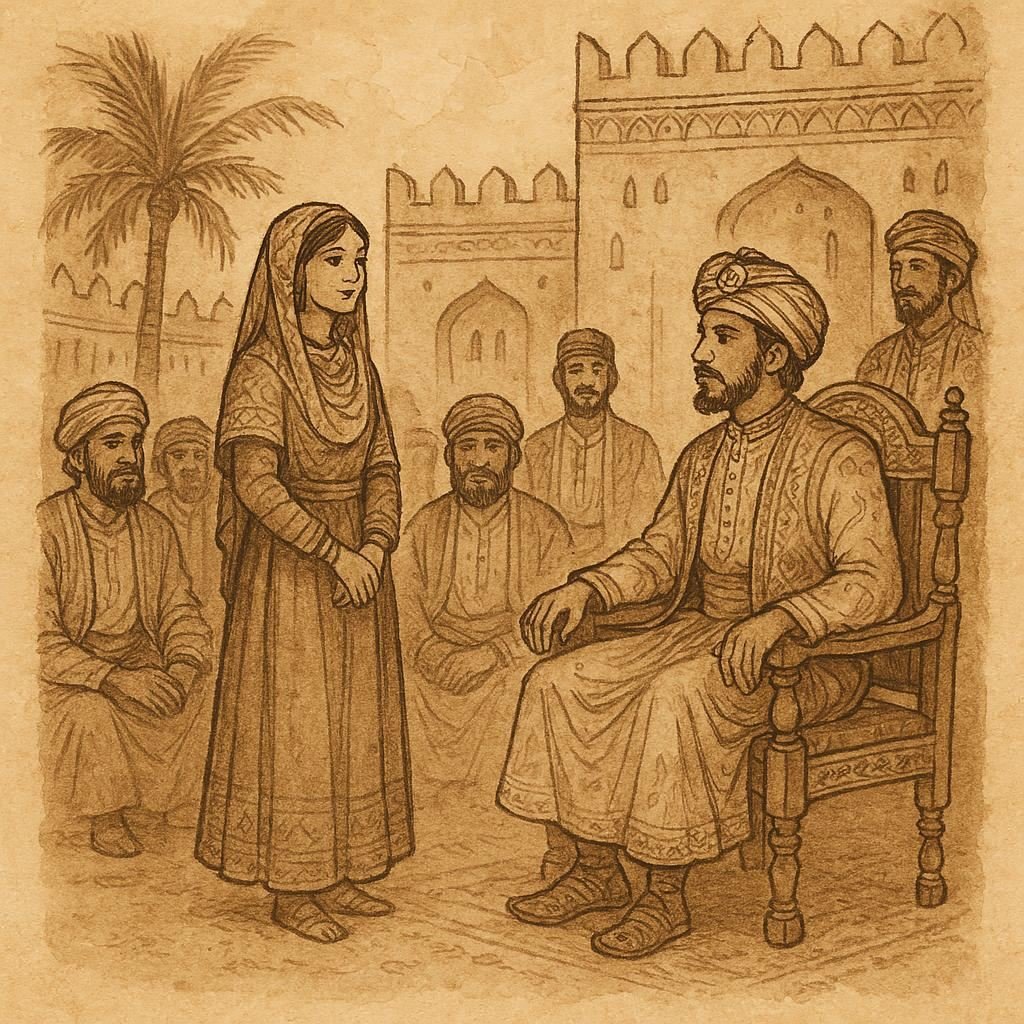
At last, the carpenter’s daughter arrived. Her dress was simple linen, her eyes steady and calm. The court laughed at her modest look, but the prince, curious, gave her a chance. “Tell me,” he said, “what is stronger than truth, swifter than thought, and more precious than gold?”
She bowed and replied, “Wisdom, my lord. For wisdom keeps truth from pride, gives thought its wings, and teaches gold its worth.”
The prince smiled. “Well said. Then tell me this: what is the sharpest thing in the world?”
“The tongue,” she answered. “For it can wound deeper than a sword or heal faster than a balm.”
The courtiers murmured. The prince leaned forward. “And what is the softest thing?”
“A heart that forgives,” she said, her voice soft as the desert wind.
The prince fell silent, moved by her answers. But he had one final test. He ordered her to come to the palace the next day neither walking nor riding, clothed nor unclothed, bringing a gift yet bringing nothing. The court whispered: “No one can solve this.”
That night, the carpenter’s daughter thought deeply. At dawn, she wrapped herself in a fishing net, half-covering her body. She sat astride a goat, holding in her hands a bird that flew away as soon as she reached the gates. The guards gasped; the prince laughed aloud. “You have fulfilled my challenge,” he said. “You came neither walking nor riding, clothed nor unclothed, bearing a gift that stayed not a moment. Your wit is finer than gold.”
And so, before all the court, he took her hand and said, “Let all Dhofar know that a wise heart makes a kingdom richer than a thousand treasures.”
The carpenter’s daughter became a beloved queen, not by wealth or beauty, but by the grace of her intelligence, her humility, and her steadfast wisdom. The people of Dhofar still tell her story to remind their children that the clever and kind shall rise, even from the humblest homes.
Moral Lesson
True wisdom lies in humility and thoughtfulness. Intelligence guided by kindness and modesty can elevate anyone beyond birth or fortune.
Knowledge Check
-
Who is the main character in “The Prince and the Intelligent Maiden”?
The main character is a humble carpenter’s daughter known for her intelligence and wit. -
What is the key virtue celebrated in this Omani folktale?
The tale celebrates wisdom, humility, and intelligence as higher than wealth or appearance. -
How did the maiden prove her intelligence to the prince?
She answered his riddles wisely and fulfilled an impossible challenge with creativity. -
What moral lesson does the story teach?
That true wisdom, joined with kindness and humility, triumphs over pride and riches. -
Where does this folktale originate?
The story originates from Dhofar, in southern Oman. -
Why is the folktale still relevant today?
It reminds us that intellect and compassion are timeless virtues in both leadership and life.
Source
Adapted from the Omani folktale “The Prince and the Intelligent Maiden” in My Grandmother’s Stories: Folktales from Dhofar, collected by Mohammed bin Musallam Al Mahri (Kids Magazine reprint, early section).
Cultural Origin: Oman (Dhofari folklore)