In a remote Dhofari village, beneath the shade of acacia trees and among the windswept hills, there lived a young orphan whose name none remembered. From earliest memory, she knew only the hush of hunger and the ache of loss. The villagers whispered that her parents had died of fever, leaving her in the care of a distant relative who treated her poorly. Yet, amid her suffering, she clung to a single quality: kindness.
Each dawn, while others slept, she would rise and fetch firewood, gather water, and tend goats for her cruel guardian. She carried her burdens without complaint, her eyes quiet but watching, her spirit soft but unbroken. Though she owned nothing, she gave what little she could, a crust of bread to a starving kitten, a cup of water to a thirsty traveler, a piece of shade under her cloak to a weary beggar.
One year, famine struck Dhofar. Crops withered in the fields, wells ran dry, and villagers grew desperate. The orphan’s guardian blamed her and drove her out, telling her she was useless in such hard times. With nothing left, she set out on foot across rocky ridges, carrying a small gourd of water and a handful of dates.
As she walked, she encountered a poor logger, an old man carving beams for passage huts. He too had nothing left but his tools and calloused hands. Tossing aside his ax, he begged the orphan for water. She paused, then gave him half her gourd, though it meant she would grow thirstier. The logger bowed his head in gratitude.
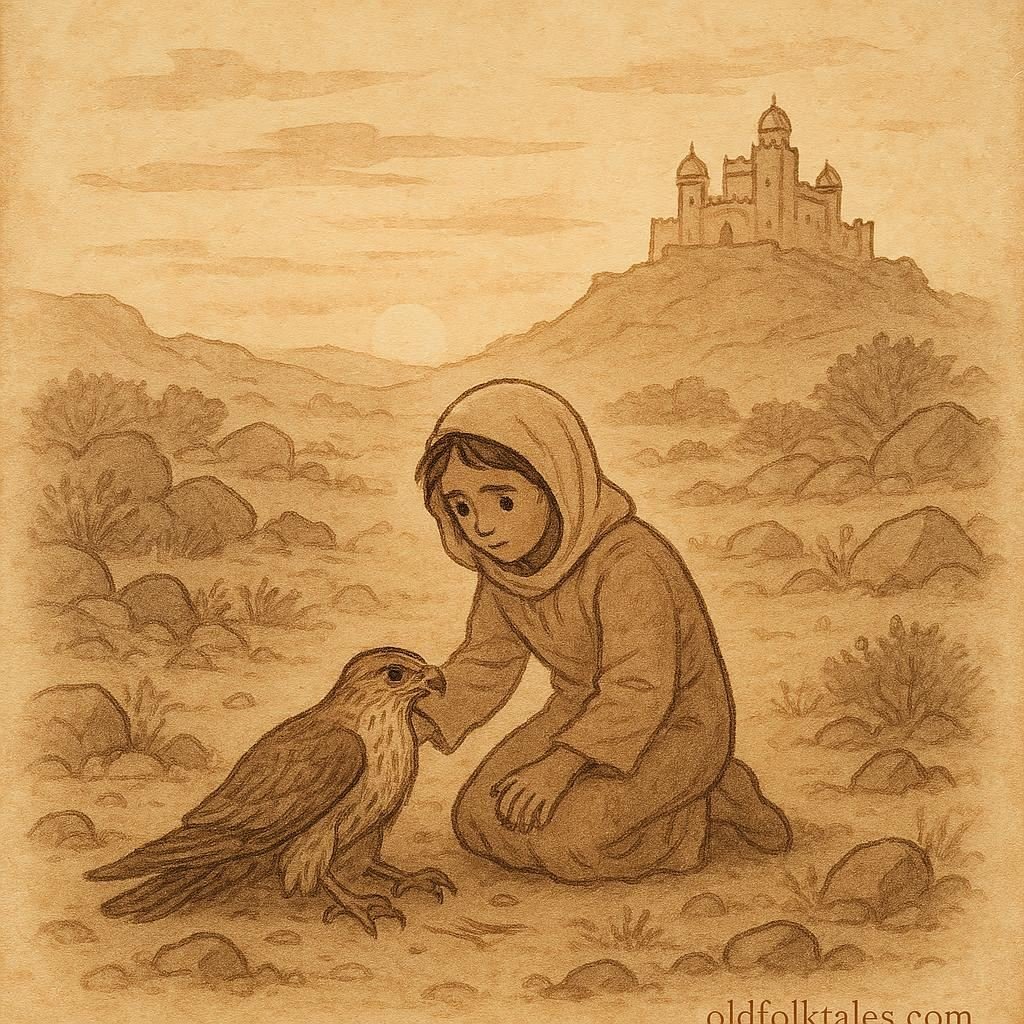
Further along, she met a wounded hawk lying in the scrub. Its wing was broken. Her heart twisted. She laid it gently in her lap, fed it a morsel, and whispered coaxing words. Night fell; she built a small fire, warmed the bird, and slept beside it, turning her back to the cold.
Days later, she reached the palace gates of the Prince of Dhofar, who had heard of the famine and sought to reward those who helped others in misery. The guards refused her entrance, for she was ragged and unknown. But she asked only to report the plight of her village. She told how fields perished, wells dried, and people starved. She spoke also of the logger and the hawk, her charity to creatures and humans alike.
The prince, moved by her tale, invited her to stay at court while he deliberated. He decreed a test for all who claimed compassion: for three nights, caretakers of the palace would observe who had truly been kind in hardship. Some guests brought food for the noble; some sang flattery; but only the orphan, in the halls of stone, quietly fed the palace beggars, offered water to guards, and healed a wounded bird found in the courtyard.
On the fourth dawn, the prince gathered all before him. He praised those who worked for his favor, then turned to the orphan. He said: “In famine, true wealth is measured by what one gives, not by what one keeps.” He bestowed upon her a house in town, grants for her village, and named her the Prince’s Compassionate Protector, charged with distributing food and water during droughts.
The logger was summoned and rewarded; the hawk healed, when let free, circled above the palace before flying beyond the mountains. The orphan’s guardian, regretful, sought her forgiveness; she forgave and offered him dry bread when he came begging in later days.
In time, Dhofar prospered again. But people never forgot how a delicate, poor girl, bereft of privilege, stood taller than kings through simple acts of quiet kindness.
Moral Lesson
True nobility lies in compassion, not birth. Even in suffering, kindness to others redeems both giver and receiver. Justice often rewards the humble more richly than wealth or power ever can.
Knowledge Check
-
Who is the main protagonist of the story?
The story centers on a young orphan in Dhofar, known for her enduring kindness despite hardship. -
What acts of compassion does she perform?
She shares water with a logger, cares for a wounded hawk, gives to beggars, and helps guards and beggars in the palace. -
How does the prince test true charity?
He observes guests over three nights, seeing who acts without expectation of reward, the orphan’s quiet kindness stands out. -
What lesson does the folktale teach?
That genuine compassion and generosity in adversity are more enduring virtues than superficial wealth. -
What cultural values does the tale reflect from Dhofar?
It emphasizes mercy, community duty, humility, and the belief that moral virtue brings lasting honour. -
How is justice served by the story’s end?
The orphan is honored, her village aided, the logger rewarded, and her former guardian forgiven, virtue is uplifted.
Source: Adapted from the Dhofari folktale tradition in My Grandmother’s Stories: Folktales from Dhofar, collected by Khadija bint Alawi al-Dhahab.
Cultural Origin: Oman (Dhofari folklore)