Long ago, in the fragrant gardens of an ancient Persian kingdom, a queen wandered among her orange and citron trees, her heart aching with longing. Though her palace gleamed with marble and gold, she yearned for one thing only, a child. Day after day she prayed beneath the trees: “Grant me a daughter as radiant as these fruits, whose beauty will bring joy to all who see her.”
One moonlit night, her prayers were answered. A soft voice drifted through the scented air: “Your wish shall be granted, but guard her well, for envy follows beauty.” Soon after, the queen gave birth to a daughter, a child so lovely that her cheeks glowed like ripe oranges and her skin shone pale as citron blossoms. They named her Nâranj o Toranj, meaning Orange and Citron.
The Hidden Princess
From her birth, the royal astrologers warned that the princess’s beauty would invite both admiration and danger. To protect her, the queen built a high tower within the royal gardens, where no harm could reach her. There, surrounded by tutors and servants, the princess grew wise, gentle, and pure-hearted. Yet, though she had everything, her eyes often turned wistfully to the horizon, dreaming of a life beyond the tower walls.
The Prince’s Dream
In a faraway kingdom, a young prince was visited by a mysterious dream. Three times he saw a maiden glowing with the light of orange and citron trees, her voice calling softly through the mist. Each time, a whisper followed: “Seek her in the land of the setting sun, she is your destiny.”
Unable to ignore the vision, the prince set forth on a long and perilous journey. He crossed golden deserts, climbed snow-capped mountains, and rode through valleys filled with blooming myrtle and pomegranate trees. At last, he came upon a garden surrounded by high walls, and from a distant tower, he heard the sweetest voice singing to the dawn.
A Secret Love Blossoms
Disguised as a gardener’s apprentice, the prince entered the royal garden. For many days, he tended the flowers beneath the tower, hoping to see the singer whose voice haunted his heart. One afternoon, as he arranged a basket of citrons, he called softly, “O maiden of the orange and citron trees, your song has guided me across the world.”
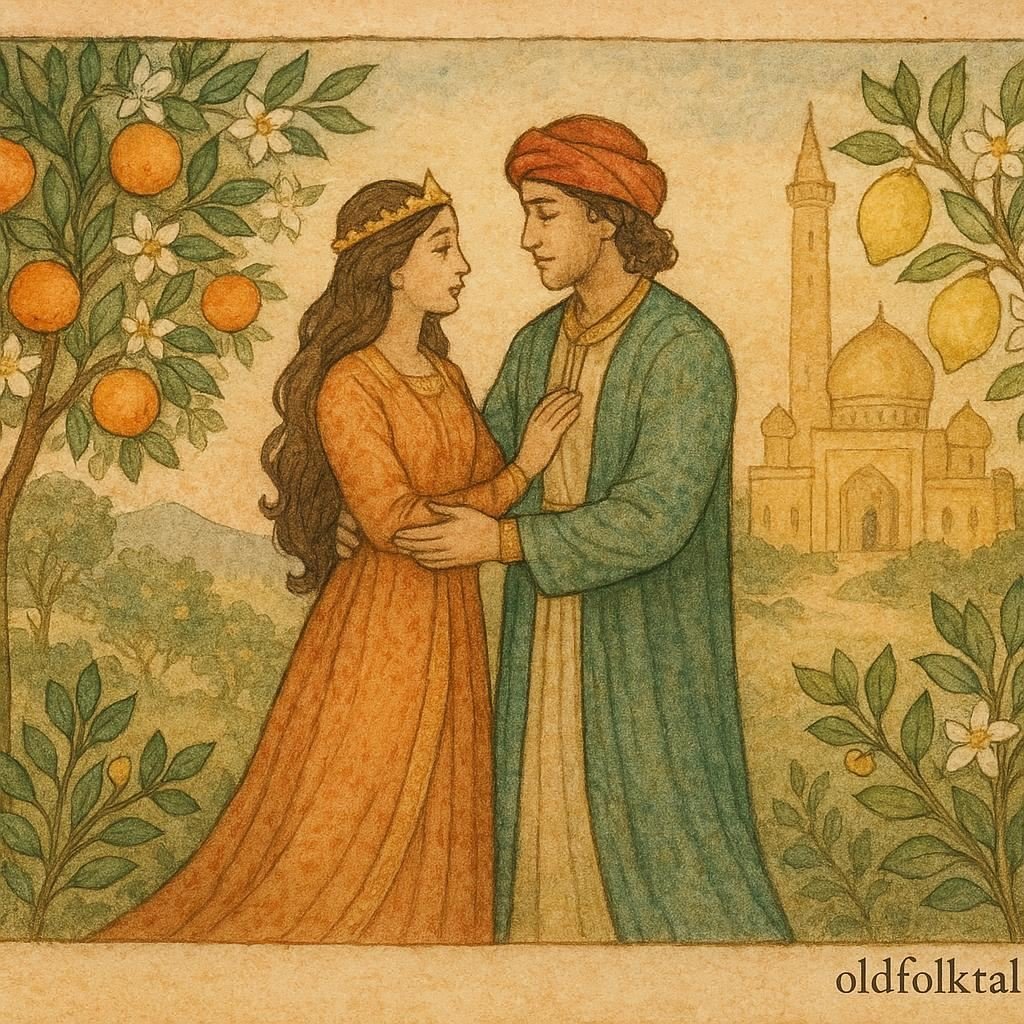
The princess peered from her window and beheld the stranger. The moment their eyes met, both knew fate had united them. Every day thereafter, they spoke through the tower window, their words weaving threads of love stronger than stone. On a moonlit night, the prince climbed up to her with a silken rope, and they pledged themselves to each other in secret.
The Witch’s Deceit
Among the servants lived an old woman, envious of the princess’s grace. Learning of their hidden love, she plotted to destroy it. One night, while the princess slept, the witch whispered dark spells and carried her away to a remote cave in the mountains. Her own daughter, ugly and cruel, was enchanted to resemble the princess and sent to marry the prince in her place.
But on the day of the wedding, the prince felt a deep unease. “You are not she,” he murmured, staring into her cold, lifeless eyes. Yet the witch’s spell clouded his mind, and he could not remember the truth.
The True Princess’s Trials
In the lonely cave, the real Nâranj o Toranj awoke in despair. One day, a bird with feathers like silver starlight landed before her. “I am a messenger of fate,” it said. “Your patience will break the spell. Tend to me kindly, and you shall see light again.” The princess cared for the bird, feeding it and singing softly. In gratitude, it revealed the secret of the witch’s magic and showed her how to return to her beloved.
When the false bride’s feast was held, the princess arrived at the palace disguised as a traveler selling golden fruits. She carried a basket of oranges and citrons so radiant they seemed to glow from within. When the prince touched one, it burst into light, shattering the witch’s enchantment. The impostor’s illusion vanished, and the truth stood revealed. Overwhelmed with joy and shame, the prince rushed to embrace his true bride.
Truth and Love Triumphant
The wicked witch and her daughter were banished from the kingdom, never to return. Peace and happiness filled the land once more. The prince and the true princess were married beneath the orange and citron trees, the very trees that had once heard the queen’s prayer. Their union, tested by deceit and strengthened by truth, became a symbol of love’s power to overcome darkness.
Every spring, when the orange and citron trees bloomed, their fragrance reminded all who passed that sincerity, courage, and faith are stronger than envy and lies.
Moral Lesson
“The Orange and Citron Princess” teaches lessons on love, truth, and destiny, that beauty and goodness may attract envy, but honesty and steadfast devotion will always reveal the truth and triumph over deceit.
Knowledge Check
- Who was Nâranj o Toranj?
She was the princess born from the queen’s prayer, symbolizing beauty, innocence, and destiny. - Why did the queen keep her daughter in a tower?
To shield her from harm, as astrologers predicted danger would follow her beauty. - What guided the prince to the princess?
A recurring dream that symbolized destiny and the unseen power of true love. - How did the witch deceive the prince?
By hiding the real princess and sending her enchanted daughter in disguise. - What broke the witch’s spell?
The princess’s courage and the magical fruit that revealed truth through light. - What moral values does the story reflect in Persian culture?
The triumph of virtue over deceit, destiny’s guidance, and the enduring purity of love.
Source:
Adapted from Persian Tales collected by D. L. R. Lorimer & E. O. Lorimer (1919).
Cultural Origin: Persian folktale, Iran.