In a prosperous kingdom, there lived a king with two queens: Duo and Suo. Though the palace overflowed with riches and servants attended their every need, both queens shared a common sorrow: neither had been blessed with children. The emptiness in their chambers echoed through the years, and the throne remained without an heir.
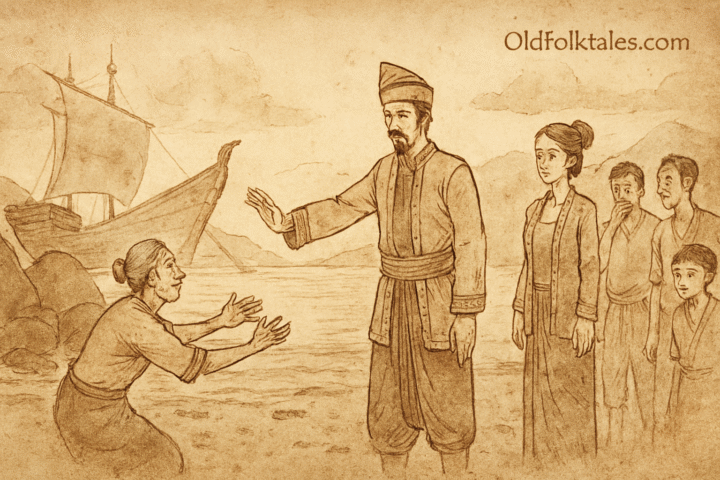
One sweltering afternoon, a holy Faquir appeared at the palace gates, his weathered face lined with wisdom, his simple robes dusty from long travels. He called out for alms, and Queen Suo came to the door carrying a handful of rice. The mendicant gazed at her with piercing eyes and asked if she had any children. When she answered no, her voice trembling with shame, he shook his head and refused her offering. A woman without children, he explained, had hands considered ceremonially unclean.
Click to read all Southeast Asian Folktales — featuring legends from Thailand, Indonesia, Vietnam, and the Philippines.
But the Faquir’s heart was not without compassion. From the folds of his robe, he drew forth a small packet containing a miraculous drug. “Take this medicine,” he instructed carefully, “and swallow it with the juice of a pomegranate flower. You will bear a son whose complexion will be as bright as that crimson blossom. You shall name him Dalim Kumar.” Then his voice dropped to a whisper, and his words carried a warning that would echo through the years. “The boy will have enemies who seek his life. Know this, his life is bound to a great boal fish swimming in your palace tank. Within that fish lies a wooden casket, and within that casket rests a golden necklace. That necklace is your son’s life itself. Guard this secret well.”
Within weeks, whispers filled the palace corridors: Queen Suo was with child. The king’s joy knew no bounds. He envisioned dynasties stretching into eternity, his line unbroken through countless generations. When Dalim Kumar was born, his beauty surpassed all expectations. His skin glowed like pomegranate petals kissed by morning dew, and his eyes sparkled with intelligence. The kingdom celebrated for forty days and nights.
As Dalim grew, he developed a passion for keeping pigeons. The beautiful birds would circle the palace towers, their wings flashing silver in the sunlight. But fate had given them a peculiar habit, they always flew into Queen Duo’s apartments. The first time, she returned them cheerfully. The second time, with reluctance. The third time, she saw her opportunity.
Queen Duo’s heart had grown dark with jealousy. Since Dalim’s birth, the king barely glanced her way, lavishing all his attention on Suo and her miraculous son. Duo had heard rumors of a secret connected to the boy’s life, and she intended to discover it. When the pigeons flew to her chambers again, she held them captive.
“I won’t return them,” she told young Dalim sweetly, “unless you tell me where your life resides.”
The innocent boy, confused by such a strange question, promised to ask his mother. Day after day, the pigeons returned to Duo’s rooms, and day after day, she pressed the child. Finally, worn down by his stepmother’s insistence and desperate to reclaim his beloved birds, Dalim pleaded with his mother until she revealed the terrible secret. The next day, with honeyed words and false affection, Duo extracted the truth from the trusting child.
Armed with this knowledge, the wicked queen set her plan in motion. She placed dried hemp stalks beneath her bed: brittle stems that cracked loudly when pressed. Lying upon them, she moaned and declared herself gravely ill, the breaking of her very bones audible to all who entered. The king summoned his physician, a man secretly in league with Duo. The doctor proclaimed that only one remedy could save her: something contained within the great boal fish in the palace tank.
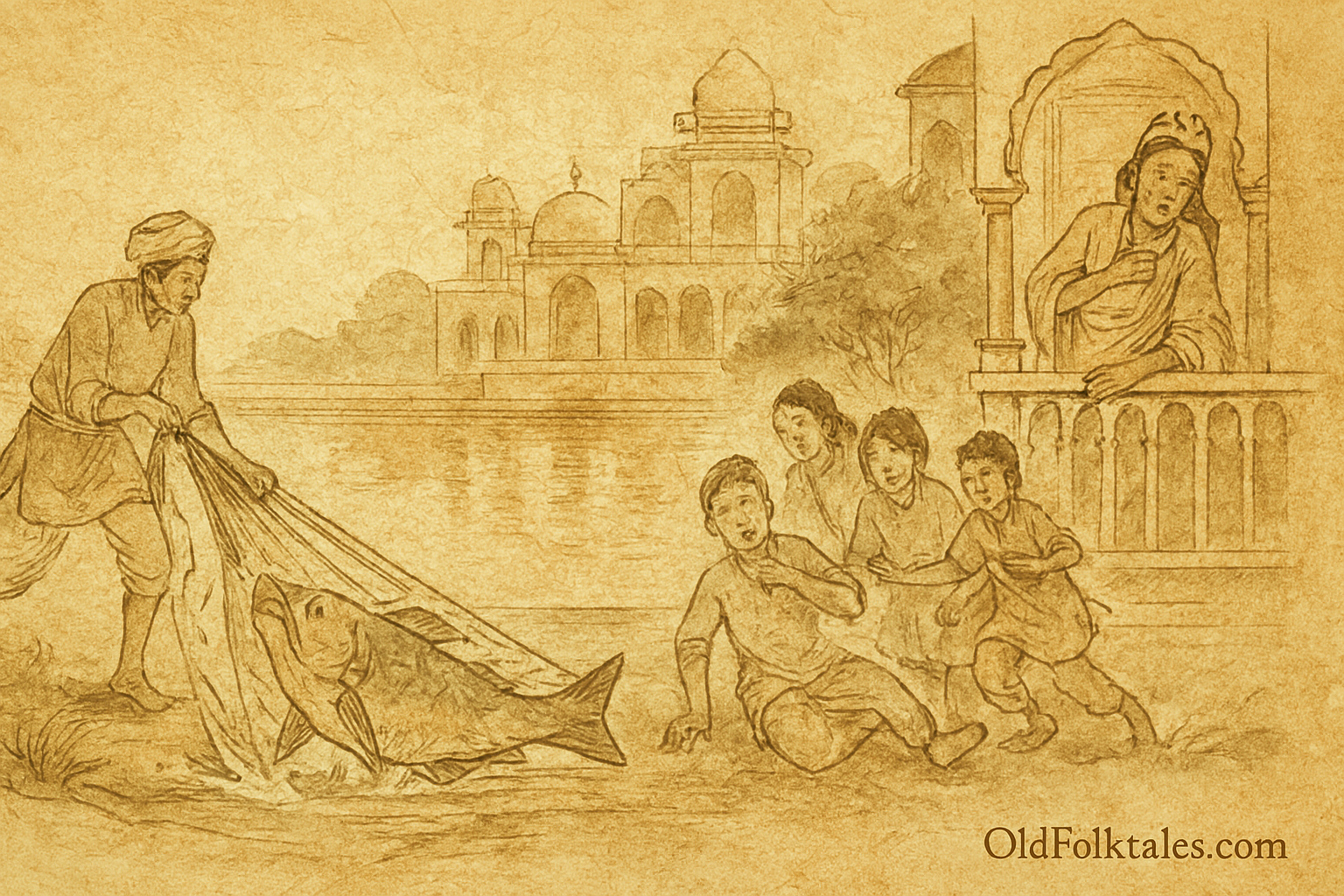
The royal fisherman cast his net, and on the first throw, caught the enormous fish. At that very moment, Dalim, playing nearby with other children, clutched his chest and fell to the ground. As the fish was hauled onto the shore, gasping and thrashing, the prince’s life began to slip away. When the fish was cut open and the wooden casket extracted, Dalim’s breathing grew shallow. And when Queen Duo fastened the golden necklace around her throat, Dalim Kumar died in his mother’s arms.
The king’s grief shook the palace foundations. He wept until his courtiers feared for his sanity. Refusing to accept his son’s death, he ordered the body preserved in a garden-house on the city’s outskirts, stocked with provisions as though Dalim might yet need them. Only the prince’s dearest friend, the prime minister’s son, held the key and visited daily.
But destiny had woven a strange thread into this tragedy. Each night, when Duo removed the necklace before the king’s visits, Dalim returned to life. Each morning, when she clasped it on again, he died once more. His friend, noticing the corpse showed no decay, began visiting at night and discovered the miraculous truth.
Years passed in this twilight existence. Then one day, the sister of Bidhata-Purusha, the divine scribe who writes every person’s fate upon their forehead at birth, arrived at the garden house gate with her daughter. This girl had been cursed with a terrible destiny: marriage to a dead bridegroom. The mother had fled far to escape this fate, but when she left her daughter momentarily to fetch water, the girl wandered through the garden house door, which shut behind her of its own accord.
That night, when Dalim revived, he found the beautiful stranger. Hearing her story, he smiled sadly. “I am your dead bridegroom,” he said. Though she protested that he stood alive before her, he explained the truth. That very night, with his friend as witness, they married in the ancient Gandharva ceremony.
The new bride’s horror the next morning, when her husband lay cold and lifeless, gradually transformed into understanding. For eight years, they lived between worlds, she experienced widowhood by day and marriage by night. She bore him two sons, perfect images of their father.
Finally, the princess devised a cunning plan. Disguising herself as a female barber, carrying the traditional tools of that trade (nail parers, foot scrapers, pumice stone, and red alakta dye), she approached the palace with her sons. She gained access to both queens, and during her second visit to Duo, instructed her elder son to cry for the necklace. The boy wept so piteously that Duo, never imagining the connection, allowed him to take it home “just for an hour.”
The woman raced to the garden house. The moment Dalim touched the necklace, his curse was broken: he lived fully once more. The next day, he rode an elephant to the palace in royal procession, his wife in a golden palanquin, his sons on ponies. The reunion of Dalim with his parents overflowed with tears of joy, while Duo trembled with fear.
When the full tale was told, justice was swift and terrible. A deep pit was dug, and the wicked queen was buried alive standing upright, covered to her crown with thorny branches: a punishment fitting her cruel heart.
Journey through enchanted forests and islands in our Southeast Asian Folktales collection.
The Moral of the Story
This ancient tale teaches us that jealousy and manipulation ultimately lead to destruction, while patience, cleverness, and destined love triumph over evil. Queen Duo’s envy drove her to murder an innocent child, but she could not overcome fate’s design. The story also reminds us that trust must be carefully guarded, young Dalim’s innocent trust in his stepmother nearly cost him everything. Finally, it illustrates that what is written in one’s destiny will come to pass, as the divine Bidhata-Purusha’s decree brought together the dead prince and his destined bride, proving that even death cannot thwart true fate.
Knowledge Check
Q1: Who is Dalim Kumar in this Bangladeshi folktale and what makes him special?
A1: Dalim Kumar is a prince born to Queen Suo after she received a miraculous drug from a holy Faquir. He is extraordinarily handsome with a complexion like pomegranate flowers, but his life is magically bound to a golden necklace hidden inside a boal fish, making him vulnerable to those who discover this secret.
Q2: What role does Queen Duo play in the story and what motivates her actions?
A2: Queen Duo is Dalim Kumar’s jealous stepmother who orchestrates his death. Motivated by envy (as the king neglected her after Dalim’s birth), she manipulates the innocent child into revealing the secret of his life, then schemes to obtain the golden necklace that controls his existence, causing him to die when she wears it.
Q3: What is the significance of Bidhata-Purusha in this Bangladeshi folktale?
A3: Bidhata-Purusha is the divine being in Hindu-Bengali mythology who writes each person’s destiny on their forehead at birth. In this story, he decreed that his niece would marry a dead bridegroom, a fate that seemed tragic but ultimately saved Dalim Kumar, as she became the destined bride who helped break his curse.
Q4: How does the theme of destiny versus free will appear in Dalim Kumar’s story?
A4: The story demonstrates that destiny cannot be escaped, the girl’s fate to marry a dead bridegroom and Dalim’s survival were both predetermined. However, it also shows that human cleverness and effort matter, as the princess’s disguise and strategy were necessary to reclaim the necklace and restore Dalim’s life fully.
Q5: What is the symbolic meaning of the golden necklace in this Bangladeshi legend?
A5: The golden necklace represents the external vulnerability of life and how our existence can be controlled by others who possess knowledge or objects of power. It symbolizes how jealousy and evil intentions can manipulate life itself, but also how reclaiming what rightfully belongs to us restores wholeness and freedom.
Q6: What cultural elements are reflected in this folktale from Bangladesh?
A6: The story reflects traditional Bengali culture through several elements: the belief in holy mendicants (Faquirs) possessing supernatural knowledge, the concept of ceremonial purity and pollution, the practice of Gandharva marriage (a form of love marriage without elaborate ceremonies), the use of alakta for decorating feet, the caste profession of female barbers, and Hindu-Bengali mythology’s Bidhata-Purusha who writes destiny.
Source: Bangladeshi folktale, Bangladesh (Bengali tradition)