In a quiet village in Bangladesh, there lived a Brahman priest who knew poverty as intimately as he knew his prayers. His wife and four children depended on him entirely, yet his earnings came only from the ceremonies he performed, weddings that happened rarely, funeral rites that arrived unpredictably. Between these occasions, his family struggled. His wife’s sharp words cut deeper than any material lack, reminding him daily of his failure to provide. His children wandered the dusty lanes with empty bellies and bare feet, their hollow eyes a constant reproach to his inadequacy.
Yet despite his circumstances, this Brahman remained steadfast in his devotion. Every morning, before a single drop of water touched his lips or morsel of food entered his mouth, he would sit cross-legged and write the sacred name of Durga one hundred and eight times in crimson ink. Throughout each day, the prayer fell from his lips like a rhythmic chant: “O Durga! O Durga! Have mercy upon me!” The goddess Durga consort of mighty Siva, the creative Energy that flows through all existence was his tutelary deity, his spiritual anchor in troubled waters.
Click to read all Southeast Asian Folktales — featuring legends from Thailand, Indonesia, Vietnam, and the Philippines.
One morning, weighted down by despair heavier than stone, the Brahman walked many miles to a distant forest. There, surrounded by ancient trees that whispered with age-old wisdom, he collapsed to his knees and wept. His tears fell like monsoon rain as he poured out his heart: “O Mother Bhagavati! Will you not end my misery? If I were alone, poverty would be bearable but you have given me a wife and children who depend on me. Grant me, O Mother, the means to care for them!”
As fate would have it, the god Siva and goddess Durga were walking through that very forest at that very moment. Durga’s compassionate eyes fell upon the weeping priest. She turned to her divine husband and said, “O Lord of Kailas, do you see that faithful Brahman? His devotion never wavers. His family suffers greatly. Should we not ease his burden?” She proposed creating a magical handi an earthen pot that would pour forth an endless stream of mudki, the sweet fried paddy boiled in sugar, whenever turned upside down.
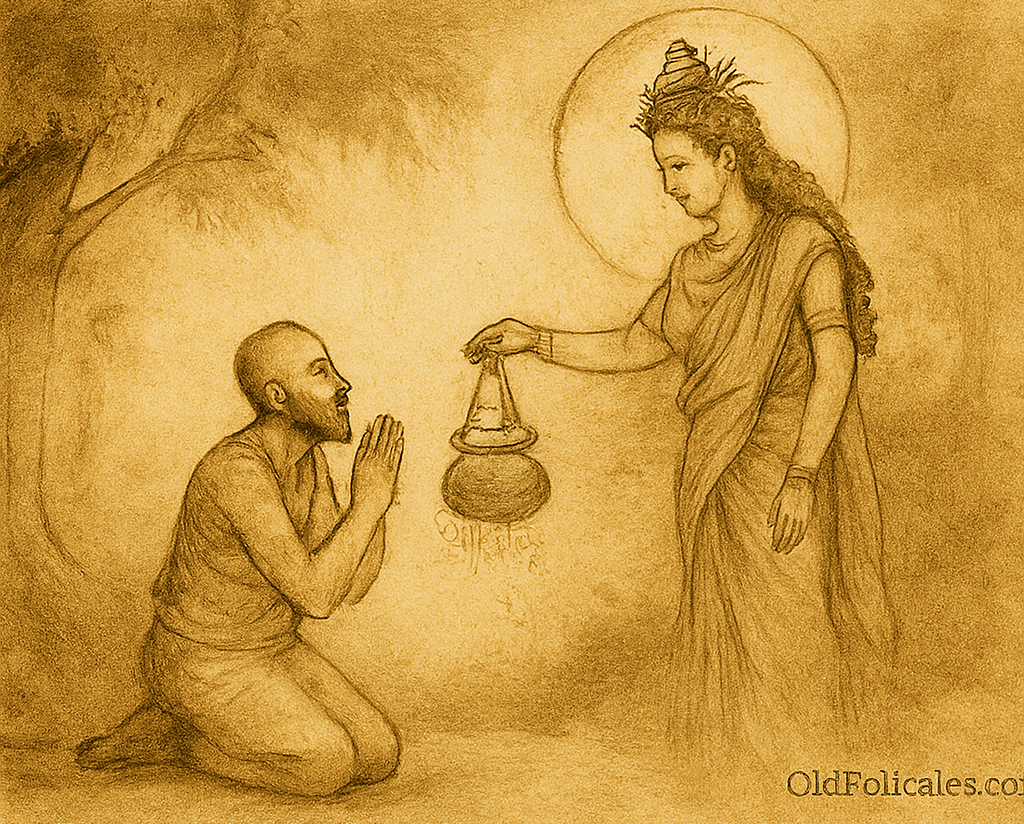
Siva agreed, and with divine will, the miraculous vessel materialized. Durga approached the startled Brahman and placed the handi in his trembling hands. “Your prayers have moved my heart,” she said gently. “This pot will provide unlimited mudki to feed your family and sell for income. But guard it carefully.”
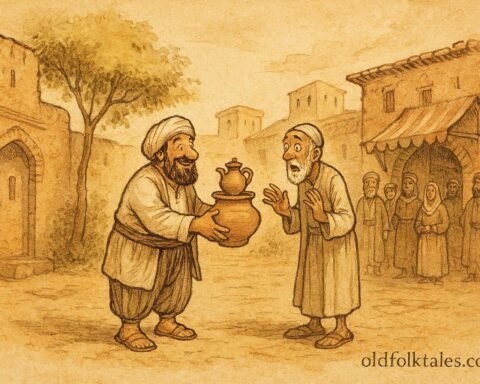
The Brahman’s joy knew no bounds. Clutching his treasure, he hurried homeward, pausing only to test the pot’s power. Sure enough, the finest, whitest mudki he had ever seen cascaded forth like sugared rainfall. But the day had grown hot, and he needed to bathe and pray before eating. Spotting an inn beside a tank of water, he stopped there, entrusting the handi to the innkeeper with urgent pleas for its safekeeping.
The innkeeper’s curiosity burned like fever. Why would a poor Brahman care so deeply about an empty clay pot? When he turned it over during his inspection, mountains of mudki tumbled out endlessly. Greed seized his heart. He quickly substituted an identical pot, hiding the magical one for himself.
When the unsuspecting Brahman returned home and demonstrated his “gift” to his family, nothing fell from the vessel. His wife thought he had lost his mind. The children stared in confusion. Heartbroken, the Brahman realized the deception and returned to confront the innkeeper, who angrily denied everything and drove him away.
Back in the forest, the Brahman prayed once more. Durga appeared again, this time with a different handi. “You lost the first,” she said knowingly. “Here is another. Use it wisely.” But when the Brahman tested this pot, instead of sweets, a horde of fierce demons erupted forth, beating him mercilessly with fists and kicks until he frantically turned the pot upright again.
Understanding dawned this was a weapon against injustice. He returned to the inn, left the demon-pot in the innkeeper’s care, and waited. When the greedy innkeeper opened it expecting more treasures, the demons descended upon him and his family with terrible fury. Only when they begged for mercy did the Brahman restore order, reclaiming his original mudki-handi in the process.
At home, behind locked doors, the Brahman finally demonstrated the true magic to his family. The mudki flowed like rivers of sweetness. They ate until satisfied, filled every container in the house, and the next day opened a shop. The Brahman’s mudki became legendary so perfect, so delicious that customers traveled from distant regions to purchase it. Cartloads sold daily. The family’s fortune grew rapidly. They built a grand brick house and lived with dignity and comfort.
But prosperity brought new dangers. One day, his children accidentally shook the demon-pot, unleashing chaos until their father arrived to stop it. He locked that dangerous handi away in a secure room. Yet fate had more tests in store. During his absence one afternoon, his children fought over who would shake the mudki-pot, and in their struggle, it shattered on the ground.
The Brahman’s grief was overwhelming. No punishment could restore what was lost. Once again, he journeyed to the forest. When Durga appeared, she gave him one final handi with a stern warning: “This is your last chance. If you lose or break this one, I will give you no more.”
This third pot produced sandesa an even more exquisite sweetmeat made of curds and sugar, fit for the gods themselves. The Brahman’s new business flourished beyond imagination. His sandesa became essential at every wedding, every festival, every sacred ceremony throughout the land.
But wealth attracts jealousy. The village Zemindar, a powerful landlord, demanded the Brahman bring the magical pot to his son’s wedding feast. When mountains of sandesa had been produced, the Zemindar seized the handi and expelled the Brahman from his house.
The Brahman’s response was swift and just. He returned with the demon-pot and unleashed its terrible inhabitants upon the Zemindar’s celebration. Demons dragged guests by their hair, beat the mighty Zemindar like a cotton bale, and created such havoc that the house nearly collapsed. Only when the Zemindar prostrated himself, begging forgiveness, did the Brahman show mercy and withdraw the demons.
From that day forward, no one disturbed the Brahman’s peace. He lived many years in happiness with his family, never forgetting the divine grace that had lifted them from poverty, nor the wisdom that had protected their blessings.
Journey through enchanted forests and islands in our Southeast Asian Folktales collection.
The Moral Lesson
This folktale teaches that divine blessings require human wisdom to preserve them. The Brahman’s devotion earned him divine gifts, but only through vigilance, justice, and responsible stewardship could he maintain his prosperity. Greed and carelessness threaten even heaven-sent treasures, while courage and righteous action protect them. True wealth comes not just from receiving gifts, but from the wisdom to guard and use them well.
Knowledge Check
Q1: Who was the Brahman’s tutelary deity and why was this significant?
A: The Brahman worshipped Durga, the consort of Siva and the creative Energy of the Universe. His unwavering devotion to her, demonstrated through daily prayers and writing her name 108 times in red ink, ultimately moved her to compassion and led to her divine intervention in his poverty.
Q2: What do the three handis (pots) symbolize in Bangladeshi folktale tradition?
A: The three magical pots represent divine blessings, divine justice, and final grace. The mudki-handi symbolizes prosperity through devotion, the demon-handi represents the power to punish injustice, and the sandesa-handi represents ultimate blessing tempered with the responsibility of stewardship.
Q3: What lesson does the innkeeper’s theft teach about greed?
A: The innkeeper’s theft demonstrates that greed blinds people to consequences and brings its own punishment. His attempt to steal divine blessings resulted in a demonic beating, showing that ill-gotten gains carry hidden curses and that dishonesty toward the devoted brings swift retribution.
Q4: Why did Durga give the Brahman a demon-filled pot as his second gift?
A: The demon-pot served as an instrument of justice, allowing the Brahman to punish the innkeeper’s theft and later the Zemindar’s greed. It represents the principle that divine power includes both blessing and correction, and that the righteous need tools to defend themselves against exploitation.
Q5: What does the breaking of the first mudki-pot reveal about maintaining blessings?
A: The accidental breaking of the pot by the Brahman’s children teaches that divine gifts require careful guardianship and that carelessness, even without malicious intent, can destroy prosperity. It emphasizes the importance of teaching responsibility to future generations who will inherit blessings.
Q6: How does this folktale reflect Hindu beliefs about devotion and divine intervention?
A: The story embodies core Hindu concepts of bhakti (devotional worship), karma (action and consequence), and the responsive relationship between devotees and deities. It shows that sincere, persistent devotion to the divine can bring tangible help in earthly struggles, while also teaching that spiritual gifts require earthly wisdom to maintain.
Source: Bangladeshi folktale, Bangladesh