In the heart of Yemen, there once lived a devout man known throughout his village for his piety and gentleness. He lived a humble life, sustained only by two precious ewes, which provided him milk enough to satisfy his hunger without relying on others. The man regarded them not merely as livestock but as blessings from God, his sole livelihood and companions in solitude.
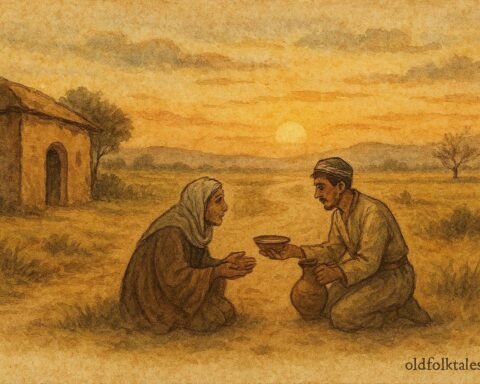
One morning, when the sun had just touched the dunes with gold, the man went to milk his ewes as usual. To his shock, they were gone. He called their familiar names, sounds that usually brought them running, but only silence answered. Desperate, he searched far and wide until his steps led him to a deserted place few people ever visited. There, on the barren ground, lay the heartbreaking remains of his ewes, blood, scattered wool, and traces of slaughter.
His heart trembled with sorrow. Among the signs left behind, he noticed one small but telling clue, the faint imprint of a toe-tip on a flat rock, likely left by the thief. With nothing else to hold onto, he went to the tracker, a man famed for his ability to read the ground as if it were a written page.
The tracker examined the mark carefully, squinting under the morning sun.
“This trace,” he said, “belongs to so-and-so. I know his footsteps well, he is known for such wicked acts.”
The devout man, still heartbroken, asked, “What should I do now?”
The tracker replied, “Go to the king and present your complaint. If he asks for proof, swear that your ewes were stolen and that the thief is the man I’ve named.”
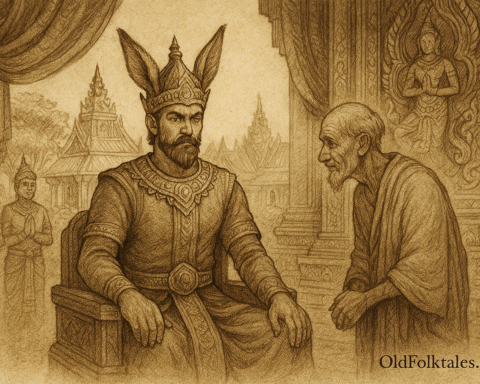
So the poor man went to the king’s court. The ruler, wise and compassionate, welcomed him and asked, “What troubles you, good man? You look heavy with sorrow.”
The man bowed and said, “Your Majesty, my two ewes were stolen and slaughtered by so-and-so. The tracker himself recognised the thief’s footprint.”
The king listened intently. “Do you have evidence?” he asked.
The man swore solemnly to his words, invoking truth before God. Trusting the man’s honesty and the tracker’s skill, the king ordered the accused thief to be brought before him.
He then summoned the princes, sheikhs, and tribal elders to witness what was to come. Once everyone was gathered, and the thief stood among them, the king declared, “Arrest him!”
Before the assembled crowd, the king demanded, “Did you steal and slaughter the ewes of this man?”
The thief’s face turned pale. Caught off guard and ashamed before his people, he confessed his guilt, hoping to soften the king’s anger. The court erupted in murmurs. The king decreed that his hand be cut off, as was the ancient law.
Yet the princes and sheikhs protested, saying, “Your Majesty, this is a sacred place of gathering. Let not blood defile it.”
The king, respecting their request, agreed to delay the punishment. He released the thief temporarily, declaring, “Run, and I shall pursue you. Wherever I overtake you, your punishment shall be carried out.”
The thief fled for his life, sprinting faster than he had ever run. The king mounted his camel and chased him relentlessly through the desert winds. But the thief, driven by fear, outran even the royal steed. Breathless, he stumbled into the king’s palace, where he found the queen alone.
“Mercy!” he begged. “Save me! The king seeks my hand for my crime.”
The queen, moved by his desperation, hid him inside the storeroom, bolting the door. Moments later, the king arrived, his robe dusted with sand and sweat.
“Has a man entered here?” he demanded.
The queen replied calmly, “No, my lord. No one has come.”
The king sighed, lamenting, “The thief has escaped justice!”
When his fury subsided, the queen gently asked what had transpired. The king recounted the tale from the beginning, the theft, the chase, and the near punishment. Then the queen revealed, “The man you seek hides within our storeroom. I saved his life. I beg you, for my sake, spare him.”
But the king shook his head solemnly. “By God, justice must be done.”
The queen, unwilling to yield, summoned the king’s brothers and noblemen. They pleaded alongside her, arguing that mercy would bring greater honour than punishment. “Let him atone through service,” they said, “rather than through loss of limb.”
The king, moved by their wisdom and his wife’s compassion, relented. “So be it,” he declared. “The thief shall serve in my household until his debt is repaid.”
Thus the thief became a servant of the king, labouring faithfully to redeem his wrongdoing. Time passed, and one day the king and his servant went out to gather fodder for the royal animals. Rain began to fall softly as they worked.
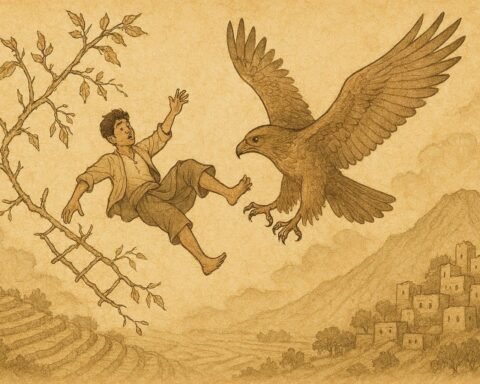
The king ordered the servant to climb a tall tree and cut down branches. But as the man climbed, his feet slipped on the wet bark. “I cannot go higher, my lord,” he cried. The king, determined, took his place and began to climb. Halfway up, he too slipped, and fell straight into the servant’s arms. The servant caught him with all his strength, but the impact caused blood to flow from his nose. He fainted briefly, while the king stood in awe of his loyal act.
When the servant regained consciousness, the king said, “You have saved my life. I see now that your heart has changed.”
The king then proclaimed, “I free you from bondage. You shall no longer bear the mark of your sin. I forgive you before God. As for the man whose ewes you stole, I have repaid him. Go in peace, and never again steal from the poor or the orphan.”
And from that day, the thief lived honestly, his life transformed by the mercy that followed justice.
Moral Lesson
This tale from Yemen teaches that justice must be tempered with compassion. Even the guilty can change when given a chance to redeem themselves, and forgiveness can restore both peace and honour.
Knowledge Check
1. Who were the main characters in The Tracker, the King, and the Thief?
The story features a devout man, a skilled tracker, a wise king, a merciful queen, and a repentant thief.
2. What did the tracker use to identify the thief in the Yemeni folktale?
He identified the thief through the faint trace of a toe-tip left on a rock.
3. How did the king initially plan to punish the thief?
He decreed that the thief’s hand should be cut off according to ancient law.
4. What role did the queen play in The Tracker, the King, and the Thief?
The queen showed mercy by hiding the thief and persuading the king to spare his life.
5. What moral value does this Yemeni folktale teach?
The folktale highlights mercy, repentance, and the power of forgiveness over strict punishment.
6. What is the cultural origin of this folktale?
It originates from Socotra Island, an ancient cultural part of Yemen.
Source: Adapted from the Yemeni folktale “A Tale of the Tracker, the King, and the Thief” in Folk Tales from Socotra (2023), pp. 35–46.
Cultural Origin: Yemen (Socotri Folklore)