In the sunlit lands of Yemen, where mountains meet the sea and the wind carries the scent of frankincense, there once lived a man renowned for his extraordinary skill as a tracker. From the softest prints in the sand to the faintest marks on stone, he could read traces that others would never see. People said he could tell who had passed by, their mood, and even what they carried. His gift was so famous that he became a trusted figure among tribes, called upon to uncover thieves and resolve disputes.
Yet, not all believed in his integrity. Envy and gossip soon surrounded his name. Some whispered that he was a fraud, that he guessed his findings, deceived people for money, or even took part in the crimes he solved. The tracker, though saddened, remained silent and let his work speak for him. But as rumours grew, even the powerful began to question his honesty.
Among those who heard of the tracker was a wise and just king, respected across the land for his fairness and obedience to divine law. When news of the tracker reached his palace, the king felt both admiration and doubt. “Can a man truly see the unseen?” he wondered. “Or are the people merely dazzled by clever talk?”
Determined to uncover the truth, the king resolved to test the man himself, not out of malice, but to ensure justice was served. “If he is honest,” the king said, “I shall honour him before the people. But if he deceives them, he shall answer for his deceit.”
The King’s Test
One bright morning, the king decided to travel beyond the city walls for a walk in the open desert. He took with him several trusted companions, loyal servants, and camels carrying their provisions. They journeyed far until the sun began to fade into crimson light, and there, in the stillness of the sand, they made camp for the night.
As the campfire crackled and the group slept, the king quietly rose. Without waking a soul, he took his own camel, led it a short distance away, and unloaded all the belongings it carried. He hid the luggage behind a cluster of stones and returned silently to camp, lying down as if nothing had happened.
When dawn broke, the desert shimmered in gold. The king looked around and called out in feigned alarm, “My belongings are missing!” His men awoke, startled and confused. The servants searched frantically, yet no one found a trace of theft. Fear filled the air; none wished to face the king’s anger.
Seeing their distress, the king raised his hand. “Bring me the tracker,” he commanded. “Let him prove his skill before us all.”
The Tracker’s Search
When the tracker arrived, he bowed respectfully. “Your Majesty,” he said, “what troubles you?”
“My luggage has been stolen,” the king replied sternly. “They say you are a master of tracing footprints. Show me the truth.”
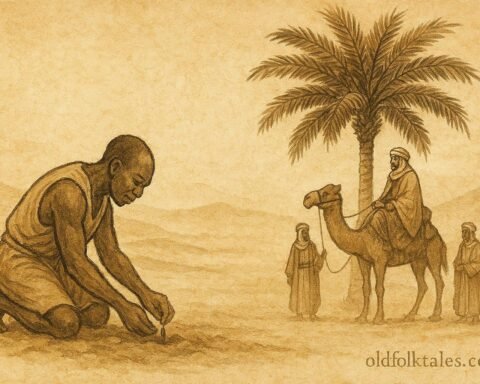
Without hesitation, the tracker began his work. He studied the ground, the sand, and even the stones nearby. His eyes moved with calm precision, reading signs invisible to others. The king followed him silently, curious to see what he would find.
The tracker walked farther from the camp, scanning every surface. At last, his gaze fixed upon a familiar mark on the sand, a print shaped by royal sandals. He traced the line of steps until he reached a pile of stones. There, hidden beneath them, was the missing luggage.
The tracker turned and bowed. “Your Majesty,” he said with quiet confidence, “no human footprints but your own led to this place. It was you who hid the luggage.”
The camp fell into silence. The king looked upon the tracker with astonishment and admiration.
The King’s Judgment
Returning to camp, the king gathered his companions, nobles, and servants. He stood tall before them and spoke with a voice that carried across the plain.
“O people,” he declared, “you all know I summoned this man to test his claim of being a tracker. Many doubted his truthfulness, even I had my doubts. So I tested him myself, hiding my luggage without a witness. And behold! He has uncovered it and spoken the truth without fear or hesitation.”
The king continued, “From this day forward, let it be known that this man is innocent of all rumours. His skill is genuine, his integrity pure. I bear witness before you all that he is truthful in his work, deserving of honour rather than suspicion.”
The people rejoiced, praising both the king’s fairness and the tracker’s honesty. And from that day, the tracker’s name was no longer tarnished by doubt. His reputation spread even farther, a symbol of truth and righteousness in Yemeni tradition.
Moral Lesson
This Yemeni folktale teaches that truth always reveals itself, even when shadowed by envy or suspicion. Honesty and integrity outlast false rumours, while justice shines brightest when guided by wisdom and fairness.
Knowledge Check
1. Who are the main characters in The King and the Wise Tracker?
The story features a wise Yemeni king and a skilled tracker tested for his honesty.
2. What special ability did the tracker possess?
He could read and interpret footprints and traces with remarkable precision.
3. Why did the king decide to test the tracker?
The king wanted to determine whether the tracker’s fame was based on truth or deceit.
4. What did the tracker discover during the test?
He found the king’s hidden luggage and proved that the king himself had concealed it.
5. What is the moral lesson of this Yemeni folktale?
Honesty and integrity triumph over false rumours and deceit.
6. What is the cultural origin of The King and the Wise Tracker?
It originates from Socotra Island, Yemen, part of traditional Yemeni folklore.
Source: Adapted from the Yemeni folktale “A Tale of the King Testing the Tracker” in Folk Tales from Socotra (2023), pp. 47–52.
Cultural Origin: Yemen (Socotri Folklore)