In the old lands of Iraq, where golden deserts met the blue shimmer of the Tigris, there lived a merchant renowned for his honesty and prosperity. He had three daughters, each more beautiful than the next. His eldest was wise and composed, the second gentle and clever, and the youngest, whose eyes shone with curiosity and kindness, was the dearest to his heart.
One day, the merchant prepared for a long journey to trade in faraway lands. As he packed his goods, he called his daughters and asked, “My beloved children, what shall I bring back for you from my travels?”
Discover the wisdom of ancient India and the Silk Road in South & Central Asian Folktales.
The eldest smiled and said, “Father, bring me a robe woven of the finest silk.”
The second requested, “Please bring me a necklace of shining gold.”
But the youngest, after a moment’s thought, said softly, “Bring me clusters-of-pearl.”
The merchant was puzzled. “Clusters-of-pearl?” he repeated. “Child, do you mean pearls from the sea?”
She shook her head. “No, Father. I do not mean jewels. That is the name I heard in a dream, it belongs to a prince.”
The merchant frowned, uneasy, but he could not deny her request. He promised to try and fulfill each of their wishes and departed across the sea.
His journey was long and weary. He found silks of radiant color and necklaces of gold, yet nowhere could he find anything called clusters-of-pearl. Finally, deep in a distant land, an old man stopped him. “I see worry in your face, merchant. What troubles you?”
When the merchant explained, the man smiled knowingly. “Ah, Clusters-of-Pearl is no object of this world. He is a Jānn prince, one of the spirits who dwell between earth and sky. You will find him only if he wishes to be found.”
Guided by the old man, the merchant traveled to a hidden valley shimmering with strange light. There, upon a throne of crystal, sat the Jānn prince. His face was radiant like moonlight, his eyes as calm as still water. The merchant bowed and told him of his daughter’s request.
The prince listened and replied gently, “Tell your daughter that I have heard her heart’s wish. Take this box and give it to her. Within are three hairs, each holds my power. When she uses them with a pure heart, the path between us will open.”
The merchant thanked the prince and journeyed home. His two elder daughters rejoiced over their splendid gifts, but the youngest accepted the small box with quiet wonder. When she opened it, the hairs gleamed like threads of silver. She touched one and whispered, “O Clusters-of-Pearl, reveal yourself.”
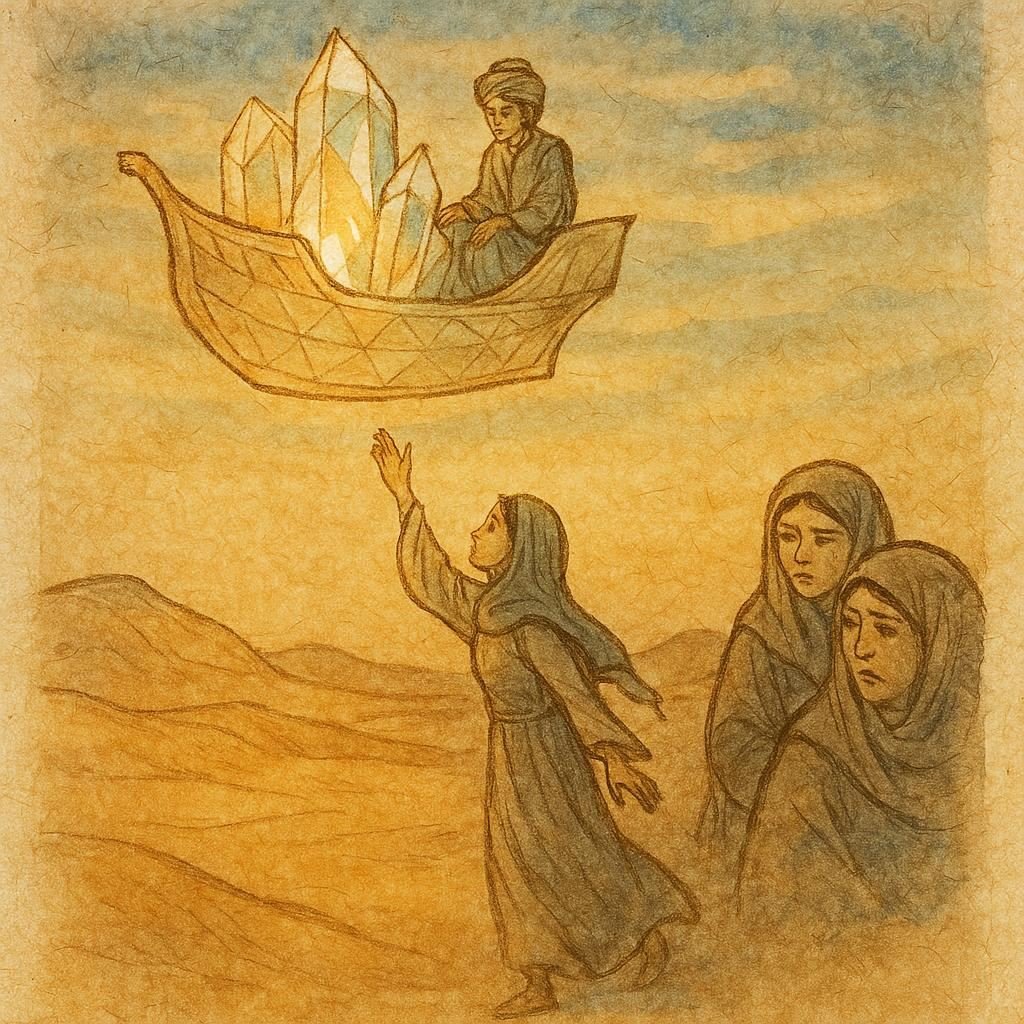
At once, the air shimmered, and from the horizon rose a crystal ship, glowing like morning dew. It floated gracefully above the earth, and within stood the Jānn prince himself, radiant as her dream had promised.
The prince took her aboard, and together they sailed to his kingdom of light. Time passed in joy and peace. But far away, envy grew in the hearts of her elder sisters. They longed for her beauty and her happiness. When the youngest returned home to visit her father, they plotted against her.
“Show us how your magic works,” said the eldest.
“Tell us how the ship comes,” added the second.
Trusting them, the youngest revealed her secret. While she slept, they stole the box, called forth the ship, and sailed away, leaving her alone and heartbroken. When she awoke and found both her sisters and the box gone, she wept bitterly.
But her love for the prince gave her courage. She set out barefoot on a long journey to find him again. Along the way, she met a wise woman who gave her iron shoes and an iron staff. “These will carry you far,” said the woman. “Do not rest until the soles are worn thin.”
The young woman walked across mountains and deserts. She slept under stars and drank from rivers. One dawn, she overheard three birds speaking among the trees. “The prince of the crystal ship lies ill,” said one. “Only the feather of the talking bird and a drop of the phoenix’s blood can heal him.”
Determined, she followed the birds’ words. Through courage and wit, she gathered the magical items and reached the Jānn kingdom once more. There she found the prince pale and near death, deceived by her sisters who claimed to be his true brides. She gently anointed him with the blood and placed the feather upon his chest.
At that moment, the prince stirred, light returning to his face. When his eyes opened, they met hers, and memory flooded back. “It is you,” he whispered. “My true love, Clusters-of-Pearl’s chosen.”
The sisters’ lies were exposed, and the prince banished them. The young woman and the Jānn prince were reunited and lived together in the crystal kingdom, where love and loyalty shone brighter than any gem.
Moral Lesson
This Iraqi folktale teaches lessons on perseverance, loyalty, and the triumph of truth over envy. The youngest daughter’s steadfast heart reminds us that love guided by patience and faith will always overcome betrayal and hardship.
Knowledge Check
1. Who is Clusters-of-Pearl in the story?
He is a Jānn prince who rewards the youngest daughter’s pure heart and faith.
2. Why does the merchant seek the Jānn prince?
To fulfill his youngest daughter’s mysterious request for “clusters-of-pearl.”
3. What is the crystal ship a symbol of?
It symbolizes divine connection, purity, and the spiritual bond between mortal and spirit.
4. How do the elder sisters betray their younger sibling?
They steal her magic box, summon the crystal ship, and leave her behind.
5. What magical items help the heroine on her quest?
Iron shoes, an iron staff, the feather of a talking bird, and phoenix’s blood.
6. What cultural lesson does this folktale highlight?
It reflects the Middle Eastern values of loyalty, endurance, and the victory of goodness over jealousy.
Source & Origin
Source: From Drower’s Folk-Tales of Iraq, collected 1930s by Lady E. S. Drower, edited by Jorunn Buckley.
Published by De Gruyter Brill.
Origin: Tale originates from oral storytellers among Iraqi communities (Arab and minority groups) in the mid-20th century.