In the ancient city of Basra, where the Tigris River shimmered under the desert sun and traders from faraway lands filled the bazaars with scents of spice and gold, there lived a young man named Hasan. Though born with little, Hasan possessed sharp eyes, steady hands, and a pure heart. He worked as an apprentice to a skilled Jewish jeweler who recognized Hasan’s honesty and craftsmanship.
One season, the jeweler told Hasan they must journey far across the deserts to a mountain famed for its hidden treasures. Trusting his master, Hasan agreed, unaware that this trip would change his life forever.
Journey through enchanted forests and islands in our Southeast Asian Folktales collection.
When they reached the mountain, the jeweler gave Hasan a strange task. “Take this sheepskin,” he said, “and wrap yourself inside it. When the eagles descend, they will lift you to the mountain’s summit. Once there, gather the shining stones and throw them down to me, but beware, do not speak a word.”
Hasan obeyed. Wrapped in the skin, he felt powerful wings seize him and lift him skyward. The mountain air grew thin, and the earth fell away below. When the eagle dropped him upon the peak, he gathered the glittering stones that sparkled like frozen stars. But when he called out to his master for help, the jeweler did not reply. Realizing he had been betrayed, Hasan was left stranded, alone on the mountain.
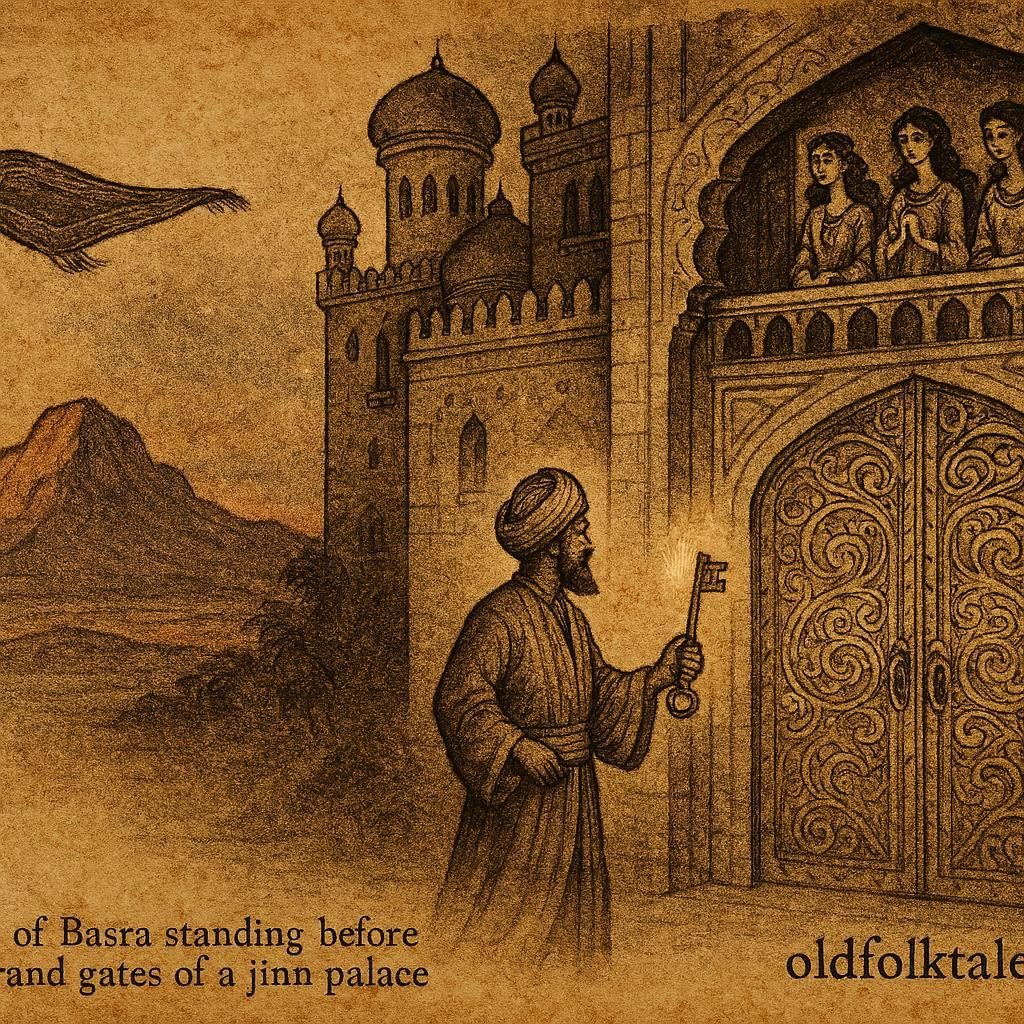
For days he wandered, surviving on spring water and wild fruit. One night, as moonlight washed the rocks silver, Hasan saw a gleaming doorway appear in the mountain’s side. Beyond it was a vast underground palace, glowing with lanterns of crystal and gold. Three beautiful maidens, daughters of the jinn, welcomed him warmly.
“You are safe here,” the eldest said. “We serve the King of the Jinn. You may live with us in peace, but heed our rule: you may enter all the rooms of this palace except one. That door is forbidden.”
Hasan agreed, and for a time, he lived joyfully. He explored chambers filled with jewels, gardens blooming with silver leaves, and fountains that sang like flutes. Yet curiosity soon gnawed at his heart.
One day, unable to resist, Hasan opened the forbidden door. Inside was a magnificent garden under a dome of glass. A radiant maiden stood beside a crystal lake, her eyes deep as the night sky. She looked upon Hasan with sorrow and wonder. “You should not have come,” she whispered. “But since you have seen me, your fate is bound to mine.” Before Hasan could speak, a storm rose. The door slammed shut, and the jinn palace vanished.
Cast out into the desert once more, Hasan carried only a few enchanted objects left by the maidens: a flying carpet, a staff, and a ring of power. With these, he began his long journey through lands of danger and deceit. He used the flying carpet to cross scorching sands and raging seas, the staff to defend himself from monsters, and the ring to summon help when all seemed lost.
In time, Hasan’s courage and cleverness won him respect. He defeated his enemies, exposed those who had wronged him, and used his magical gifts to help the weak and poor. Yet his heart remained restless, for he longed to find the maiden of the crystal garden once more. Guided by dreams and divine signs, he finally reached her kingdom.
There, Hasan faced trials of fire, water, and wind set by the jinn king himself. But through faith, humility, and the strength of his spirit, he prevailed. The king, moved by Hasan’s endurance, allowed him to wed the maiden. Together, they ruled wisely, uniting the realms of men and jinn in harmony and peace.
Explore desert legends and palace tales in our Western Asian Folktales archive.
Moral Lesson
The story of Hasan of Basra reminds us that curiosity without wisdom leads to hardship, yet patience, courage, and faith can turn misfortune into destiny fulfilled. Obedience to guidance and humility before mystery are keys to both earthly and spiritual success.
Knowledge Check
1. Who was Hasan’s master at the beginning of the story?
He was a Jewish jeweler who employed Hasan as his apprentice.
2. What trick did the jeweler use to trap Hasan on the mountain?
He made Hasan enter a sheepskin to be carried up by eagles, then abandoned him after receiving the jewels.
3. Who rescued Hasan after he was stranded?
Three jinn maidens took him into their palace and offered him safety under one condition.
4. What was the forbidden act that changed Hasan’s fate?
He opened a door he was told not to enter and saw a mysterious maiden tied to his destiny.
5. What magical items did Hasan use on his journey?
He used a flying carpet, a magical staff, and a ring of power left by the jinn maidens.
6. What moral does Hasan’s story teach?
The importance of obedience, patience, and humility when facing temptation, and that courage leads to redemption.
Source & Origin
Source ; Adapted from Drower’s Folk-Tales of Iraq (collected by Lady E. S. Drower, edited by Jorunn Buckley), published by De Gruyter Brill.
Origin: Oral tradition collected in Iraq in the 1930s; multi-ethnic communities.