In a remote village tucked away in the mountain valleys of Bhutan, where mist clung to the hillsides like silver scarves and the roar of rivers echoed through the gorges, there lived an orphan boy named Daw Butshu. He had no mother to cook his meals, no father to protect him, no family to shelter him from the cold mountain nights. His clothes were ragged and patched, his small house barely more than a lean-to with a thatched roof that leaked when it rained.
But Daw Butshu was a survivor. Every day, he would take his simple fishing hook, fashioned from a bent piece of metal and tied to a length of string, and make his way down to the rushing river that cut through the valley. There, among the smooth stones and swirling pools, he would catch fish, enough to fill his belly and keep him alive for another day. The fish were his lifeline, his only reliable source of food in a world that had shown him little kindness.
Click to read all Southeast Asian Folktales — featuring legends from Thailand, Indonesia, Vietnam, and the Philippines.
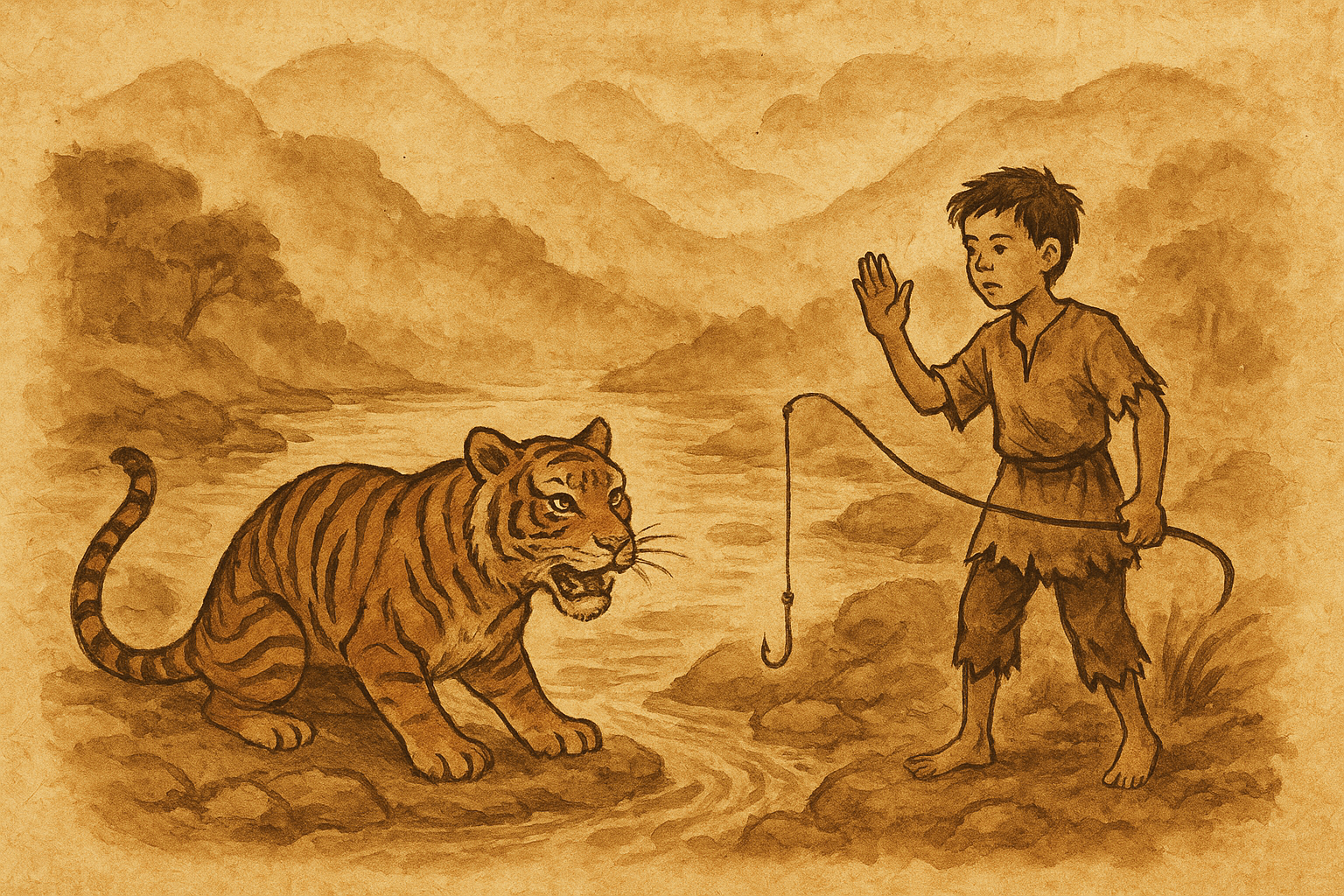
One morning, as the sun rose over the jagged peaks and painted the sky in shades of pink and gold, Daw Butshu arrived at his usual fishing spot by the river. But something was different today. Standing at the water’s edge, massive and terrifying, was a tiger. The great beast’s orange and black striped coat rippled with muscle, its yellow eyes gleamed with predatory intelligence, and its enormous paws rested on the rocks as it lapped water from the river with its rough pink tongue.
Daw Butshu’s heart nearly stopped. He froze in place, every instinct screaming at him to run, but he knew that running from a tiger was the surest way to trigger its hunting instinct. He stood perfectly still, his small body trembling like a leaf in the wind.
The tiger lifted its great head and fixed its penetrating gaze on the boy. “What are you doing here, little human?” the tiger asked in a deep, rumbling voice that seemed to vibrate through the very ground.
“I… I came to catch some fish, great king of the jungle,” Daw Butshu replied, his voice barely above a whisper, his throat tight with fear.
“Fish?” The tiger’s ears pricked forward with interest. “What are you going to do with these fish?”
“I eat them, mighty one,” the boy explained, trying to keep his voice steady. “I survive on fish. They are the most delicious food one can ever eat. Their flesh is sweet and tender, and when cooked over a fire, nothing in this world tastes better.”
The tiger’s eyes widened with fascination. In all its years prowling the forests and mountains, it had never thought to try eating fish. It hunted deer and wild pigs, monkeys and birds, but fish? The idea intrigued the great predator.
“Can I use your fishing hook to catch some fish?” the tiger asked, moving closer to the boy. “I want to try it myself. I want to taste this delicious food you speak of.”
Daw Butshu clutched his fishing gear protectively. The hook was his most precious possession, his only means of survival. Without it, he would starve. “Great tiger, I need this hook. It’s all I have. Please, I cannot give it to you.”
The tiger’s expression darkened. Its lips curled back, revealing rows of sharp, gleaming teeth. A low growl rumbled from deep in its chest. “Give me the hook, boy, or I will eat you instead of fish.”
Terrified, knowing he had no choice, Daw Butshu held out his precious fishing hook with shaking hands. The tiger snatched it with its massive paw, and the boy immediately turned and ran, his feet flying over the rocky path back toward his village, not stopping until he reached the safety of his small house where he bolted the door and collapsed against it, gasping for breath.
Meanwhile, the tiger positioned itself on a large rock jutting out over the river. It dangled the fishing line into the water and waited. And waited. And waited. Hours passed. The sun climbed high in the sky and began its descent toward the western peaks. The tiger’s tail twitched with impatience. Fish swam past the hook, darting this way and that, but none took the bait. The tiger had no understanding of patience, of stillness, of the subtle art of fishing.
As the day wore on, exhaustion crept over the great beast. Its eyes grew heavy. Its powerful body grew weary from standing so still for so long. Finally, overcome by fatigue, the tiger lost its balance and tumbled headfirst into the rushing river with an enormous splash.
The cold water shocked the tiger awake. It thrashed and spluttered, finally managing to pull itself onto the bank, soaking wet and furious. “That wretched boy fooled me!” the tiger roared, water streaming from its fur. “He made a fool of the king of the jungle! I will find him and tear him to pieces!”
The next day, the tiger prowled through the forest, searching for the orphan boy with murder in its heart. As it padded along a narrow trail, it spotted a figure ahead. There was a boy extracting gum from the trunk of a tree, using a small knife to make cuts in the bark and collecting the sticky sap that oozed out.
“You!” the tiger roared, bounding forward. “You deceived me! I almost drowned in that cursed river, forget about catching any fish!”
But the boy turned and looked at the tiger with innocent, confused eyes. “Oh, mighty king of the jungle,” he said respectfully, bowing low. “I think you have mistaken me for someone else. The boy you met at the river must have been Gang Dawla. I am a different person entirely. My name is Pin Dawla.”
The tiger paused, studying the boy’s face. Could it be that this was a different child? They all looked so similar, these human cubs. The tiger’s anger cooled slightly, replaced by embarrassment.
“I apologize for my mistake,” the tiger said gruffly. “But what are you doing here with that tree?”
“I am extracting this sacred gum,” Pin Dawla explained, holding up a small ball of sticky resin that gleamed golden in the dappled sunlight. “This is no ordinary tree sap, great tiger. With this gum, one can visit heaven without having to die. Imagine that! To see the celestial realms while still alive!”
The tiger’s eyes grew wide with wonder. “Truly? One can go to heaven with that substance?”
“Yes, indeed,” the boy confirmed solemnly. “Would you like to try it?”
“Very much so!” the tiger replied eagerly, all thoughts of revenge forgotten in the face of this extraordinary opportunity.
“The method is simple,” the boy explained carefully. “Tonight, before you sleep, apply this gum thoroughly around your eyes and mouth. Seal them completely. Then go to sleep, and when you wake in the morning, you will find yourself in heaven itself.”
The tiger took the gum carefully in its great paw and thanked the boy profusely before bounding away to its den. That night, following the instructions exactly, the tiger smeared the sticky gum all over its eyes and around its mouth until they were completely sealed shut. Then it lay down and fell into a deep sleep, dreaming of celestial palaces and divine gardens.
When morning came, the tiger tried to open its eyes. They would not budge. The gum had hardened overnight, gluing its eyelids firmly together. The tiger tried to open its mouth to roar. It was sealed shut. Panic seized the great beast. It clawed at its face, rubbed against rocks and tree trunks, rolled in the dirt. For a long, terrifying time, it struggled in total darkness, unable to see or speak.
Finally, after what seemed like hours, the gum began to give way. The tiger managed to pry its eyes open and work its jaw free. There was no heaven, no celestial realm. It was still in its ordinary den, its face sticky and sore, feeling utterly humiliated.
“That cursed boy!” the tiger roared with renewed fury. “He has made a fool of me twice! This time, I will not be deceived. I will hunt him down and devour him!”
The tiger raced through the forest, following scent trails, searching high and low. Far up on the mountainside, near a rocky cliff face dotted with caves, the tiger finally spotted him. The boy was standing near what appeared to be a large, hollow drum hanging from a tree branch, and nearby was a beehive, golden honey dripping from its entrance.
“Now I have you!” the tiger roared, charging forward. “I am really going to kill you this time! You almost made me go blind, forget about visiting heaven!”
But the boy looked at the tiger with wide, innocent eyes. “Come now, mighty king of the jungle,” he said calmly. “The one you met before must have been Pin Dawla. I am Phacho-Dawla, and I have never seen you before in my life.”
The tiger skidded to a halt, confusion clouding its rage. Again? Was this yet another boy?
“I am so sorry,” the tiger said, suddenly uncertain. “I seem to keep mistaking different boys for each other. Please forgive me.”
“Of course, great tiger,” the boy said graciously. “What brings you to this remote place?”
“I was searching for someone, but clearly I was mistaken,” the tiger replied. Then, curiosity getting the better of it once more, it asked, “But what are you doing here with that drum?”
Phacho-Dawla gestured to the object hanging from the tree. “This is a magic drum. When I am hungry, I simply beat this drum, and all kinds of delicious food appear from within it. Rice, vegetables, meat, sweets, everything I could desire simply materializes. I never go hungry.”
The tiger’s mouth watered at the thought. “That sounds incredible! May I try it? Just once?”
The boy hesitated, then nodded. “Very well. But you must beat it strongly and rhythmically. The magic only works if you strike it with great force.”
“Thank you! Thank you!” the tiger said eagerly, and the boy backed away, disappearing into the forest.
The next morning, the tiger returned to the spot, stood beneath the hanging “drum,” and began to beat it with its powerful paws. Thump! Thump! Thump! The sound echoed across the mountainside.
Suddenly, the air filled with an angry buzzing sound. The “drum” was not a drum at all, but the beehive! Thousands of furious bees poured out of their disturbed home, swarming around the tiger in a black, writhing cloud. They covered every inch of the tiger’s body, stinging its face, its ears, its nose, even getting into its mouth and under its eyelids.
The tiger roared in agony and fled, crashing through the underbrush, rolling on the ground, diving into streams, doing anything to escape the relentless attack of the bees. By the time the swarm finally dispersed, the tiger was swollen and covered in painful welts, barely recognizable beneath all the stings.
“That boy!” the tiger snarled through swollen lips. “No more! This ends today! I will find him and finish this once and for all!”
Driven by fury and wounded pride, the tiger hunted with single-minded determination. Finally, it spotted the boy near a tall cliff, surrounded by five large woven baskets arranged in a circle around him.
“I will not leave you today!” the tiger roared, advancing with deadly purpose. “Those bees almost killed me, forget about getting any food!”
The boy looked up calmly and spoke in a respectful but firm tone. “Great tiger, you are by far the wisest animal in the entire animal kingdom. Surely, with your intelligence and experience, you should be wise enough to recognize different people. The one you met before must have been Phacho-Dawla. I am Brokpa Dawla, and I have five countries to look after.”
He gestured to the five baskets around him. “Each of these baskets contains one of my kingdoms. Inside each one live thousands of my subjects, warriors and farmers, women and children. If you kill me, their king and protector, my people might wage terrible wars on you. Do you think you, even as mighty as you are, can fight back against five kingdoms full of warriors armed with spears and arrows?”
The tiger stopped, suddenly uncertain. Five kingdoms? Thousands of warriors? The tiger had encountered human hunters before and knew how dangerous they could be with their weapons.
“I… I apologize again,” the tiger said, its voice less certain now. “I seem to keep making mistakes.”
“Indeed you do,” the boy said sternly. Then his expression softened slightly. “But perhaps we can come to an arrangement. You seem lonely, great tiger. Would you like to join one of my kingdoms? You could be one of my subjects.”
“Which basket would I be in?” the tiger asked cautiously.
“Well, I cannot simply give you a basket to rule. My people would never accept that,” the boy explained. “But you could serve under me. I would put you in one of these baskets, and you would be part of my kingdom. You would have a home, a purpose, a place where you belong.”
The tiger, tired and confused, worn down by three days of humiliation and pain, found this oddly appealing. To belong somewhere, to have a purpose, even if it meant serving this boy…
“Very well,” the tiger agreed. “I will join your kingdom.”
“Excellent!” the boy said with a smile. “Come, step into this basket here.”
The tiger climbed into the large basket, and the boy quickly secured the lid, weaving it shut with strong ropes. Then, with effort, he began to drag the heavy basket toward the edge of the tall cliff.
“Where are we going?” the tiger called from inside.
“I am taking you to meet your fellow subjects,” the boy replied. “They live down in the valley below.”
When they reached the cliff’s edge, the boy positioned the basket right at the precipice. Then, with all his strength, he pushed.
The basket tipped over the edge and plummeted down, down, down through the air, tumbling end over end. The tiger’s roars of confusion turned to screams of terror as it fell. The basket struck the rocky ground far below with a tremendous crash.
When the dust settled, the basket lay shattered among the stones, and the king of the jungle was no more, his broken body scattered among the debris.
Daw Butshu stood at the top of the cliff, looking down at the scene far below. He had survived through cleverness and quick thinking, using the tiger’s greed and gullibility against it. The orphan boy had defeated the mighty predator not with strength, but with wit.
He gathered his remaining baskets and walked back toward his village, free at last from the threat that had haunted him. That night, he returned to the river with his fishing hook, which he had hidden safely away, and caught his dinner in peace, knowing that he would live to see many more sunrises over the mountains of Bhutan.
Journey through enchanted forests and islands in our Southeast Asian Folktales collection.
The Moral Lesson
This clever tale teaches us that intelligence and quick thinking can overcome even the greatest physical strength. Daw Butshu, though small, poor, and powerless, survived and ultimately defeated a mighty tiger through his wit, creativity, and ability to think on his feet. The story reminds us that greed and gullibility are dangerous weaknesses, even for the strong, and that believing something simply because we want it to be true can lead to our downfall. Most importantly, it shows that the truly powerful are not those with physical might, but those who can adapt, improvise, and outsmart their adversaries.
Knowledge Check
Q1: Who is Daw Butshu and why does he live such a difficult life?
A: Daw Butshu is an orphan boy living alone in a remote Bhutanese village with no family to support him. He survives by catching fish from the river using a simple fishing hook, living in poverty with barely enough to eat each day. His difficult circumstances force him to develop cleverness and resourcefulness to survive.
Q2: What different names does Daw Butshu use to fool the tiger?
A: Daw Butshu uses four different names to convince the tiger he is meeting different boys each time: Gang Dawla (the fisherman at the river), Pin Dawla (the gum collector), Phacho-Dawla (the drum keeper), and finally Brokpa Dawla (the ruler of five kingdoms). Each false identity allows him to trick the tiger again without the tiger realizing it’s the same boy.
Q3: How did the fishing trick work on the tiger in this Bhutanese folktale?
A: Daw Butshu convinced the tiger that fish were delicious, making the tiger curious to try fishing. When the tiger demanded the fishing hook, the boy gave it up and fled. The tiger, having no understanding of the patience and skill required for fishing, stood exhausted all day catching nothing and eventually fell into the river, teaching it nothing while allowing the boy to escape.
Q4: What was the purpose of the tree gum trick?
A: The boy told the tiger that tree gum could take one to heaven without dying. He instructed the tiger to seal its eyes and mouth with the sticky gum before sleeping. When the gum hardened overnight, the tiger’s eyes were glued shut and its mouth sealed, leaving it temporarily blind and panicked. This humiliated the tiger and bought the boy more time.
Q5: How did Daw Butshu finally defeat the tiger?
A: In the final encounter, Daw Butshu convinced the tiger that he ruled five kingdoms kept in baskets and that killing him would bring the wrath of thousands of warriors. He offered to let the tiger join his kingdom by getting into a basket. Once the tiger was secured inside, the boy carried the basket to a cliff edge and pushed it over, killing the tiger in the fall.
Q6: What cultural and survival themes from Bhutan are present in this folktale?
A: The story reflects several Bhutanese cultural elements including the harsh mountain environment where orphans must rely on resourcefulness to survive, the reverence for tigers as “kings of the jungle” in Himalayan folklore, the importance of wit over strength in Buddhist wisdom traditions, the use of natural resources (fishing, tree gum, beehives), and the value placed on cleverness and adaptability in challenging mountain life. The tale also emphasizes that intelligence and quick thinking are survival skills as important as physical strength.
Source: Bhutanese folktale, Bhutan
Alternative SEO-Friendly Titles:
- “Daw Butshu and the Foolish Tiger – Bhutanese Folktale”
- “The Clever Orphan’s Tricks – Bhutanese Folktale”
- “How a Boy Outwitted a Tiger – Bhutanese Folktale”