Under the burning sun of the Kuwaiti desert, where golden dunes stretched endlessly into the horizon, there lived a humble family on the outskirts of a small Bedouin settlement. Each morning, their youngest daughter, a gentle and brave girl, would walk to the nearest well to fetch water for her family. She was loved for her kindness and modesty, and her laughter brought joy to the quiet desert camp.
One fateful afternoon, as she filled her jar, a fierce sandstorm swept across the plains. The winds howled like angry spirits, swirling sand into her eyes until she could no longer see the path home. Lost and afraid, she wandered for hours, her small footprints fading in the shifting sands.
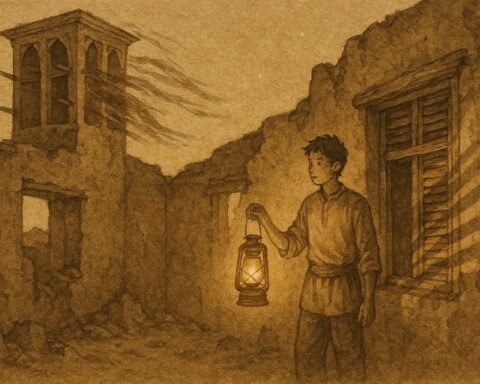
When the storm passed, the desert grew silent again, vast, empty, and endless. As twilight fell, she saw a dim light flickering in the distance. Desperate for shelter, she followed it until she came upon a strange house built of sun-bleached stones. Smoke curled from a crooked chimney, and the air smelled of roasted meat.
Gathering her courage, the girl knocked softly at the door. It creaked open by itself. Inside stood an ogress, a monstrous ghoula, towering and terrible, with a single glaring eye in the middle of her forehead. Her long hair hung in tangled ropes, and her teeth were sharp as desert thorns.
“What brings you here, child?” the ogress growled, her voice deep as thunder.
The girl trembled but spoke politely. “I lost my way in the storm, Mother. Please, give me shelter for the night.”
The ogress laughed, a sound like grinding stones. “You shall stay, but only if you serve me. Refuse, and I will eat you before dawn.”
Fearing for her life, the girl agreed. From that night on, she became the ogress’s servant.
The ogress was cruel and cunning. To amuse herself, she gave the girl three impossible tasks.
On the first morning, she placed a heap of sand before her. “Grind this into flour by nightfall,” she commanded, “or you’ll be my supper!”
The girl wept silently, her tears falling onto the lifeless grains. As she cried, a white dove flew down from the open window and perched beside her. “Do not weep, kind one,” cooed the dove. “You have done no wrong. Rest, and I will help you.”
By sunset, the pile of sand had miraculously turned to flour. When the ogress returned, she frowned, muttering, “Hmm… perhaps luck favours you.”
The next morning, the ogress handed her a sieve and a clay pot. “Fetch water from the well,” she sneered. “If you return empty, you know what will happen.”
The girl tried, but the water slipped through the holes faster than she could move. Again she cried, and again the dove appeared. “Smear the holes with clay and ashes,” it whispered. She did so, and to her wonder, the sieve held the water perfectly.
When the ogress saw the pot full of water, her single eye widened. “You are a clever one,” she hissed. “But let us see how you fare tomorrow.”
On the third day, the ogress handed her a thorny branch. “Comb my hair with this,” she commanded. “Do it gently, if I feel pain, I shall eat you whole.”
The girl’s hands trembled as she began. The sharp thorns tore her fingers, but she moved carefully, humming softly to soothe the monster. The lullaby worked, the ogress’s eyelid grew heavy, and soon she fell into a deep, snoring sleep.
Seizing her chance, the girl noticed a small key hanging from the ogress’s neck. She slipped it off gently and crept toward a locked chest in the corner of the room. Inside gleamed gold coins, pearls, and precious ornaments, the plunder of travellers the ogress had devoured.
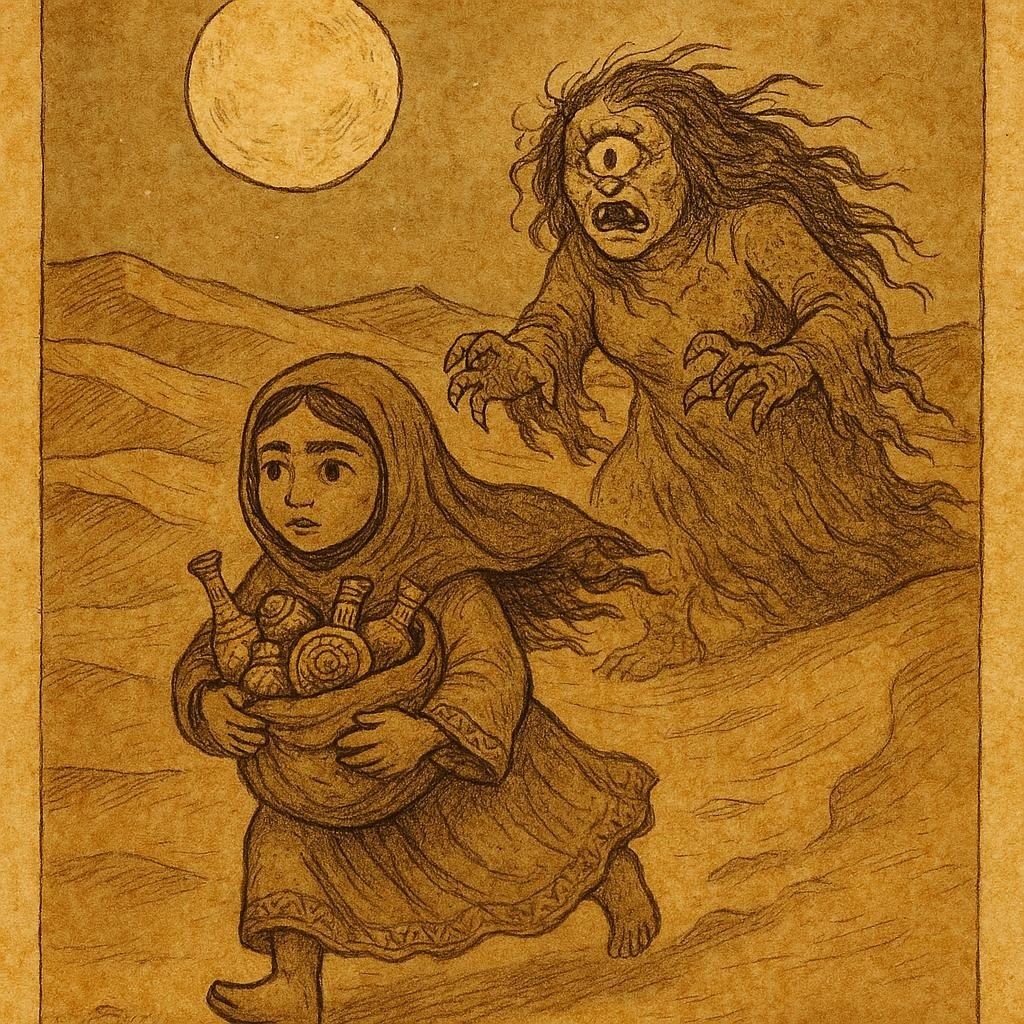
The girl took only what she could carry and fled into the night. The moon shone bright over the dunes, lighting her path home.
But the ogress awoke and, realising her loss, let out a roar that shook the desert. She charged after the girl, her long hair whipping wildly behind her. “Stop, thief!” she bellowed, “You cannot escape me!”
The girl ran faster, clutching her bundle of treasures, praying to reach her village. But fate favoured the brave: as the ogress ran, her tangled hair caught beneath her feet. She stumbled, tripped, and tumbled down a dune, her cries echoing until the desert swallowed her whole.
At dawn, the girl finally reached her family’s tent. When she showed them the treasures, they wept with joy, not for the gold, but for her safe return. From that day on, the story of Bint el-Ghoula was told across the Kuwaiti deserts as a reminder that courage and cleverness can defeat even the darkest evil.
Moral Lesson
Courage, intelligence, and faith in the face of fear can overcome any hardship. True strength lies not in power, but in wisdom and bravery.
Knowledge Check
1. What is the main lesson in The Girl and the Ogre Kuwaiti folktale?
It teaches that courage and clever thinking can overcome cruelty and danger.
2. Who helps the girl complete her tasks in the story?
A compassionate dove assists her with wisdom and kindness.
3. What impossible tasks does the ogress give the girl?
Grinding sand into flour, fetching water with a sieve, and combing hair with a thorny branch.
4. How does the girl escape from the ogress?
She steals the key to a chest of treasures while the ogress sleeps and flees into the desert.
5. What happens to the ogress at the end of the story?
She trips over her own tangled hair and dies in the desert dunes.
6. What cultural value does this folktale reflect?
It reflects Bedouin respect for courage, cleverness, and survival in the harsh desert environment.
Source: Adapted from the Kuwaiti folktale “The Girl and the Ogre” in Folktales from the Arabian Peninsula (Taibah & MacDonald, 2016).
Cultural Origin: Kuwait (Bedouin folklore).