In the golden sands of southern Kuwait, where palm trees swayed gently in the desert wind and tents of woven wool dotted the horizon, there lived an old widow known for her patience and quiet dignity. Her husband had passed away many years before, leaving her with little more than a spindle, a few sheep, and her sharp wisdom, which had guided her through life’s many storms.
Each day, she sat by her small clay house, spinning wool under the shade of a date palm. Her neighbours respected her, for she spoke little but always spoke wisely. Her name was Um Saad, though in time, she would earn another name, Um al-Hikma, meaning Mother of Wisdom.
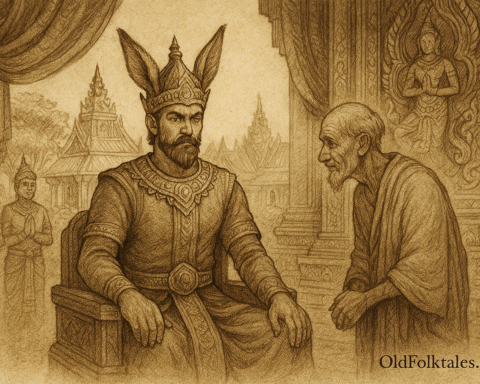
One spring morning, news spread through the village that the Emir himself was travelling through the desert to inspect his lands. The villagers bustled about, cleaning their courtyards and setting up tents to welcome their ruler. When the Emir arrived with his retinue of guards and camels adorned in gold-embroidered saddles, he brought with him not only gifts but also a challenge.
The Emir was known across the region for his love of riddles. Wherever he travelled, he tested the wit of his people, believing that wisdom, not wealth, was the true measure of greatness. Standing before the gathered villagers, he declared, “I shall give a bag of gold to the one who can answer my riddle. But beware, it is not an easy one.”
He raised his hand and spoke clearly, his voice carrying over the desert breeze:
“What walks without feet, speaks without a tongue, and dies without sickness?”
The people murmured among themselves. Some said it must be the wind; others guessed it was the shadow, the river, or the flame. Yet none of their answers satisfied the Emir. He shook his head, smiling slightly, and said, “Think carefully. Wisdom lies hidden in simple things.”
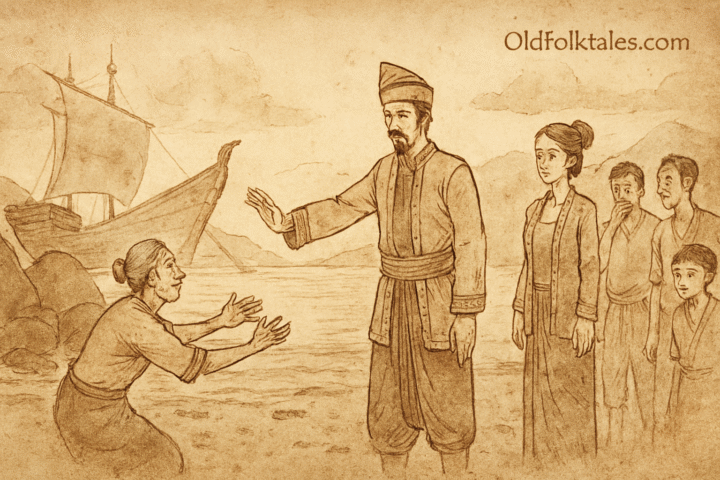
Hours passed, and still no one could solve the riddle. The villagers grew silent, ashamed. It was then that the old widow stepped forward, her face weathered by years of sun and sorrow, but her eyes bright as stars.
She bowed respectfully and said, “My lord, may I speak?”
The Emir nodded, intrigued. Few dared to address him directly, and even fewer dared to challenge his intellect.
Calmly, she said, “The answer to your riddle is the echo. It walks without feet when your words travel across the air; it speaks without a tongue when it answers your voice; and it dies without sickness when silence falls.”
A hush swept through the crowd. Then, the Emir threw back his head and laughed, a deep, genuine laugh that echoed through the dunes. “By the grace of the Almighty,” he exclaimed, “the old woman has answered truly! Wisdom is not found in crowns but in minds, even those wrapped in the cloth of age.”
He ordered that she be brought forward and presented her with a bag of gold coins, a reward worthy of her cleverness. The crowd erupted in cheers, praising her insight. But the widow, humble as ever, bowed and said, “My lord, wisdom is a gift to be shared, not sold. I shall use your gold to feed the poor.”
The Emir’s respect for her grew even greater. “You are more than a wise woman,” he said. “You are Um al-Hikma, the Mother of Wisdom. From this day forward, your words shall be remembered in my court.”
And so it was. From that day onward, people from distant villages came to seek her counsel. Merchants, travellers, and even the Emir’s advisors visited her small home, where she continued to spin wool as she spoke of life, patience, and humility.
Her fame spread across the land, not because she sought honour, but because true wisdom shines even in the humblest hearts.
When she grew old and passed away, the Emir himself ordered that her story be told to every child in the land, a tale to remind generations that wisdom is greater than gold and that knowledge and humility walk hand in hand.
Moral Lesson
True wisdom does not come from wealth or youth but from experience, reflection, and a humble heart.
Knowledge Check
1. What is the main lesson of The Clever Old Woman and the Emir Kuwaiti folktale?
The tale teaches that wisdom and humility are far more valuable than riches or status.
2. What riddle does the Emir ask the villagers to solve?
He asks, “What walks without feet, speaks without a tongue, and dies without sickness?”
3. What is the correct answer to the Emir’s riddle?
The answer is “the echo.”
4. How does the Emir reward the old woman for her wisdom?
He gives her a bag of gold coins and honours her with the title “Um al-Hikma” — Mother of Wisdom.
5. What virtue does the old widow display after receiving her reward?
She chooses to use the gold to help the poor, showing humility and generosity.
6. What cultural value does this Kuwaiti folktale reflect?
It reflects the deep Arabian respect for intelligence, modesty, and wisdom in elders.
Source: Adapted from the Kuwaiti folktale “The Clever Old Woman and the Emir” in Folktales from the Arabian Peninsula (Taibah & MacDonald, 2016).
Cultural Origin: Kuwait (Bedouin folklore, Southern region).