In the ancient lands of Syria, where desert winds carried stories from village to village and caravans crossed long stretches of gold-colored earth, there lived a young prince known for his beauty, education, and skill. Yet, for all his gifts, he carried a shadow of pride, an arrogance that came from being groomed since childhood to inherit power. Those around him admired his potential, but many whispered that he lacked the humility necessary for true leadership.
One day, while traveling beyond the palace walls, the prince rode ahead of his companions, eager to prove his bravery and mastery of the terrain. The noon sun shimmered upon the stones, hiding cracks and crevices in the earth. Without warning, the ground beneath his horse crumbled. The prince plunged downward into a deep pit, dark, jagged, and impossible to climb.
His shouts echoed upward, but no one heard. The world above continued undisturbed, while the prince lay bruised, frightened, and alone at the bottom of the pit. Days passed. Hunger gnawed at him. His fine clothes grew torn, and dust clung to his face. Stripped of status, he had nothing but his wit to sustain him.
Then, on the fourth morning, a shepherd boy wandering nearby heard a faint cry. He approached the pit cautiously and peered down to see the prince—a figure he recognized by the royal crest embroidered upon the young man’s tattered sleeve. The shepherd boy was poor, his clothes patched, and his sandals worn, but his heart was kind. He called out, “My lord, how did you come to be here?”
Ashamed to admit his recklessness, yet desperate for help, the prince replied simply, “I have fallen. Please help me climb out.”
The pit’s walls were steep and smooth. The boy could not pull him out alone. “Wait here,” he said, and ran off.
The prince, impatient and unused to depending on those of humble status, muttered under his breath. But soon the shepherd boy returned—with an elderly woman from a nearby village. Her back was bent, and her gait slow, yet her eyes held wisdom. She observed the prince quietly, then said, “We must work together.”
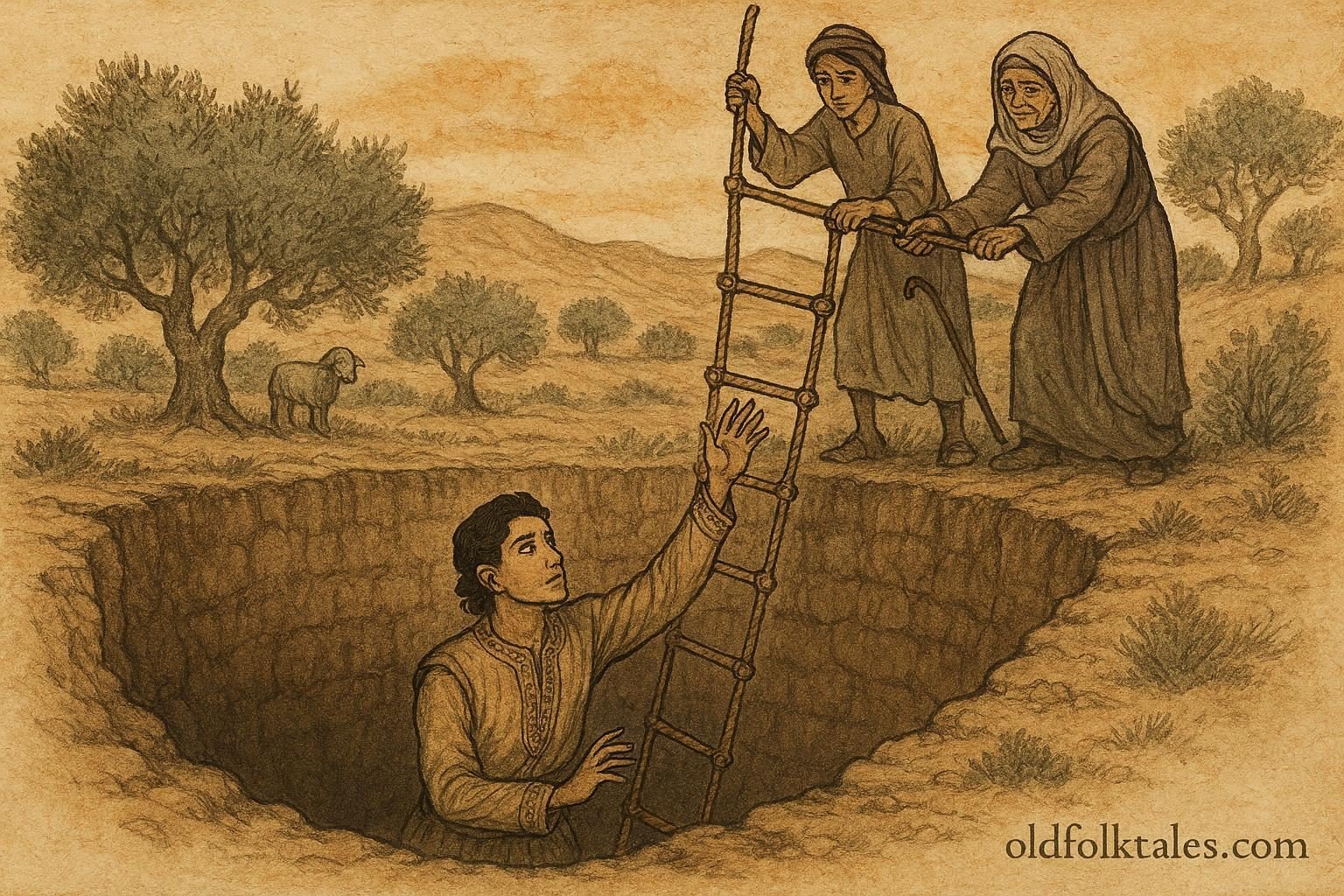
The prince expected immediate rescue, but instead the two helpers gathered long branches, woven rope, and knots of cloth. They lowered the makeshift ladder into the pit. The prince tried to climb, but halfway up he slipped, falling painfully back to the bottom. Frustration swelled in him.
“Again,” the old woman said gently. “Patience is the rope that saves the fallen.”
On the second attempt, he climbed slowly, listening as the shepherd boy called out encouragement. Inch by inch, the prince rose until his hand reached the rim. The boy gripped his wrist firmly, pulling with surprising strength, while the woman pushed from behind. At last, the prince emerged into the light.
Exhausted, trembling, and humbled, he looked at the two who had saved him, neither noble nor educated, but rich in compassion and perseverance. He bowed his head to them, a gesture he had rarely offered even to members of his own court.
“Without you,” he said, “I would have perished. Tell me how I may repay you.”
The old woman smiled. “We ask nothing. A true leader serves before he rules. Remember this.”
The shepherd boy added softly, “And remember who lifted you when you could not stand alone.”
The prince returned to the palace transformed. No longer did he speak with impatience or walk with arrogant pride. Instead, he carried the memory of the pit, the darkness, the hunger, the helplessness, and the radiant humility of those who came to his aid. When he finally took his place on the throne, his rule was marked by fairness and respect for both the lowly and the learned.
And so, the Syrian people told this tale for generations, teaching that greatness is not in crowns or palaces, but in the heart that bows before it rises.
Moral Lesson
True strength is revealed not in power or privilege, but in humility, patience, and gratitude. Even the highest among us sometimes rely on those we overlook, and wisdom grows from recognizing the value of every helping hand.
Knowledge Check
1. Who is the main character in “The Prince in the Pit”?
The story centers on a young Syrian prince who learns humility after falling into a pit.
2. What causes the prince to fall into the pit?
His pride and impatience lead him to ride ahead carelessly, causing him to fall through weakened ground.
3. Who helps the prince escape from the pit?
A humble shepherd boy and an elderly village woman work together to rescue him.
4. What does the pit symbolize in the Syrian folktale?
It represents pride, downfall, and the humbling trials that teach wisdom and patience.
5. What character traits help the prince survive and return home?
Patience, resourcefulness, and a newfound humility toward the helpers who saved him.
6. What cultural lesson does this Syrian legend emphasize?
It highlights the value of community, compassion, and recognizing the worth of humble people.
Source
Adapted from the Syrian folktale “The Prince in the Pit,” referenced in Arab Folktales by Inea Bushnaq. Internet Archive.