Beneath the vast canopy of the Bodhi Tree, where leaves rustled with whispers of eternity, Siddhartha Gautama sat in perfect stillness. His body formed a mountain of calm, his breath moved like the gentlest breeze, and his mind journeyed toward the shores of enlightenment. For forty-nine days he had remained beneath that sacred tree, seeking the truth that would liberate all beings from suffering.
But Mara, the Evil One, watched from the shadows with jealous eyes. His heart burned with envy as he witnessed the Bodhisattva drawing ever closer to his goal. “This man shall not succeed,” Mara hissed into the darkness. “I will not allow another enlightened being to walk this earth and teach humanity the path to freedom.”
Discover more East Asian Folktales from the lands of dragons, cherry blossoms, and mountain spirits.
With a terrible roar that shook the heavens, Mara summoned his vast armies. From every corner of the demon realm they came warriors with weapons of flame and shadow, wild beasts with eyes of burning coal, and grotesque creatures that defied description. Thunder rolled across the sky as Mara’s forces assembled, and the very earth trembled beneath their terrible weight.
Then came Mara’s three daughters, Tanha, Arati, and Raga personifications of craving, aversion, and desire. They danced before the Bodhisattva, their movements seductive and hypnotic, their voices sweet as honey but laced with poison. They sang songs of earthly pleasures, of power and glory, of all the comforts the world could offer if only he would abandon his quest.
The gods who had been watching over the Bodhisattva’s meditation scattered in terror. Even the celestial beings could not withstand Mara’s fearsome display. They fled to distant realms, leaving the Bodhisattva alone beneath the tree, facing the demon king and his endless legions.
But Siddhartha did not move. His eyes remained closed, his breathing steady, his resolve unshaken.
Mara stepped forward, his voice booming like thunder. “Who are you to sit upon this throne of enlightenment? Who witnesses your worthiness? I have my armies, my daughters, my powers to testify to my dominion. But you sit here alone, without a single witness to vouch for your merit. Abandon this seat that does not belong to you!”
The Bodhisattva opened his eyes then, and in their depths shone a light more ancient than the stars. Slowly, with deliberate grace, he raised his right hand and stretched it downward. His fingers, long and elegant, reached toward the earth itself. With the gentlest touch, a touch that held within it the weight of countless lifetimes he made contact with the ground.
“Mother Earth,” he called, his voice resonating through every atom of creation, “I call upon you to be my witness. You who have borne me through countless incarnations, you who have received the water of my generosity in life after life, you who know every act of kindness I have performed bear witness now to my accumulated merit.”
The earth began to tremble, but this was no tremor of fear. This was a stirring of recognition, of awakening. The soil began to shift and part, and from the very ground beneath the Bodhi Tree, a radiant figure emerged.
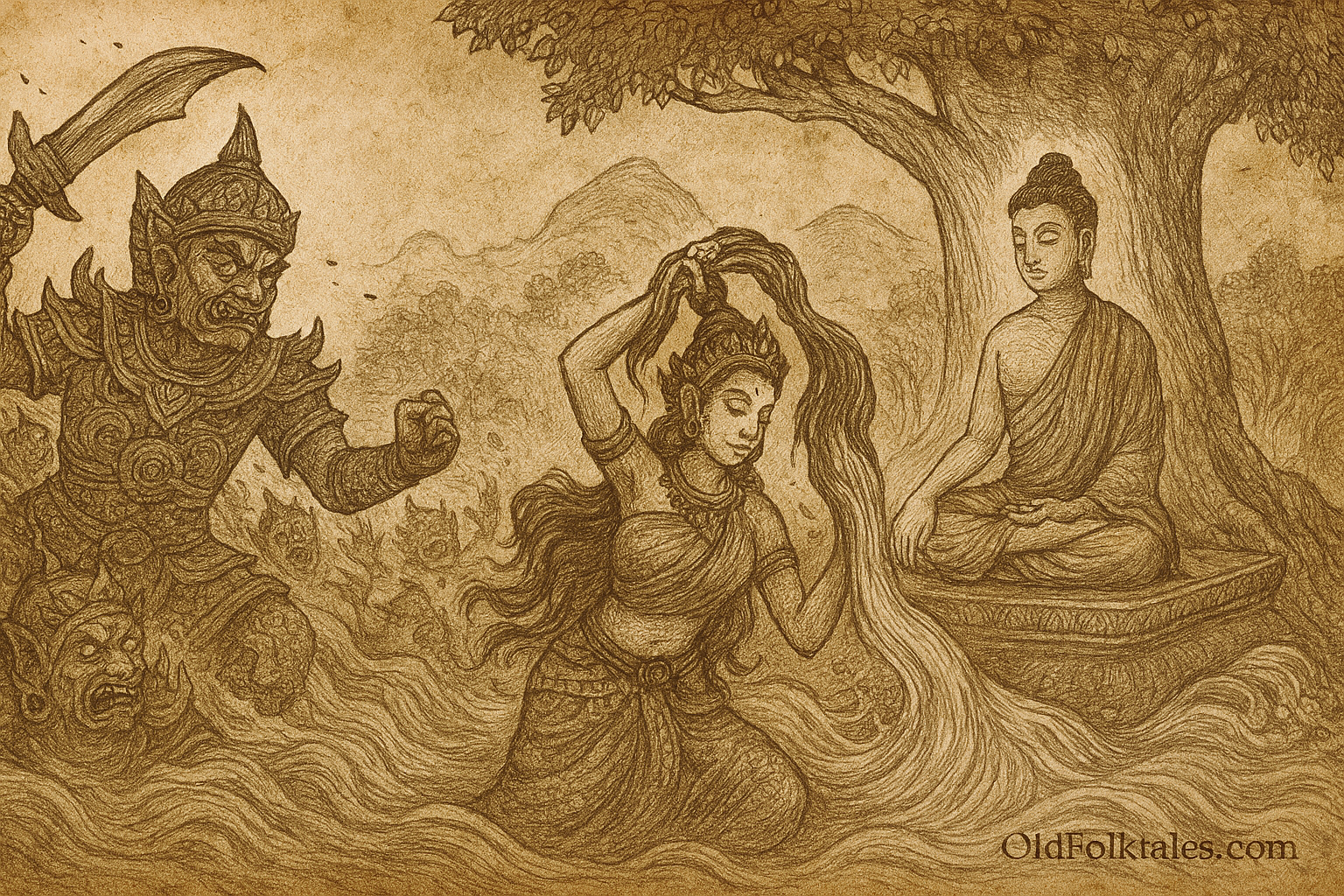
She rose like the dawn itself, Phra Mae Thorani, the Earth Goddess, Mother of all beings. Her form was that of a beautiful young woman, her face serene and filled with ancient wisdom. Her hair fell in dark cascades down her back, so long that it pooled upon the ground around her feet hair that held within it every drop of water poured in offering throughout the Bodhisattva’s countless previous lives.
“I am witness,” Phra Mae Thorani proclaimed, her voice like the sound of rivers flowing and mountains growing. “I have held this being through ten thousand lifetimes. I have received the sacred water from every act of generosity, from every sacrifice, from every moment of selfless giving. His merit is as vast as the ocean, as immeasurable as the sky.”
Mara’s face contorted with rage. His armies pressed forward, weapons raised, ready to strike the Bodhisattva down.
But Phra Mae Thorani smiled, serene and terrible in her power. She gathered her magnificent hair in both hands, raising the long dark lengths before her like a sacred offering. Then, with a motion that seemed to encompass all the flowing waters of the world, she began to wring her hair.
From those dark tresses came water not mere droplets, but torrents. This was the water of dana parami, the perfection of generosity, the accumulated essence of every gift the Bodhisattva had given across immeasurable ages. When he had been King Vessantara, he had given away everything he possessed. When he had been a merchant, he had shared his wealth with the poor. When he had been a prince, a scholar, a farmer, a humble servant in every life, he had given freely, and with each gift, water had been poured as an offering to the earth.
Now that water returned.
It flowed from Phra Mae Thorani’s hair like a mighty river bursting its banks. The streams became torrents, the torrents became a deluge, the deluge became an overwhelming flood. The cool waters of detachment, carrying the power of countless good deeds, rushed forward in an unstoppable wave.
Mara’s daughters shrieked and fled, their seductive forms swept away like leaves before a storm. The demon warriors, with all their fearsome weapons, found themselves tumbling helplessly in the sacred flood. The wild beasts howled and were carried off. Mara himself, for all his power and rage, could not stand against the flood of the Bodhisattva’s accumulated merit.
The waters rose and rose, washing away everything that stood in opposition to enlightenment. They carried away temptation, delusion, and fear. They swept clean the path before the Bodhisattva, leaving only clarity and truth.
As the flood receded, Phra Mae Thorani bowed deeply to the Bodhisattva, her task complete. Then, as gracefully as she had risen, she descended back into the earth, her presence remaining always as a witness to truth, a protector of virtue, a testament to the power of accumulated goodness.
The Bodhisattva sat alone once more beneath the Bodhi Tree, but now the path was clear. With Mara’s forces defeated and the Earth herself having testified to his worthiness, nothing remained to prevent his awakening. As the morning star rose in the eastern sky, Siddhartha Gautama attained complete enlightenment, becoming the Buddha, the Awakened One.
And to this day, in temples throughout Thailand and across Southeast Asia, the image of Phra Mae Thorani remains sacred and beloved. She is depicted in countless shrines, fountains, and paintings a beautiful woman wringing water from her endless hair, a reminder that the Earth herself bears witness to every act of goodness, that virtue accumulates like water over time, and that truth will always triumph over deception.
Click to read all Southeast Asian Folktales — featuring legends from Thailand, Indonesia, Vietnam, and the Philippines.
The Moral Lesson
This sacred story teaches us that every act of kindness, generosity, and virtue leaves an indelible mark upon the universe. The water flowing from Phra Mae Thorani’s hair symbolizes accumulated merit from countless past good deeds, reminding us that no good deed is ever forgotten or wasted. When we face our own demons whether they be temptation, doubt, fear, or opposition from others our accumulated goodness becomes our greatest defense. The Earth herself witnesses our actions, and truth will ultimately prevail over deception and evil. This myth encourages us to persist in virtue, to give generously, and to trust that righteousness, though sometimes challenged, will always find its witness and its vindication.
Knowledge Check
Q1: Who is Phra Mae Thorani in Thai Buddhist mythology?
A1: Phra Mae Thorani is the earth goddess who appeared as a beautiful woman during Buddha’s enlightenment to bear witness to his accumulated merit from past lives. She is revered as the protector of Buddha and symbolizes the earth’s role as witness to all virtuous deeds.
Q2: What role did Mara play in Buddha’s enlightenment story?
A2: Mara was the Evil One who grew jealous and tried to prevent Buddha from reaching enlightenment by attacking him with warriors, wild animals, and his daughters. He challenged Buddha’s right to sit beneath the Bodhi Tree and demanded witnesses to prove his worthiness.
Q3: Why did Buddha touch the earth during his meditation?
A3: Buddha touched the earth to summon Phra Mae Thorani as his witness to affirm his accumulated merit from past good deeds. This gesture, known as the earth-touching mudra or Maravijaya Attitude, called upon the Earth Goddess to testify to his worthiness for enlightenment.
Q4: What does the water wrung from Phra Mae Thorani’s hair symbolize?
A4: The water represents accumulated merit from Buddha’s past acts of generosity and symbolizes the perfection of generosity (dana parami). This water, gathered from countless donative libations throughout the Bodhisattva’s previous lives, created a flood that washed away Mara and his demonic forces.
Q5: How is Phra Mae Thorani depicted in Thai art and temples?
A5: Phra Mae Thorani is commonly shown kneeling with her long hair gathered, wringing water from it that flows like a great river. She appears in temple murals, water fountains, shrines, and statues throughout Thailand, often alongside Buddha in the earth-touching posture.
Q6: What cultural significance does Phra Mae Thorani hold in modern Thailand?
A6: Phra Mae Thorani appears on government logos including the Metropolitan Waterworks Authority and the Democrat Party emblem, symbolizing the importance of earth and water for Thailand. She is worshipped at shrines, featured in decorative fountains, and represents the triumph of good over evil in Thai Buddhist culture.
Cultural Origin: Thai Buddhist tradition, Thailand and Southeast Asia