
In the ancient kingdom of Singapura, during the prosperous reign of the third raja, Sri Rana Wikrama, there lived a young man whose name would echo through the centuries. His name was Badang, and though his beginnings were humble and his frame slight, destiny had woven a fate for him far grander than anyone could have imagined.
Badang was born in a small village called Saluang, believed by many to be located near the Besisek River in what is now Sumatra. Life had dealt him a difficult hand he was a slave, bound to serve a landowner named Nira Sura, who owned vast tracts of farmland that needed constant clearing. Day after day, Badang labored beneath the merciless tropical sun, his wiry arms swinging an axe against towering trees, his back bent under the weight of fallen logs. While the other workers, strong and muscular, moved through their tasks with ease, Badang struggled. His small frame and limited strength made every chore an exhausting ordeal, and he often fell behind, earning the frustration of his master and the pity of his fellow slaves.
Click to read all East Asian Folktales — including beloved stories from China, Japan, Korea, and Mongolia.
To supplement his meager existence, Badang would sometimes slip away to the river when the moon hung low in the sky. There, he would set fish traps along the banks, hoping to catch enough fish to trade for a few extra coins or perhaps a proper meal. The river was his secret refuge, a place where he could dream of a different life while waiting for his traps to fill.
But one morning, when Badang returned to check his traps, he discovered only bones and scales scattered across the woven bamboo. The fish were gone. Confused and disappointed, he reset the traps with fresh bait and returned the next day, only to find the same devastation nothing but scraps remained. This pattern continued for several nights, and with each loss, Badang’s anger grew. Someone, or something, was stealing his fish.
Determined to catch the thief, Badang armed himself with a sharp parang a traditional Malay machete and hid in the dense bushes near the riverbank just before dawn. The air was thick with moisture, and the chorus of frogs and crickets created an eerie symphony. As the first pale light of morning touched the water, Badang heard a rustling sound. His heart pounded as he peered through the leaves.
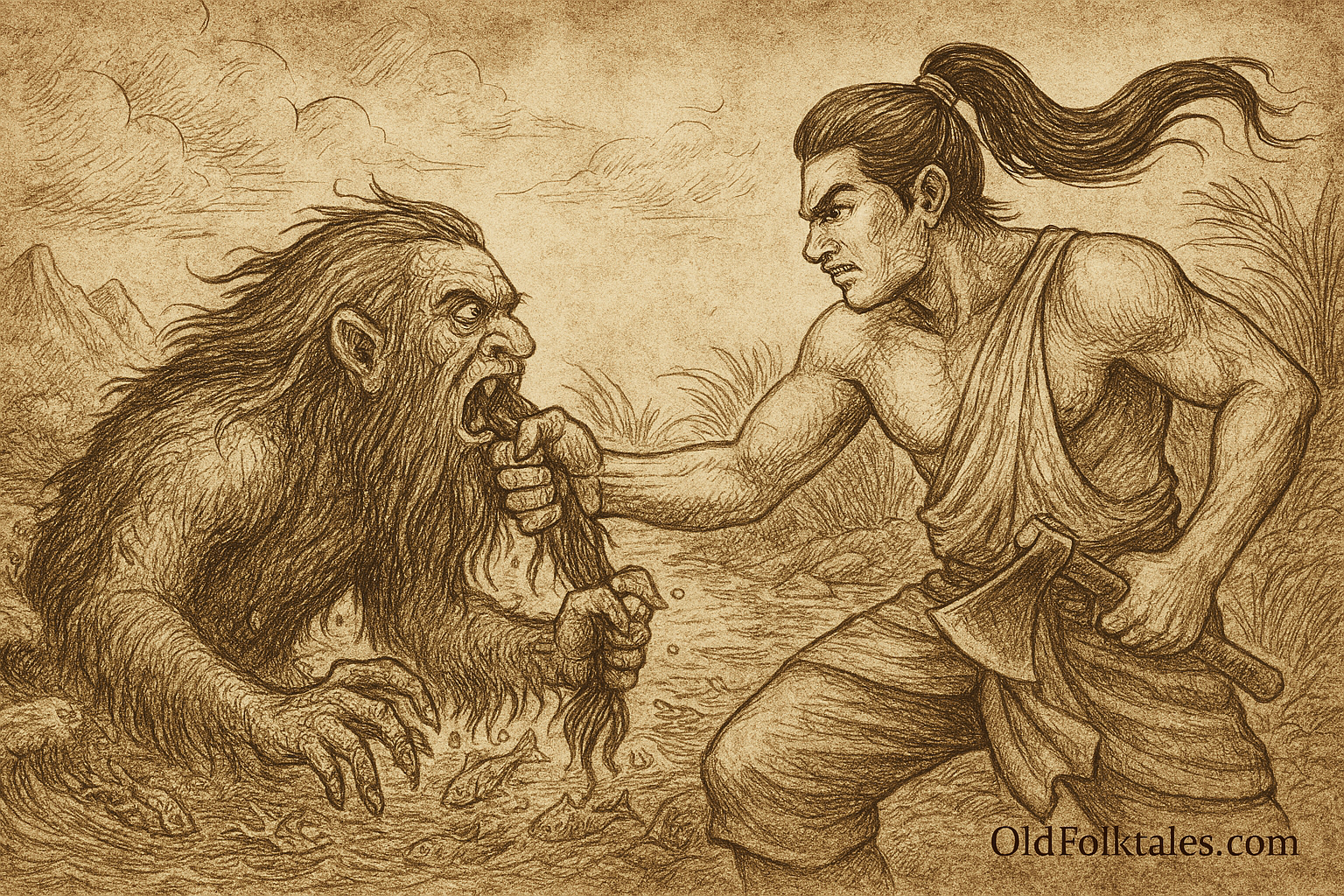
What emerged from the river was no ordinary thief. It was a hantu air a water demon of ancient Malay lore. The creature was terrifying to behold taller than any man, with eyes that glowed like hot coals, matted hair that hung past its waist in tangled clumps, and long tusks protruding from its mouth. Its gnarled hands reached into Badang’s trap, pulling out the fish and devouring them with savage hunger, bones crunching between its powerful jaws.
Fear surged through Badang’s veins, but so did righteous anger. These were his fish food he had worked hard to trap, and this demon had been stealing from him night after night. Summoning every ounce of courage he possessed, Badang burst from his hiding place and lunged at the creature. Before the hantu could react, Badang grabbed its long, filthy beard with one hand and pressed the blade of his parang against its throat with the other.
The demon roared in surprise and terror, stumbling backward. “Mercy! Mercy, human!” it croaked, its voice like grinding stones. “Please spare my life!”
“You have been stealing from me!” Badang shouted, his voice trembling with both fear and fury. “You owe me for every fish you have taken!”
The hantu air writhed in his grip, but Badang held firm. Desperate to escape, the demon made an offer. “Release me, and I shall grant you any wish you desire! Anything within my power shall be yours!”
Badang paused, his mind racing. He thought of his grueling days in the fields, his aching muscles, and the humiliation of being the weakest worker. He thought of how much easier life would be if he possessed the strength to complete his tasks without suffering. “I wish for great strength,” he declared. “I want to be stronger than any man alive, so that I will never again struggle with my work.”
The demon’s fiery eyes narrowed. “Your wish can be granted, but you must pay a price. I will vomit, and you must consume what comes forth. Only then will the power be yours.”
Badang’s stomach churned at the thought, but he had come too far to turn back now. He nodded his agreement. The demon convulsed, and from its mouth came a foul, glowing substance some say it was enchanted vomit, others claim it was two red magical gems called geliga. Whatever the truth, Badang closed his eyes, held his breath, and swallowed the offering whole.
The effect was immediate and overwhelming. Heat surged through Badang’s body like liquid fire. His muscles expanded, his bones grew denser, and strength beyond mortal comprehension flooded every fiber of his being. When he opened his eyes, the demon was gone, vanished into the river mist. Badang looked down at his hands they were larger now, powerful and steady. He felt as though he could uproot mountains.
Returning to the plantation that morning, Badang began his work as usual. But now, trees that had taken him hours to fell crashed to the ground with a single swing of his axe. Massive logs that required four men to carry, he lifted effortlessly onto his shoulder and carried alone. By midday, he had cleared an entire section of dense forest that should have taken a week.
When Nira Sura came to inspect the work, he was astounded. He had expected to scold Badang for laziness, but instead found more work completed than seemed humanly possible. “How did you do this?” his master demanded.
Badang explained everything the thieving demon, the wish, and the terrible price he had paid. Nira Sura, a fair and generous man despite being a slave owner, was moved by Badang’s honesty and his incredible new gift. “You have served me loyally,” he said, placing a hand on Badang’s shoulder. “I hereby grant you your freedom. You are a slave no longer. But I ask one thing of you: never use your strength to boast or harm others. Use it to help those in need.”
Badang bowed gratefully, accepting both his freedom and the responsibility that came with his power.
Word of Badang’s miraculous strength spread like wildfire across the kingdom. Villagers came from distant lands to witness his feats. They watched in awe as he pulled entire trees from the earth, roots and all, with his bare hands. He rescued people trapped beneath collapsed houses, lifted boats stranded on riverbanks back into the water, and carried loads that would have required a dozen oxen.
Eventually, stories of this extraordinary man reached the royal court of Singapura. King Sri Rana Wikrama, intrigued by the tales, summoned Badang to appear before him. When Badang arrived at the grand palace atop the hill now known as Fort Canning, he bowed respectfully before the throne.
“I have heard remarkable things about you,” the king said, studying the young man with keen interest. “But I must see for myself if these stories are true. I have commissioned the construction of a massive boat forty-five feet long and built from the heaviest timber. Five hundred of my strongest men have been unable to push it into the sea. Can you accomplish what they could not?”
“I will try, Your Majesty,” Badang replied humbly.
The entire court followed the king to the harbor, where an enormous vessel sat immobile on the sand, far from the water’s edge. Hundreds of onlookers gathered to watch, skeptical that one man could achieve what five hundred had failed to do. Badang approached the boat, placed both hands against its hull, and with one smooth motion, pushed. The boat glided across the sand as if it weighed no more than a leaf and splashed into the harbor waters.
The crowd erupted in cheers. The king was overjoyed. “From this day forward, you are no longer a common man!” he proclaimed. “I appoint you commander of my army and grant you the title of Raden, a princely honor. You shall protect this kingdom and serve as my champion.”
Badang accepted the position with gratitude and served the king with unwavering loyalty. He became a beloved figure throughout the kingdom, using his strength to defend the people, build infrastructure, and maintain peace. His reputation spread across the seas, reaching distant lands and faraway courts.
One day, a messenger arrived at the palace bearing a letter sealed with royal wax. It was from the Maharaja of Kalinga, a powerful kingdom in India. The letter proposed a friendly challenge: the Maharaja had his own champion, a strongman named Nadi Bijaya Pikrama, who was said to be the strongest man in all of India. The Maharaja wished to test whether Badang was truly as mighty as the legends claimed. The terms were simple the two strongmen would compete in a series of contests, and the loser’s king would owe the victor seven ships laden with precious cargo.
King Sri Rana Wikrama, who delighted in tests of skill and enjoyed diplomatic games, accepted the challenge immediately. Preparations were made, and weeks later, Nadi Bijaya Pikrama arrived in Singapura aboard a magnificent vessel, accompanied by an entourage of warriors and courtiers.
The Indian champion was an impressive sight tall, muscular, and radiating confidence. The two strongmen faced each other in the palace courtyard, and the contests began. They wrestled, each trying to throw the other to the ground, but neither could gain the advantage. They competed in bending iron bars, lifting enormous stones, and pulling ships across the sand. Every contest ended in a tie. The crowd watched in suspense, unable to predict a winner.
Finally, as the sun began to set, Nadi Bijaya Pikrama proposed a final, decisive challenge. “Let us see who can lift and throw that boulder the farthest,” he said, pointing to an enormous stone that sat at the edge of the palace grounds. It was a massive rock, ancient and heavy, covered in moss and lichen.
The Indian champion approached the boulder first. He bent low, wrapped his powerful arms around the stone, and heaved with all his might. Sweat poured down his face as he managed to lift the rock to his knees before the weight became too much. With a grunt of exhaustion, he dropped it back to the earth with a thunderous crash.
Now it was Badang’s turn. The crowd held its breath. Badang walked calmly to the boulder and placed his hands upon its rough surface. He closed his eyes for a moment, remembering the demon’s gift, the price he had paid, and the responsibility he carried. Then, with a mighty surge of power, he lifted the stone above his head as though it weighed no more than a basket of fruit.
The crowd gasped in amazement. Badang pivoted his body, drew back his arms, and with a tremendous roar, hurled the boulder through the air. It sailed over the palace walls, over the treetops, and landed with a colossal splash at the mouth of the Singapore River, nearly a kilometer away.
The earth trembled. The crowd erupted in thunderous applause and cheering. Nadi Bijaya Pikrama bowed his head in defeat, acknowledging that he had met his match. The Maharaja of Kalinga, true to his word, sent seven ships filled with gold, silk, spices, and precious stones to King Sri Rana Wikrama. Singapura’s honor was secured, and Badang’s name became immortal.
That enormous boulder remained at the mouth of the Singapore River for centuries, a testament to Badang’s incredible feat. It became known as the Singapore Stone, a sacred relic covered in mysterious inscriptions that no one could decipher. For generations, sailors used it as a landmark, and the people of Singapura told their children stories of how it came to rest there.
In 1819, when the British arrived and began to colonize Singapore, they discovered the ancient stone still sitting where Badang had thrown it centuries before. But in 1843, as they worked to widen the river mouth and build military fortifications, they made the fateful decision to blow up the boulder with explosives. When the smoke cleared, only fragments remained. One large piece, inscribed with the mysterious ancient script, was saved and is now displayed at the National Museum of Singapore, a fragment of legend preserved for future generations.
Badang continued to serve King Sri Rana Wikrama faithfully for the rest of his life. When he finally passed from this world, the king honored him with a magnificent burial. According to the Malay Annals, the Maharaja of Kalinga sent a grand monument to mark Badang’s grave, acknowledging the greatness of the man who had once defeated his champion. Some say Badang was buried on Pulau Buru in the Riau Archipelago, where his grave became a keramat, a sacred shrine that people visit to this day, seeking blessings and protection.
The legend of Badang lives on, woven into the cultural fabric of Singapore and Malaysia. His story is told in schools, illustrated in books, and celebrated in festivals. The Singapore Stone, though broken and incomplete, remains a powerful symbol of the past proof that legends sometimes have their roots in truth, and that greatness can emerge from the most unexpected places.
Click to read all Southeast Asian Folktales — featuring legends from Thailand, Indonesia, Vietnam, and the Philippines.
The Moral Lesson
The legend of Badang teaches us that true strength is not just physical power, but the courage to face our fears, the wisdom to use our gifts responsibly, and the humility to serve others rather than ourselves. Badang began as the weakest among his peers, but through bravery confronting the demon rather than fleeing he transformed his life. More importantly, he never forgot where he came from. Even after gaining supernatural strength and rising to command the king’s army, Badang remained humble and used his power to protect and help others, not to dominate or boast.
Knowledge Check
Q1: Who was Badang and where did he come from in Singaporean and Malay folklore?
A1: Badang was originally a humble slave or coolie from the village of Saluang (possibly in Sumatra or along the Besisek River) who worked for a landowner clearing forests. He was known for being the weakest worker among his peers, struggling with physical labor due to his small, frail frame. His story is one of the most famous legends from the Sejarah Melayu (Malay Annals) and is central to both Singaporean and Malaysian cultural heritage.
Q2: How did Badang gain his supernatural strength?
A2: Badang gained his superhuman strength after capturing a hantu air (water demon or spirit) that had been stealing fish from his traps along the river. In exchange for its freedom, the demon offered to grant Badang a wish. When Badang wished for great strength, the demon agreed but required him to consume what it vomited described in some versions as magical vomit or two red gems called geliga. After swallowing this supernatural substance, Badang was immediately transformed into the strongest man alive.
Q3: What was Badang’s relationship with King Sri Rana Wikrama of Singapura?
A3: After word of Badang’s incredible feats spread throughout the kingdom, King Sri Rana Wikrama summoned him to the royal court and tested his strength by asking him to push a massive 45-foot boat into the sea a task that five hundred men had failed to accomplish. When Badang succeeded effortlessly, the impressed king freed him from slavery, appointed him commander of the royal army, and granted him the princely title of Raden. Badang served the king faithfully and loyally for the rest of his life, becoming the kingdom’s champion and protector.
Q4: What is the Singapore Stone and how is it connected to Badang’s legend?
A4: The Singapore Stone is a massive boulder that Badang reportedly threw from Fort Canning Hill to the mouth of the Singapore River during a strength competition with Nadi Bijaya Pikrama, the champion strongman from the Indian kingdom of Kalinga. The stone, which featured mysterious ancient inscriptions that have never been fully deciphered, remained at the river mouth for centuries as a landmark. In 1843, British colonial authorities blew up the boulder to widen the river for military purposes, and only fragments survived. One large inscribed fragment is now displayed at the National Museum of Singapore as an important historical artifact.
Q5: What was the contest between Badang and Nadi Bijaya Pikrama, and what were the stakes?
A5: The Maharaja of Kalinga in India challenged King Sri Rana Wikrama by sending his champion, Nadi Bijaya Pikrama, to compete against Badang in a series of strength contests. The stakes were high whichever king’s champion lost would owe the victor seven ships loaded with precious cargo including gold, silk, and spices. The two strongmen competed in multiple events including wrestling, bending iron bars, and lifting stones, with all contests ending in ties. The final decisive challenge was to see who could throw a massive boulder the farthest. While Nadi Bijaya could only lift it to his knees, Badang hurled it across the landscape to the Singapore River mouth, securing victory for Singapura.
Q6: What is the cultural and historical significance of Badang’s legend in Southeast Asian culture?
A6: This legend embodies themes of social mobility, showing how even those born into slavery can rise through courage and merit a narrative that resonates with Singaporean values of meritocracy. Badang represents the archetypal hero who uses his gifts responsibly to serve others rather than for personal gain. Both Singapore and Malaysia claim Badang as a cultural hero, and his story continues to be taught in schools, featured in children’s books, and celebrated as part of the region’s rich folklore tradition. The surviving fragment of the Singapore Stone serves as a tangible connection to this ancient legend, linking myth to historical archaeology.
Cultural Origin: Malay folklore and literature, Kingdom of Singapura, Malay Archipelago (modern-day Singapore, Malaysia, and Indonesia)








