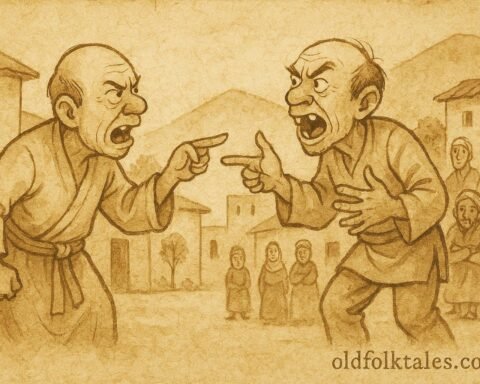
In the northern hills of Lebanon, where olive groves shimmer beneath the Mediterranean sun and stone houses cling to the terraces of Bishmizzine, there lived a poor peasant and his only child, a daughter known throughout the village for her remarkable wisdom. Though their home was modest and their fields small, she possessed a mind so sharp and a heart so steady that people often came seeking her counsel.
One day, word of her intelligence reached the king. Curious and skeptical, he decided to summon her to the palace. He wished to see whether the stories about the peasant girl’s brilliance were true or merely village exaggeration.
When she arrived, she bowed respectfully. The king studied her for a moment, then spoke:
“I hear you are wise. Let me test your understanding. If you answer my riddles correctly, I shall reward you. If not, you may return home.”
“I am ready, my lord,” she replied calmly.
The king leaned forward and posed his riddle:
“I have something. It belongs to my father, yet my children will inherit it. What is it?”
The courtiers whispered among themselves, bewildered, but the girl answered immediately.
“It is land, my king. A father passes it to his son, and the son to his own children.”
The king’s eyes widened. Her answer was perfect, simple, clear, and irrefutable. He questioned her further with other riddles, and each time she responded with confidence and precision. Impressed not only by her intelligence but also by her steady composure, he declared before his court:
“This woman shall be my queen.”
And so the peasant’s wise daughter became royalty.
For a time, the king delighted in his queen’s counsel. Her insight helped him settle disputes, judge fairly, and govern with clarity. Yet as the admiration of the court grew, so did a shadow of insecurity within the king. He feared becoming dependent on her advice and worried the people would think she guided him more than he guided her.
One day, in a moment of pride and unease, he told her:
“From now on, you must not offer counsel in matters of state. I am king, and I alone must judge.”
The queen bowed respectfully and agreed, though the order pained her. Wisdom, after all, was not something she could simply turn off, it was part of her nature. Still, she kept her word.
Not long after, a foreign king visited, bringing with him a challenge wrapped in politeness but sharpened with malice. He presented the Lebanese king with a finely carved statue of a horse, made entirely of stone.
“My friend,” the foreign king said, “my lands have produced many fine colts this season. I send you this stone mare so that you may raise a colt from her. When it is born, send the colt to me as a gift.”
The trap was clear: no one could produce a living creature from stone, and any failure would make the Lebanese king appear foolish and inferior.
Confused and humiliated, the king paced the halls. He dared not ask his queen for advice, but his distress soon became impossible to hide. Seeing his troubled state, the queen approached him gently.
“My king,” she said with a quiet bow, “what burdens you?”
He sighed heavily. “I cannot tell you. I forbade you from advising me.”
The queen hesitated only a moment. She loved her husband and loved her country, and she knew that silence now could cost Lebanon its dignity.
So she spoke softly. “Perhaps I may say only one thing: if he expects a colt from a stone mare, then surely he will not object if you request a simple thing in return.”
The king looked at her, puzzled. “And what is that?”
“Tell him that before his colt arrives, you must have wheat. Ask him to sow his fields, harvest his crop, and send you the wheat that grew from the stones in his own land.”
The king understood. Just as stone horses cannot give birth, stone soil cannot produce grain.
He sent his reply to the foreign king, who, realizing he had been answered with wisdom equal to his trick, withdrew his challenge at once.
But the Lebanese king remembered the order he had given his queen, and how she had broken it. His pride wounded, he summoned her.
“You disobeyed me,” he said. “You gave me advice when I forbade it.”
The queen lowered her gaze. “I wished only to protect you.”
“Yet the rule was mine to give,” he insisted. “And for breaking it, you must leave the palace. But out of the affection I still bear you, I allow you to take with you the thing you treasure most.”
His judgment was final. She bowed once more, accepting her fate with dignity.
That evening, as she prepared to depart, she invited the king to share one last meal. She poured him a drink infused with a mild sleeping draught, harmless, but strong enough to lull him into deep slumber. When he drifted off, she called her servants and said:
“Carry him. The king is my most precious possession.”
By dawn, he awoke in her father’s cottage, lying on a simple straw bed. Confused, he sat up as she stepped forward, her expression calm but tender.
“You told me to take whatever I valued most,” she reminded him. “And I chose you.”
The king felt his pride fall away. He saw her loyalty, her cleverness, and her unwavering love. Humbled, he rose from the bed and embraced her.
“Come home,” he said softly. “From now on, your wisdom shall be honored, not forbidden.”
And so the wise daughter of the peasant returned to the palace, not just as queen, but as the king’s trusted partner, her wisdom cherished for the rest of their days.
Moral of the Story
True wisdom serves with love, humility, and loyalty. Power guided by pride collapses, but power guided by understanding thrives.
Knowledge Check
1. What is the main theme of “The Wise Daughter of the Peasant”?
The story highlights wisdom, humility, and fairness as essential virtues in leadership.
2. Why does the foreign king send the stone horse statue?
He aims to embarrass the Lebanese king with an impossible task.
3. How does the queen solve the foreign king’s challenge?
She advises her husband to request wheat grown from stones, exposing the trick.
4. Why is the queen banished from the palace?
The king banishes her for giving advice after he forbade it.
5. What item does the queen choose as her most prized possession?
She chooses the king himself, proving her love and loyalty.
6. What lesson does the Lebanese folktale teach?
Wisdom should never be suppressed, and pride should not overshadow fairness.
Source
Adapted from “The Wise Daughter of the Peasant,” Folktales of Lebanon, Anis Frayha, 1953. Collected from Bishmizzine, Koura District.