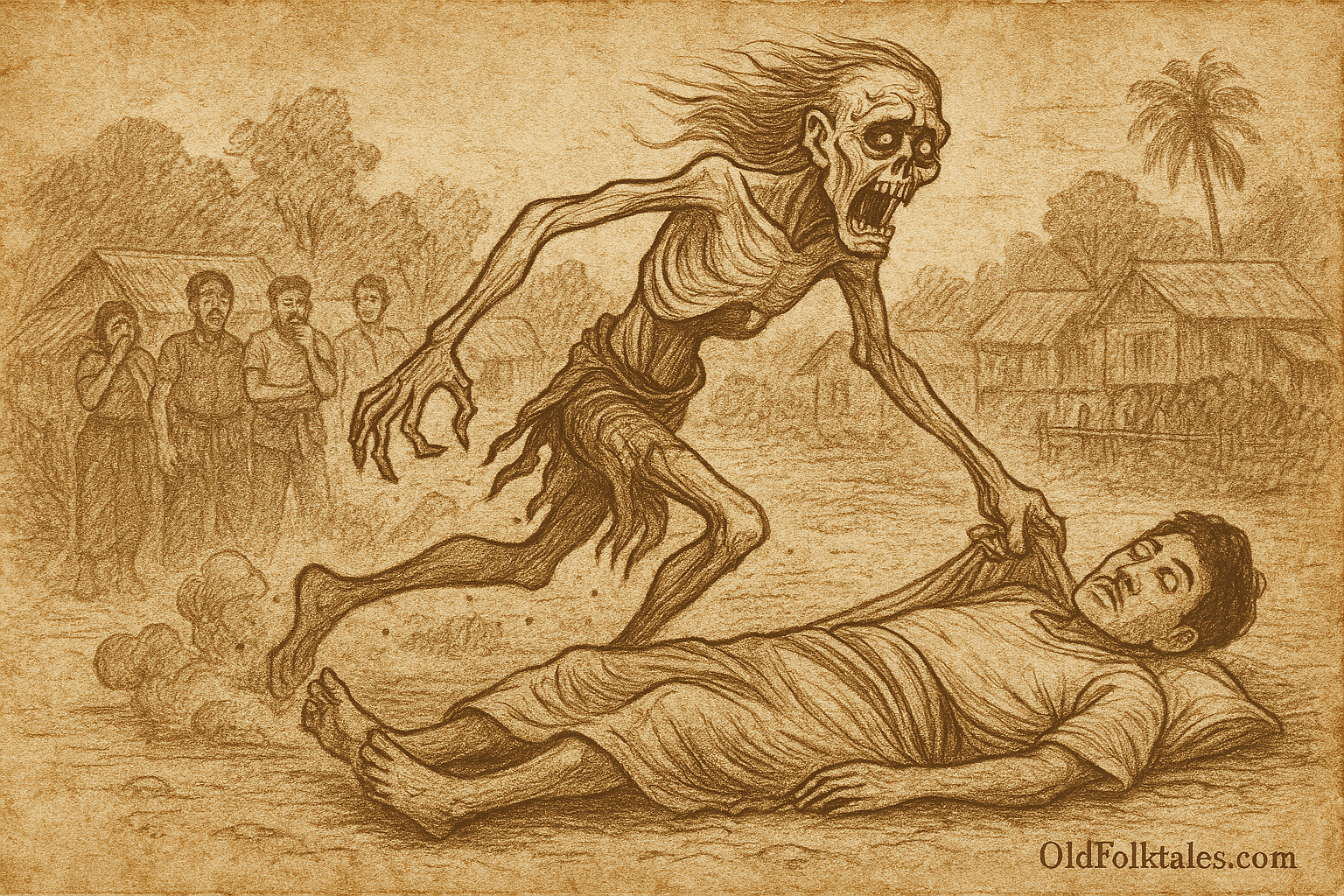
In a quiet village nestled among the rice paddies of Cambodia, there lived a man whose reputation preceded him wherever he went. His name has been lost to time, but his laziness was legendary. While his neighbors rose with the sun to tend their crops, he would turn over on his sleeping mat and pull a thin blanket over his head. While others mended fishing nets or repaired their wooden homes, he would sit idly in the shade, watching clouds drift across the tropical sky.
The villagers had long grown weary of his ways. His relatives begged him to help in the fields during planting season. The village elders gently suggested he might earn his keep by catching fish in the nearby stream. Even the children whispered behind his back, wondering how a grown man could spend entire days doing absolutely nothing. But no amount of pleading, scolding, or shaming could stir him to action.
Click to read all East Asian Folktales — including beloved stories from China, Japan, Korea, and Mongolia.
One sweltering afternoon, as the cicadas sang their relentless chorus and the heat shimmered above the dirt paths, the lazy man had an idea. It was, he thought, quite brilliant in its simplicity. If everyone believed he was dead, they would finally stop bothering him about work. They would mourn him, remember him kindly, and most importantly, leave him in peace.
With a cunning smile, he arranged his plan. He lay down carefully on his woven mat, positioning himself as though life had just departed from his body. He draped a white cloth over himself, leaving just enough of his face visible to appear convincingly deceased. Then he slowed his breathing to shallow whispers, barely moving his chest, and let his arms fall limp at his sides.
Before long, a neighbor noticed him through the open doorway and raised the alarm. Villagers gathered quickly, their voices hushed with concern. Women covered their mouths in shock. Men shook their heads sadly. Some whispered prayers, while others speculated about what could have caused such a sudden death in a man so young. The lazy man, hidden beneath his cloth, felt a twinge of satisfaction. His trick was working perfectly.
But he had not accounted for the spirits.
In Khmer belief, the boundaries between the living and the dead are thin and porous. Wandering through these liminal spaces are the preta, hungry ghosts with grotesque, skeletal frames and stomachs swollen with insatiable hunger. These tormented spirits are cursed to roam the earth, forever seeking but never finding satisfaction. They are drawn to death like moths to flame, sensing the departure of souls with an eerie, supernatural awareness.
One such preta had been drifting near the village that day. Its hollow eyes scanned the landscape, its bony fingers twitching with anticipation. When the lazy man’s false death sent ripples through the spirit world, the ghost sensed what it believed to be a fresh corpse, a soul not yet claimed, a body not yet cold.
The temperature in the room seemed to drop. A foul wind stirred the cloth covering the lazy man’s face. Then came the sound: a long, mournful wail that froze the blood of everyone present. The villagers stepped back in terror as the preta materialized before them, its emaciated form casting an impossible shadow in the afternoon light.
The lazy man’s eyes, which had been peacefully closed, now flew open beneath the cloth. His heart hammered against his ribs. Every instinct screamed at him to run, but he forced himself to remain still, desperately clinging to his deception. Perhaps, he thought with mounting panic, if he just stayed motionless, the creature would lose interest and depart.
But the preta was not so easily fooled by stillness. It approached with jerking, unnatural movements, its wailing growing louder and more insistent. The ghost’s cold, bony hands wrapped around the lazy man’s ankles with a grip like iron. Then, with shocking strength, it began to drag him across the floor toward the door.
The lazy man felt himself sliding across the rough wooden planks, then bumping over the threshold and onto the dirt path outside. The ghost pulled him past the stunned villagers, through the center of the settlement, toward the rice fields where the spirits of the dead were said to gather at twilight. With each lurch and pull, terror mounted in his chest until he could bear it no longer.
With a shriek that startled even the ghost itself, the lazy man bolted upright, ripping the cloth from his face. He scrambled to his feet and ran, stumbling and gasping, while the preta vanished in a confused swirl of shadow and mist bewildered by this corpse that suddenly refused to be dead.
The villagers stood in shocked silence for a heartbeat. Then someone began to laugh. Another joined in, and soon the entire crowd erupted in roaring, breathless laughter. The lazy man stood there, trembling and covered in dust, his face burning with shame as he realized his trick had been exposed in the most humiliating way possible.
In the days that followed, something changed in him. The encounter with the preta had shaken something loose in his soul. He had felt the cold touch of the spirit world, had glimpsed what awaited those who wasted their lives in idleness and deception. For the first time, he understood that avoiding work was not freedom, it was a different kind of death.
Slowly at first, then with growing determination, he began to work. He joined his neighbors in the rice paddies, learning to plant seedlings in neat rows. He mended his own home and caught fish in the stream. The villagers watched this transformation with amazement, and gradually, their mockery turned to respect. The lazy man became a living reminder in the village: even the most stubborn heart can change when confronted with truth.
Click to read all Southeast Asian Folktales — featuring legends from Thailand, Indonesia, Vietnam, and the Philippines.
The Moral of the Story
This Cambodian folktale teaches us that laziness and deception ultimately lead to shame and danger, not the easy life we might imagine. The lazy man’s attempt to avoid responsibility through trickery brought him face to face with genuine terror, forcing him to confront the emptiness of his existence. True peace and respect come not from avoiding work, but from honest effort and contributing to our community. Sometimes, it takes a frightening wake-up call to reform our ways and discover the dignity that comes from living authentically.
Knowledge Check
Q1: Who is the main character in this Cambodian folktale?
A: The main character is a lazy man from a Khmer village who is known throughout the community for avoiding all work and responsibilities, including farming, fishing, and household chores.
Q2: What is a preta in Cambodian folklore?
A: A preta is a hungry ghost in Khmer Buddhist tradition, a tormented spirit with a skeletal body and enormous, insatiable stomach that wanders between the worlds of the living and dead, drawn to death and corpses.
Q3: Why did the lazy man pretend to be dead?
A: He pretended to be dead to stop his relatives and fellow villagers from nagging him about work. He believed that if everyone thought he had died, they would leave him alone and he could continue avoiding all responsibilities.
Q4: What happens when the preta encounters the lazy man?
A: The hungry ghost senses what it believes to be a fresh corpse, approaches with a wailing cry, grabs the lazy man’s ankles, and begins dragging him toward the rice fields where restless spirits gather, forcing him to break his deception.
Q5: What lesson does the lazy man learn from his encounter with the ghost?
A: He learns that trying to escape work through deception only brings humiliation and genuine danger. The terrifying encounter with the preta forces him to realize that honest work and contributing to his community bring true dignity and peace.
Q6: How does this folktale reflect Cambodian cultural values?
A: The story reflects Khmer Buddhist beliefs about spirits and the afterlife, emphasizes the importance of honest labor in agrarian village life, and teaches that personal transformation is possible even for those who have strayed far from the right path.
Source: Adapted from Cambodian Peasant Folktales collected by May M. Ebihara, Columbia University Anthropology Archives.
Cultural Origin: Khmer people, rural Cambodia (Kingdom of Cambodia)