High in the misty highlands of West Sumatra, where volcanic peaks pierce the clouds and terraced rice fields cascade down emerald slopes, there lived a boy named Giran. He was the youngest of eleven siblings, born into a family that scraped by on what little the land provided. Their home was modest, their meals simple, but Giran possessed something his poverty could not diminish a heart overflowing with kindness and compassion.
While his ten older brothers and sisters worked the fields and tended to household duties, Giran moved through the village like a gentle breeze, always ready to help an elderly neighbor carry water, always quick to share his meager portion of rice with hungry children, always offering a warm smile to those burdened by troubles. The villagers adored him. Mothers pointed him out to their children as an example of goodness. Elders nodded approvingly when he passed. Even strangers felt drawn to his genuine, unassuming nature.
Click to read all East Asian Folktales — including beloved stories from China, Japan, Korea, and Mongolia.
But in the hearts of his siblings, this adoration planted seeds of bitter envy.
They watched as villagers praised Giran’s name while barely acknowledging their own hard work. They heard the elders speak of his noble character while their own efforts went unnoticed. With each passing day, jealousy twisted deeper into their hearts like thorny vines, choking out whatever love they once held for their youngest brother. They began to whisper among themselves, their conversations growing darker as resentment festered into something dangerous.
One evening, as the sun dipped behind the volcanic ridges and painted the sky in shades of crimson and gold, the ten siblings gathered in secret. Their faces were shadowed, their voices low and conspiratorial. They hatched a plan so cruel, so calculated, that it would forever alter the landscape of their homeland.
The next morning, they approached the village elders with grave expressions and trembling voices. They accused Giran of committing a terrible offense against the adat the sacred customary laws that governed Minangkabau society. The specific nature of the transgression was whispered with such convincing sorrow that the elders’ faces darkened with concern. In Minangkabau culture, violations of adat were not taken lightly. They threatened the harmony of the entire community, the balance between the living and the ancestors, the very fabric that held their world together.
The accusation spread through the village like wildfire on dry grass. People who had smiled at Giran just yesterday now looked at him with suspicion and disappointment. When he learned of the charges against him, confusion and hurt flooded his young face. He had done nothing wrong. His conscience was clear as the mountain streams that tumbled down from the peaks above.
But his siblings maintained their lie with unwavering faces, and the elders, bound by tradition and duty, demanded proof of innocence. The weight of the false accusation pressed down on Giran’s shoulders like stones. He looked into the eyes of his brothers and sisters and saw no mercy there, only the cold gleam of jealousy satisfied.
Giran understood then that words alone would not save him. In a society where family bonds were sacred and the testimony of ten siblings carried immense weight, who would believe the lone voice of the youngest child? He needed something greater than human testimony. He needed the voice of truth itself.
With quiet dignity, Giran walked through the village and began climbing the steep path that led to the cliff overlooking the valley. Villagers followed at a distance, murmuring amongst themselves. His siblings came too, confident in their deception, perhaps even eager to see him humiliated. The climb was long and arduous, but Giran’s steps never faltered.
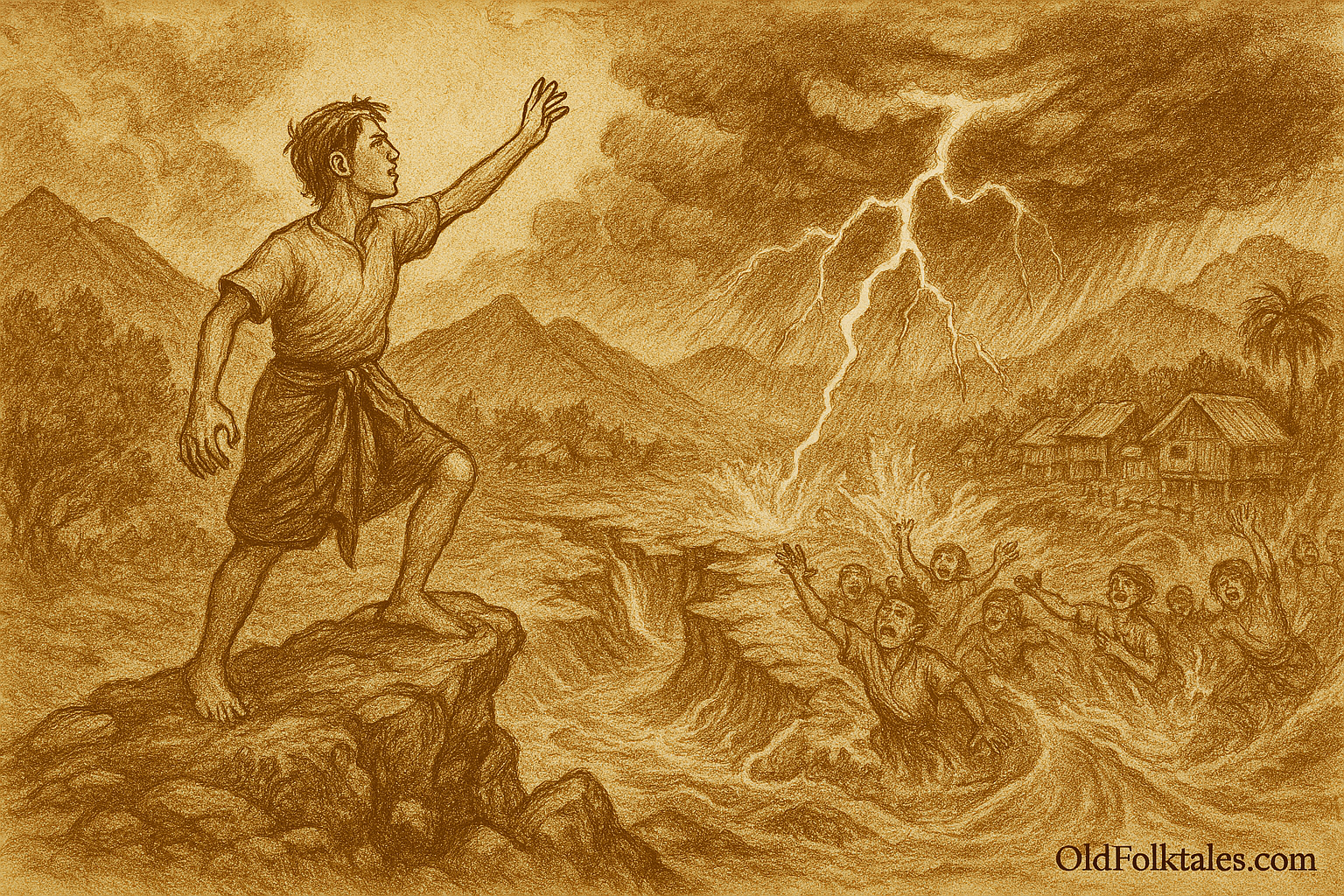
When he reached the summit, he stood at the edge of the precipice and gazed out over the valley below the patchwork of fields, the cluster of traditional rumah gadang houses with their dramatic curved roofs, the river winding like a silver ribbon through the green landscape. The wind whipped his hair and clothing as he raised his arms toward the heavens.
“If I am guilty of this crime,” Giran’s voice rang out, clear and strong, “then let me be struck down where I stand. But if I am innocent if my heart is pure and my actions blameless then let the earth itself bear witness to the truth!”
He swore by Allah, by the sacred mountains, by the spirits of the ancestors, and by the very ground beneath his feet that he had committed no wrong. His voice carried the absolute conviction of innocence, the unshakeable certainty of truth.
For a moment, everything was still. Even the birds stopped singing. The wind held its breath.
Then the sky began to change.
Dark clouds rolled in from nowhere, swallowing the blue expanse in moments. The air grew heavy and electric, crackling with unseen power. Lightning split the heavens with jagged brilliance, and thunder shook the mountains to their ancient cores. The villagers cried out in terror, falling to their knees.
The earth itself began to tremble. At first, it was a gentle shuddering, like the breathing of some enormous sleeping creature. But it quickly intensified into a violent, roaring quake that sent everyone stumbling and scrambling for balance. Massive cracks appeared in the ground, zigzagging across the valley floor with terrible speed.
From these fissures, water began to erupt. Not in gentle springs, but in powerful torrents that shot skyward before cascading down in thunderous waterfalls. More water burst from the mountainsides, from places where no springs had ever existed. The earth was weeping or perhaps it was screaming in outrage at the injustice committed against an innocent soul.
Giran’s ten siblings, standing together near the valley floor, suddenly understood the magnitude of their sin. Horror replaced their jealousy as they watched the water rushing toward them. They tried to run, but the flood was faster. They called out to Giran, their voices desperate with belated remorse, but their cries were swallowed by the roar of the deluge.
The water rose with supernatural speed, filling the valley like an enormous bowl. It swallowed the fields, the homes, the trees, and finally, the ten siblings themselves. The villagers who had climbed to higher ground watched in awe and terror as their entire valley disappeared beneath churning waters.
When the storm finally subsided and the clouds parted, the transformation was complete. Where once a fertile valley had stretched between the mountains, there now lay a vast, serene lake. Its waters were impossibly clear, reflecting the sky like polished glass. It was beautiful beyond description peaceful, pristine, and profound.
This became Lake Maninjau, one of Indonesia’s most stunning natural wonders. The Minangkabau people say that on quiet mornings, when mist hovers over the water’s surface, you can still feel the presence of truth vindicated and jealousy punished. The lake serves as an eternal reminder that lies, no matter how convincing, cannot stand against genuine innocence, and that nature itself will rise to defend the truth.
As for Giran, some say he ascended to the heavens with the storm clouds, his innocence so pure that the earth could no longer contain him. Others believe his spirit dwells in the lake’s depths, ensuring that its waters remain forever clear a mirror reflecting only truth.
Click to read all Southeast Asian Folktales — featuring legends from Thailand, Indonesia, Vietnam, and the Philippines.
The Moral of the Story
This Minangkabau legend teaches us that truth and innocence possess a power greater than any human deception. Jealousy and false accusations may temporarily harm the innocent, but ultimately, truth will reveal itself, often with devastating consequences for those who spread lies. The story reminds us to examine our hearts for envy, to speak truthfully even when lies seem advantageous, and to trust that justice, whether human or divine, will ultimately prevail. Lake Maninjau stands as a testament to the enduring power of innocence and the natural world’s role as witness to truth.
Knowledge Check
Q1: Who is Giran in the Legend of Lake Maninjau?
A: Giran is the youngest of eleven siblings from a poor Minangkabau family in the West Sumatra highlands. Despite his poverty, he is beloved by villagers for his compassion, kindness, and pure heart, which ultimately provokes deadly jealousy from his older brothers and sisters.
Q2: What is adat in Minangkabau culture?
A: Adat refers to the sacred customary laws and traditions that govern Minangkabau society in Indonesia. These laws maintain community harmony and balance, and violations of adat are treated as serious offenses that threaten the entire social fabric.
Q3: Why did Giran’s siblings accuse him falsely?
A: Giran’s ten older siblings were consumed by jealousy because the villagers constantly praised Giran’s goodness and noble character while ignoring their own hard work. Their envy grew into bitter resentment, leading them to falsely accuse him of violating the village’s sacred customs.
Q4: How did Giran prove his innocence?
A: Unable to defend himself with words alone against ten siblings’ testimony, Giran climbed to a cliff and swore by God and nature that he was innocent. He declared that if he spoke the truth, the earth itself would bear witness which it did through a catastrophic supernatural storm and flood.
Q5: What happened to create Lake Maninjau?
A: When Giran proclaimed his innocence, the earth responded with violent tremors, lightning, and water bursting from the ground and mountainsides. The resulting flood filled the entire valley, drowning the ten jealous siblings and transforming the landscape into the serene crater lake known as Lake Maninjau.
Q6: What cultural significance does Lake Maninjau hold for the Minangkabau people?
A: Lake Maninjau serves as a sacred reminder of truth’s ultimate power over deception and the consequences of jealousy. For the Minangkabau people of West Sumatra, the lake represents nature’s role as witness to justice and the belief that innocence, even when falsely accused, will ultimately be vindicated.
Source: Adapted from Minangkabau folktales documented in Adat and Minangkabau Folktales by Taufik Abdullah, Indonesian National Folklore Research.
Cultural Origin: Minangkabau people, West Sumatra, Indonesia