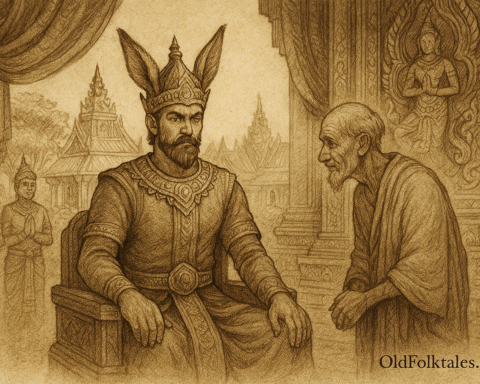
In the golden age of Bagan, when the plains of central Myanmar were crowned with thousands of pagodas gleaming like jewels under the tropical sun, there ruled a mighty king named Anawrahta. He was a monarch of great vision and fierce determination, credited with unifying the land and establishing Theravada Buddhism as the spiritual foundation of his realm. Under his command, brick by brick and prayer by prayer, the landscape transformed into a sacred geography of stupas, temples, and monuments that would endure for centuries.
Among the king’s most trusted warriors were two half-brothers known as Shwe Hpyin Gyi and Shwe Hpyin Nge. Their names meant “Big Golden” and “Little Golden,” and they lived up to these titles through their exceptional strength, courage, and unwavering loyalty. Though they shared only one parent, their bond was forged stronger than blood alone could create. They fought side by side in the king’s campaigns, their prowess in battle legendary throughout the kingdom. Villages spoke in hushed, admiring tones of how the brothers could defeat entire groups of enemies, how their coordination in combat seemed almost supernatural, as if they shared one mind between two bodies.
When King Anawrahta conceived a grand project the construction of a magnificent pagoda at Taungbyone, a village north of his capital he naturally entrusted the brothers with a task of great symbolic importance. They were to place two specific bricks into the structure at a crucial point in the construction, bricks that had been blessed by monks and were meant to imbue the pagoda with spiritual protection and permanence.
Click to read all East Asian Folktales — including beloved stories from China, Japan, Korea, and Mongolia.
“This is not merely a building,” the king told them, his voice carrying the weight of sacred purpose. “This pagoda will stand as a testament to our faith, a beacon for all who seek merit and wisdom. The bricks you place will be its spiritual cornerstone. Do not fail me in this.”
The brothers bowed deeply, pressing their foreheads to the ground in the traditional gesture of absolute obedience. “We hear and obey, Your Majesty,” they said in unison. “We will guard these bricks with our lives and place them exactly as you command.”
They set out for Taungbyone with the blessed bricks wrapped carefully in silk cloth, accompanied by other soldiers and laborers who would work on the pagoda. The journey through the dusty plains was long, and when they finally arrived at the construction site, the village was alive with energy and excitement.
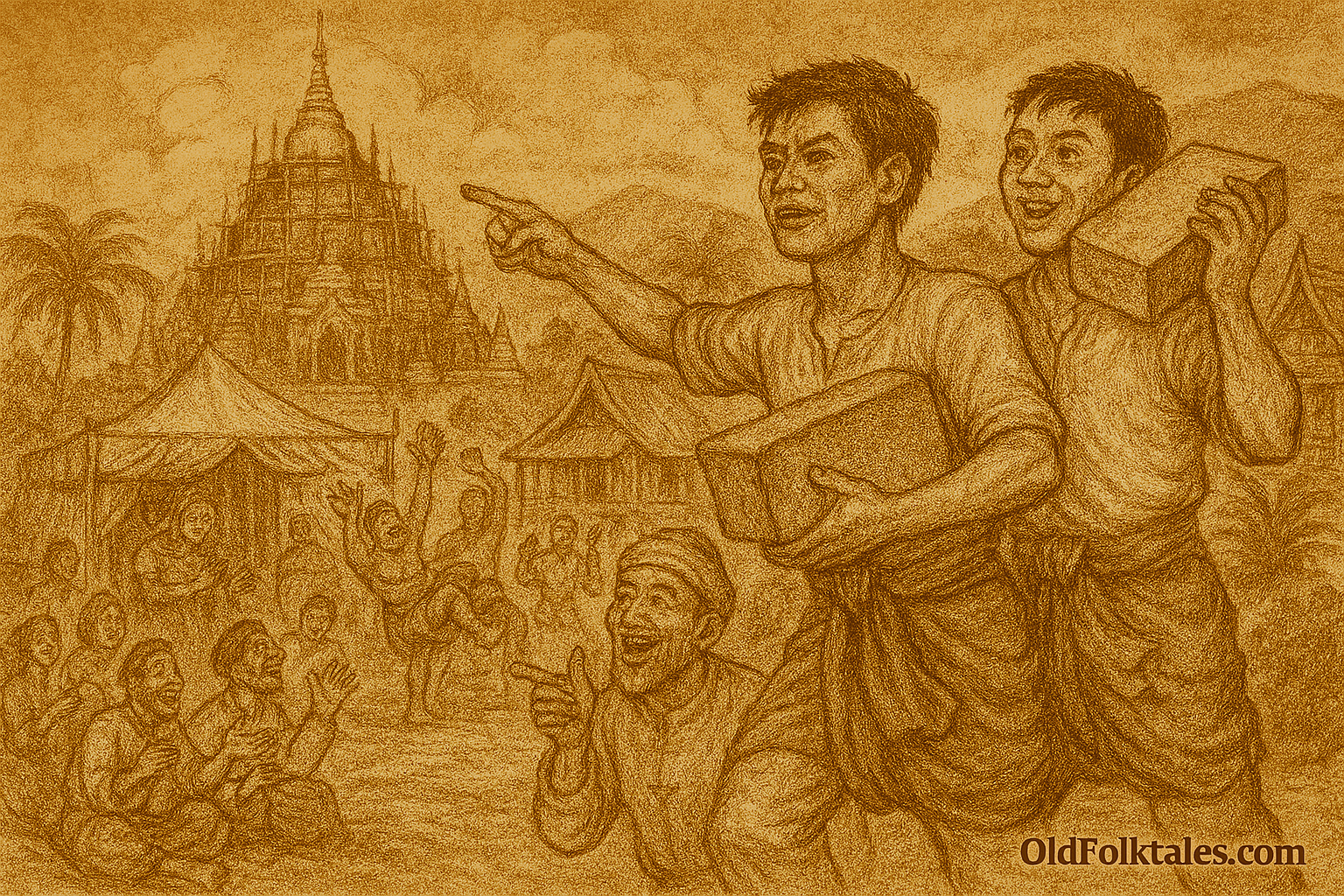
The building of a pagoda was never just a construction project in Burma, it was a festival, a merit-making celebration that drew people from surrounding areas. The air buzzed with activity and joy. Merchants had set up stalls selling everything from fragrant curries to sweet palm sugar treats. Musicians played bamboo xylophones and drums, their rhythms infectious and lively. Storytellers captivated crowds with ancient tales. Puppet shows delighted children and adults alike, the intricately carved marionettes dancing on strings manipulated by masters of the craft.
And there were wrestling matches traditional Burmese wrestling that drew crowds of cheering spectators. Strong men grappled and strained, their oiled bodies gleaming with sweat as they fought for honor and prizes.
The brothers, having safely delivered the blessed bricks to the site, told themselves they had time. The construction was ongoing, the exact moment for placing the bricks had not yet arrived. Surely they could enjoy the festivities for a little while. After all, they had traveled far, and the celebration was in honor of the very pagoda they were helping to build.
They watched one wrestling match, then another. The excitement was contagious. When someone offered them cups of palm wine that sweet, potent drink made from the sap of toddy palms they accepted. One cup led to another. The afternoon sun beat down warmly, the wine flowed freely, and time seemed to slow and blur in the pleasant haze of festival revelry.
They laughed at the puppet shows, where clever characters outwitted demons and fools. They placed bets on wrestling matches, cheering wildly when their chosen fighter won. They ate grilled skewers of meat and sticky rice wrapped in banana leaves. The blessed bricks, so carefully guarded on their journey, now sat wrapped and waiting in a corner, temporarily forgotten as the brothers lost themselves in celebration.
Meanwhile, back at the construction site, workers prepared for the ceremonial placement of the foundation elements. The head architect called for the blessed bricks. When they could not be found, confusion rippled through the assembled crowd. Where were the bricks? Where were the brothers who had been entrusted with them?
By the time someone located Shwe Hpyin Gyi and Shwe Hpyin Nge flushed with wine, laughing at some joke, completely unaware of the crisis they had caused the damage was done. Word had already been sent to King Anawrahta that the ceremony had been delayed because his chosen warriors had neglected their sacred duty.
The king arrived for the inspection expecting to see the pagoda progressing according to plan. Instead, he found disorder, delay, and worst of all, the two crucial bricks still unwrapped and unplaced. His face darkened like storm clouds gathering over the mountains.
Before the brothers could explain before they could express their remorse and beg forgiveness a court official stepped forward. This man, harboring his own grudges and jealousies, saw an opportunity to remove rivals from the king’s favor.
“Your Majesty,” he said with false concern, “these brothers deliberately ignored your command. They showed disrespect not only to you but to the Buddha himself. They chose wine and entertainment over sacred duty. Such insolence cannot be tolerated.”
The accusation was false the brothers had been careless, yes, but not deliberately disrespectful. They had simply been caught up in the celebration, losing track of time in a moment of human weakness. But the official’s words struck the king at his most vulnerable point: his pride and his religious devotion.
In his anger, King Anawrahta pronounced a terrible sentence: the brothers would be executed for their negligence and disrespect.
The brothers fell to their knees, protestations dying on their lips as they saw the immovable fury in their king’s eyes. They had served him faithfully for years, had risked their lives countless times in his service, but in this moment, none of that mattered. They were led away in chains.
The execution was carried out swiftly. The two brothers, who had faced death together so many times in battle and always emerged victorious, now faced it in chains for a crime that amounted to nothing more than poor judgment and unfortunate timing.
By the time the truth emerged that the delay had been careless oversight, not deliberate defiance, and that the accusing official had exaggerated out of personal malice it was far too late. The brothers were already dead, their bodies already cold.
But death did not end their story. It transformed it.
Strange events began to plague Taungbyone and the surrounding area. Crops that should have thrived withered in the fields. Livestock sickened and died without apparent cause. People fell ill with mysterious fevers. Tools broke at crucial moments. Accidents became common. The air itself seemed heavy with unseen anger, as if the land had been cursed.
The villagers knew immediately what was happening: the brothers’ spirits had not found peace. They had been wrongfully killed, their loyalty rewarded with execution, and now their angry ghosts their nats wandered restlessly, causing havoc as a reflection of the injustice done to them.
King Anawrahta, recognizing the supernatural crisis his hasty judgment had created, consulted with monks and spirit mediums. The solution was clear: the brothers must be honored, not punished. They must be elevated to the status of guardian nats, given offerings and respect, their anger transformed into protection.
The king decreed that Shwe Hpyin Gyi and Shwe Hpyin Nge would be officially recognized as nats powerful spirits worthy of veneration. An annual festival would be held in their honor at Taungbyone, where people could make offerings, perform dances, play music, and seek the brothers’ blessings and protection.
The moment the decree was made and the first offerings presented, the troubles ceased. The crops recovered. Health returned. It was as if the land itself had exhaled in relief.
Centuries have passed since that fateful day, but the Taungbyone Nat Festival continues to this day. Every year, thousands of devotees journey to the shrine, bringing elaborate offerings of food, alcohol, flowers, and incense. Mediums called nat kadaws enter trance states, allowing the brothers’ spirits to temporarily possess them and communicate with worshippers. Music fills the air the same kinds of festive sounds that once distracted the brothers, now offered in their honor. Dancers perform, their movements graceful and hypnotic, designed to please the spirits.
The brothers, once executed for a moment of weakness, are now among Myanmar’s most beloved and powerful nats. People pray to them for protection, for good fortune, for help with life’s struggles. And the spirits, it is said, respond generously to those who approach with sincere hearts perhaps because they remember what it was to be human, to make mistakes, and to suffer consequences far exceeding the crime.
Click to read all Southeast Asian Folktales — featuring legends from Thailand, Indonesia, Vietnam, and the Philippines.
The Moral of the Story
This Myanmar legend teaches us about the tragic consequences of hasty judgment and the importance of tempering justice with mercy and truth. The Taungbyone brothers were loyal servants who made a careless mistake, yet were punished as if they had committed deliberate treason. Their transformation from executed soldiers to revered guardian spirits reminds us that wrongs must be acknowledged and made right, even after death. The story also illustrates the Burmese understanding that spirits of those who died unjustly must be honored and appeased, and that anger transformed through recognition and respect becomes protective power. True justice requires patience, investigation, and proportionate response.
Knowledge Check
Q1: Who were Shwe Hpyin Gyi and Shwe Hpyin Nge?
A: They were half-brothers who served as strong, loyal soldiers during King Anawrahta’s reign in Bagan, Myanmar. Known as “Big Golden” and “Little Golden,” they were trusted warriors famous for their strength, courage, and exceptional coordination in battle.
Q2: What task did King Anawrahta give the Taungbyone brothers?
A: The king entrusted them with placing two blessed bricks into the foundation of a new pagoda being constructed at Taungbyone. These bricks had been consecrated by monks and were meant to provide spiritual protection and permanence to the sacred structure.
Q3: Why were the brothers executed?
A: The brothers became distracted by festival activities wrestling matches, puppet shows, and palm wine—and failed to place the blessed bricks at the proper time. A jealous court official falsely accused them of deliberate disrespect, and King Anawrahta, in his anger, ordered their execution before the truth could be revealed.
Q4: What is a nat in Burmese culture?
A: A nat is a powerful spirit in Myanmar’s traditional belief system that exists alongside Buddhism. Nats can be nature spirits or spirits of deceased humans, especially those who died unjustly or violently. They must be honored and appeased with offerings to gain their protection and avoid their wrath.
Q5: What happened after the brothers were wrongfully executed?
A: Their angry spirits began causing supernatural disturbances in Taungbyone crops failed, livestock died, people fell ill, and accidents multiplied. King Anawrahta recognized these as signs of the brothers’ restless spirits and decreed they be honored as guardian nats with an annual festival.
Q6: What is the Taungbyone Nat Festival?
A: It is Myanmar’s largest and most famous nat festival, held annually to honor the Taungbyone brothers. Thousands of devotees attend to make offerings of food, alcohol, flowers, and incense, watch spirit mediums enter trance states, and seek blessings and protection from the brothers who are now considered powerful guardian spirits.
Cultural Origin: Burmese people, Myanmar (formerly Burma), during the Bagan Dynasty period