Before memory, before names, before the very concept of time itself, there existed only two vast realms: Langit, the Sky, and Dagat, the Sea. They stretched endlessly in all directions, meeting at a horizon that was neither beginning nor end. Langit arched above like an enormous dome of endless blue, sometimes brilliant with light, sometimes dark and studded with distant stars. Below, Dagat rolled and heaved, a limitless expanse of water that had no shore, no boundary, no place to rest.
These two primordial forces existed in eternal tension. They were opposites, yet inseparable the Sky could not exist without the Sea to reflect its vastness, and the Sea had no meaning without the Sky to define its surface. But their relationship was not peaceful. They clashed constantly, pushing against each other’s boundaries in a cosmic struggle that had no witness, no referee, no end.
Click to read all East Asian Folktales — including beloved stories from China, Japan, Korea, and Mongolia.
The Sky would press downward, trying to crush the Sea into stillness. The Sea would surge upward in massive waves, attempting to breach the Sky’s infinite ceiling. Thunder rumbled from their collisions. Lightning cracked across the void. The chaos of their conflict was absolute, yet purposeless a dance of power with no partner, a war with no victor possible.
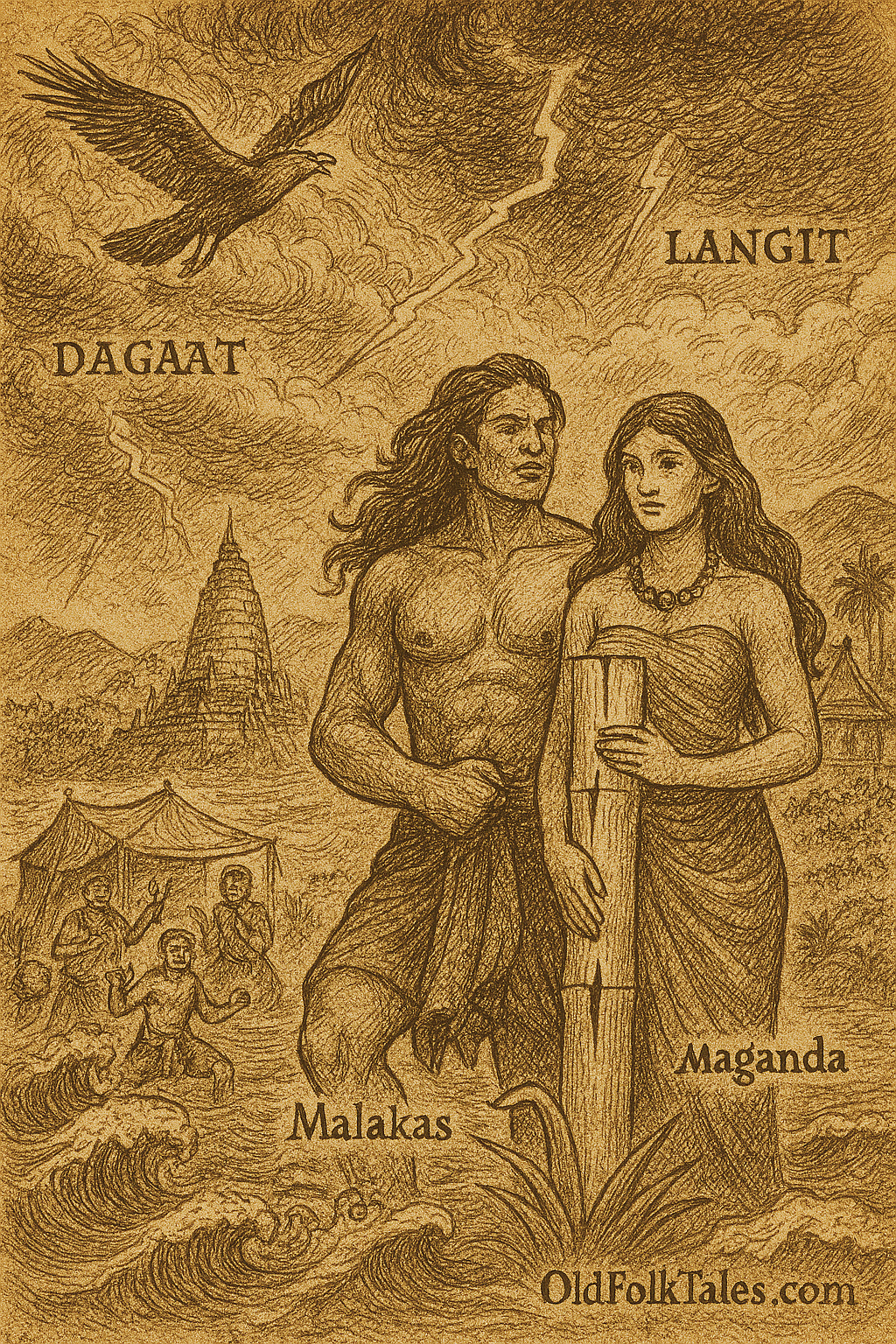
In this primordial battlefield, there flew a solitary bird. Its wings were enormous, spanning distances that had no measure in a world without landmarks. Some say it was a hawk, others claim it was an eagle, still others believe it was a creature unlike any that exists today something ancient and elemental, as old as the conflict itself. The bird’s feathers shimmered with colors that shifted between the blue of Sky and the green-blue of Sea, as if it belonged to both realms and neither.
For eons beyond counting, this bird circled through the emptiness, searching for something it could barely conceptualize: land. A place to rest its weary wings. A solid surface where it might pause in its eternal flight. But there was nothing. Only Sky above and Sea below, locked in their endless, exhausting contest.
The bird grew desperate. Its wings ached with fatigue beyond endurance. The monotony of the empty world pressed on its consciousness like a weight. In its frustration and exhaustion, the bird decided to act. If the universe would not provide land, perhaps it could force the universe to create it.
With deliberate purpose, the bird descended toward the Sea. Its powerful wings began to beat with rhythmic force, not for flight but for agitation. It swept its wings across the water’s surface again and again, creating disturbances that grew into waves, then larger waves, then towering swells that rolled outward in all directions.
The Sea, already volatile from its eternal conflict with the Sky, responded to this provocation with fury. Massive waves rose like moving mountains, crashing upward with unprecedented violence. They surged higher than they had ever reached before, slamming against the Sky with thunderous force.
Langit, the Sky, had endured the Sea’s aggression for countless ages, but this assault was different more violent, more sustained, more threatening to the delicate balance of their cosmic struggle. The Sky realized that if this continued, the very structure of existence might collapse into chaos too complete for even these primal forces to survive.
In response, the Sky did something unprecedented: it created. It reached into its own substance and formed solid matter chunks of earth, masses of rock, expanses of soil and stone. With tremendous force, the Sky hurled these newly formed islands downward into the Sea.
The islands crashed into the water with explosive impact, sending spray higher than the tallest waves. They sank partially, then stabilized, floating in the Sea’s embrace. Some were small, barely more than rocks protruding above the surface. Others were vast, with mountains and valleys, rivers and forests. The Sea, suddenly interrupted by these solid obstacles, began to calm. Its waves broke against the shores of the islands instead of rising unimpeded toward the Sky. The cosmic conflict did not end, but it transformed into something more balanced, more sustainable a dynamic tension rather than pure warfare.
The bird, witnessing this miraculous transformation, felt relief flood through its exhausted body. Land! Finally, land existed! It circled downward toward the nearest island, its keen eyes scanning for a suitable resting place.
On the shore of this new island, the bird spotted something unusual: a giant bamboo stalk, thick as several men standing side by side, floating in the shallow water where Sea met land. The bamboo swayed gently with the waves, and from within it came a strange sound not quite voices, but something alive, something waiting.
Curious, the bird approached. It landed on the bamboo, feeling its solid, smooth surface beneath its talons. The sound from within grew more distinct, more urgent. The bird tilted its head, listening, then made a decision. It raised its sharp beak and began to peck at the bamboo’s surface.
The first pecks barely scratched the tough exterior. But the bird persisted, driven by curiosity and something deeper a sense that this action was somehow necessary, somehow destined. Its beak struck again and again, each impact creating small cracks that slowly spread and connected.
Finally, with a sound like thunder splitting stone, the bamboo split open.
Brilliant light poured from the opening, bright as dawn breaking over the new world. And from within the bamboo emerged two figures, stepping out into existence as if they had always been waiting for this precise moment.
The first was a man, tall and magnificently strong. His muscles moved beneath his skin with the power of tides and the solidity of mountains. His eyes held the determination of Sky pushing against Sea, the endurance of waves that never stop. He stood on the island’s shore and looked around at the new world with wonder and recognition, as if seeing remembered dreams made real. This was Malakas the Strong One, the embodiment of power and resilience.
Behind him emerged a woman of breathtaking beauty. Her movements held the grace of wind across water, the elegance of sunlight dancing on waves. Her eyes reflected the depth of the Sea and the infinite reach of the Sky. She stood beside Malakas, neither behind nor ahead, but equal, complementary, complete. This was Maganda the Beautiful One, the embodiment of grace and wisdom.
They looked at each other, these first two humans, and understanding passed between them without words. They had been born together from the bamboo, separate yet connected, different yet unified. In Malakas’s strength was the foundation for survival; in Maganda’s beauty was the inspiration for thriving. Together, they were whole.
The bird, its purpose fulfilled in ways it had not anticipated, spread its enormous wings and took flight, circling once above the couple in blessing before disappearing into the distance between Sky and Sea.
Malakas and Maganda began their work. With Malakas’s strength, they gathered materials bamboo, palm fronds, vines and built shelters that could withstand the elements. With Maganda’s insight, they learned which plants were good to eat, which could heal, which could harm. Together, they explored the island, naming things as they encountered them, learning the rhythms of sun and moon, rain and drought.
As time passed, they had children many children each inheriting different combinations of their parents’ qualities. Some possessed great strength, others profound wisdom. Some were fierce like storms, others gentle like morning light. These children spread across the islands that the Sky had cast into the Sea, establishing communities in valleys and on coastlines, in mountains and on plains.
These descendants became the many tribes of the Philippines the Tagalog, the Visayan, the Ilocano, the Bicolano, and countless others. Each tribe developed its own customs and languages, but all traced their ancestry back to that first bamboo on that first shore, to Malakas and Maganda, who emerged from chaos into creation.
The story passed from generation to generation, told by firelight and under stars, a reminder of origin and essence. It taught that humanity was born from the elements themselves from the conflict and cooperation of Sky and Sea, from the bamboo that grows between earth and air, from the balance of strength and beauty, power and grace.
To this day, when Filipinos speak of ideal partnerships, they invoke the names of Malakas and Maganda. When they see bamboo swaying in the wind, some remember that from such simple plants came the complexity of human existence. And when they look at the thousands of islands scattered across their archipelago, they see not random geography but the deliberate gift of the Sky the foundation upon which the first humans built their world.
Click to read all Southeast Asian Folktales — featuring legends from Thailand, Indonesia, Vietnam, and the Philippines.
The Moral of the Story
This Tagalog creation myth teaches us that humanity emerged from the balance and harmony of opposing forces sky and sea, strength and beauty, masculine and feminine. Malakas and Maganda were born together, equal and complementary, showing that human flourishing requires both power and grace, action and wisdom. The story emphasizes that the diversity of Filipino peoples all share common origins, and that ideal relationships are built on mutual respect and the recognition that different qualities combine to create wholeness. From cosmic chaos came purposeful creation, and from a simple bamboo came the complexity of human civilization.
Knowledge Check
Q1: What existed before the creation of land in this Philippine myth?
A: Only two primordial forces existed: Langit (the Sky) and Dagat (the Sea). They were locked in eternal conflict, constantly clashing against each other with no land, no solid ground, and no living creatures except for one giant bird.
Q2: What role did the giant bird play in Philippine creation?
A: The exhausted bird, desperate for land to rest upon, agitated the Sea by beating its wings, causing massive waves that threatened the Sky. This forced the Sky to create and hurl islands into the Sea to calm the chaos, inadvertently creating the Philippine archipelago.
Q3: Who are Malakas and Maganda?
A: They are the first man and woman in Tagalog creation mythology. Malakas means “the Strong One” and represents power and resilience, while Maganda means “the Beautiful One” and represents grace and wisdom. They emerged together from inside a giant bamboo stalk.
Q4: What is the significance of bamboo in this creation story?
A: The bamboo serves as the vessel from which the first humans emerged, symbolizing the connection between earth and sky, flexibility and strength. Bamboo is culturally significant in the Philippines, representing resilience and the ability to bend without breaking.
Q5: How did Malakas and Maganda populate the Philippines?
A: Together, they built shelters, learned to cultivate the land, and had many children. These children inherited different combinations of their parents’ qualities and spread across the newly formed islands, establishing the various tribes and communities that became the Filipino people.
Q6: What cultural values does this myth represent?
A: The story emphasizes complementary balance between masculine and feminine qualities, the equality of strength and beauty, the unity of opposites, and the common origin of all Filipino peoples. It teaches that wholeness comes from combining different but equal forces, and that harmony emerges from respecting and balancing opposing elements.
Source: Adapted from Philippine Folk Literature: The Myths compiled by Damiana L. Eugenio
Cultural Origin: Tagalog people, Philippines (pre-colonial indigenous tradition)