There once lived a poor man in a small Lebanese village nestled between olive-covered hills and narrow stone paths. His home was modest, just a single room built of rough limestone, with a low roof of wooden beams darkened by years of smoke from his cooking fire. He lived a life of quiet hardship, working from dawn to dusk and earning barely enough to feed himself. Yet he possessed a peaceful spirit, grateful for the little he had.
One night, after a long day of labor, he fell into a deep, exhausted sleep. In his dream, a clear, commanding voice called out to him as if carried by the night wind: “Go to Istanbul. There, under a great bridge, your treasure awaits.” He awoke before dawn, startled. The dream felt different, urgent, as if it had come from beyond ordinary imagination.
He brushed it aside, telling himself that poor men often dream of riches when hunger gnaws at their bellies. But the next night, the same dream returned. The same voice. The same message. The same bridge in distant Istanbul. When it came a third time, exactly as before, he could no longer ignore it.
“Three times,” he murmured. “This must mean something.”
Though he had little money and even less strength for travel, he felt compelled to follow the dream. He packed a small bundle of bread, filled a goatskin with water, and, before sunrise, began the long and uncertain journey northward.
The road was harsh. He walked through valleys and mountain passes, slept beneath trees, and accepted scraps of food from kind strangers. Days stretched into weeks. Still he pressed on, guided by the hope that, at last, fortune might smile upon him.
When he finally reached the outskirts of Istanbul, the great city rose before him like a dream brought to life, towers glinting in the sun, domes shining like polished copper, and a sea of bustling markets and crowded streets. He made his way to the bridge from his visions, a massive structure arched over the flowing waters, its stones worn smooth by countless travelers.
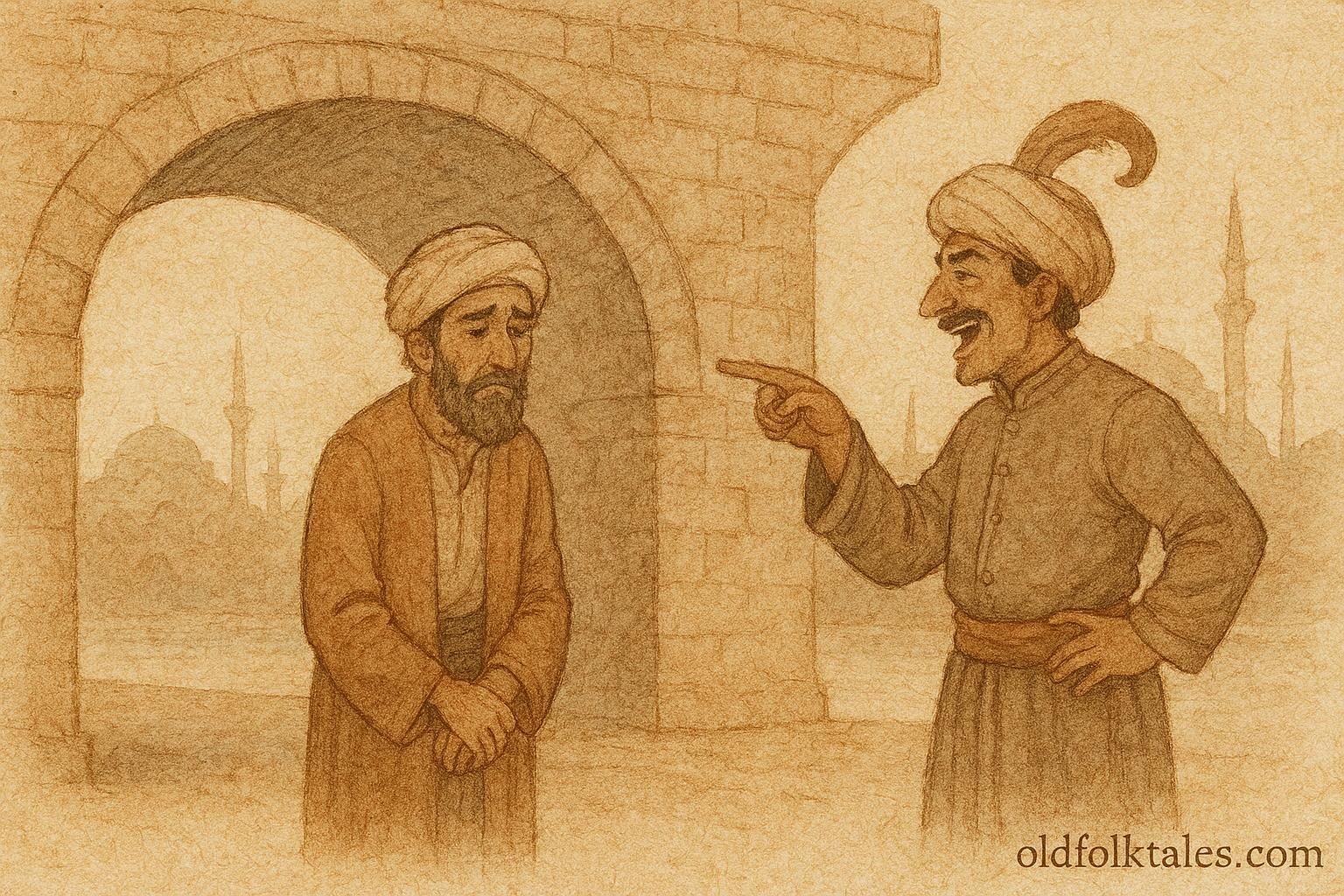
He stood there uncertainly, staring at the bridge, wondering what to do next. His exhaustion must have made him look suspicious, for before long a guard approached him. The guard, tall and broad-shouldered, eyed him with mild annoyance.
“What are you doing here, old man?” the guard demanded.
The poor man hesitated. At last, he told the truth. “I dreamed three times that a treasure lies beneath this bridge. So I came all this way to search for it.”
The guard burst into laughter, shaking his head, his armor clinking with the motion.
“A dream? You crossed half the world because of a dream?” he said incredulously. “If I believed dreams, I’d be even more foolish than you.”
The poor man lowered his eyes, feeling heat rise to his cheeks. But the guard continued, amused by his own thoughts:
“Why, last month I dreamed that in a poor man’s house, far from here, there was treasure buried under his stove!” He scoffed loudly. “A poor man, in a tiny village, with treasure under his own stove! Can you imagine anything more ridiculous?”
At the guard’s words, something inside the poor man went still. His breath caught. His heart beat like thunder.
That house in the guard’s dream… the faraway village… the simple stove…
He recognized it.
It was his house. His stove.
The treasure he had crossed mountains and borders to find had been in his home all along.
He thanked the guard with a small bow, though the guard thought he was bowing in apology for troubling him, and quickly left the bridge. This time he traveled with purpose. Hunger no longer mattered. Weariness no longer slowed him. He felt as if he were being carried home by hope itself.
When he reached his village after many days, he rushed inside his tiny stone house. Without hesitation, he cleared away the pottery and ashes from his old stove. He dug into the packed earth beneath it. His fingers struck something hard. He dug faster, and at last pulled out a heavy clay jar sealed with wax.
Inside lay a treasure, coins and ornaments of gold and silver, buried long ago and long forgotten.
Tears filled his eyes, not from greed but from gratitude. The dream that had driven him from home had led him back to the very place where his fortune waited. All the hardship of the journey had taught him to look with new eyes at the life he once thought hopelessly ordinary.
Moral Lesson
The story teaches that sometimes we must travel far and face hardship to discover blessings that were always close to us. True wealth, whether literal or symbolic, often lies within our own homes, but we need the journey to recognize it.
Knowledge Check
1. What prompted the poor man to travel to Istanbul in the folktale “The Dream”?
He was guided by a recurring dream that promised treasure beneath a bridge in Istanbul.
2. Why is the dream repeated three times in the story?
The repetition symbolizes certainty and divine or fate-driven guidance common in Middle Eastern folklore.
3. What role does the guard play in the folktale?
The guard unknowingly reveals the true location of the treasure, triggering the man’s realization.
4. What is the main moral lesson of “The Dream”?
That the treasure we seek is often in our own home, but the journey teaches us to recognize it.
5. Where does this Lebanese folktale originate?
It was collected from Bteghrine in the Metn District of Lebanon.
6. How does “The Dream” reflect traditional Middle Eastern storytelling?
Through recurring symbolic dreams, humble characters, long journeys, and lessons about fate and self-discovery.
Source