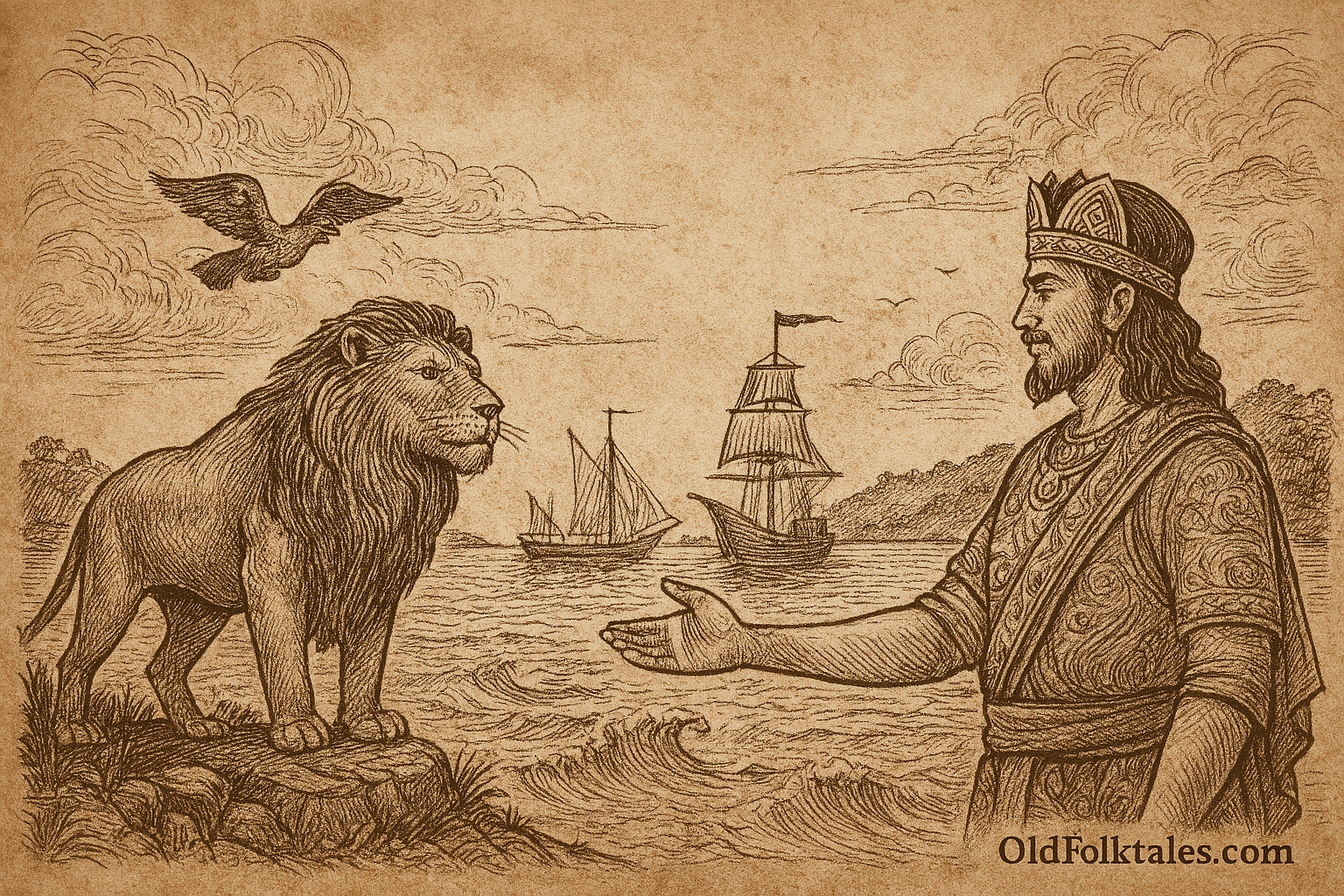
In the golden age of the Srivijaya Empire, when Malay kingdoms commanded the seas and controlled the vital trade routes between India and China, there lived a prince named Sang Nila Utama. His name meant “The Lion Lord of Red Blood,” and he was descended from the royal house of Palembang, a bloodline that traced its ancestry back through generations of warrior-kings and wise rulers. Yet despite his noble birth and the comfort of palace life, Sang Nila Utama felt an unshakeable restlessness stirring in his heart.
The palace walls, no matter how grand, felt confining. The established order of his father’s kingdom, no matter how prosperous, felt limiting. The prince possessed the soul of an explorer, a vision that looked beyond familiar horizons toward possibilities that existed only in imagination and daring. He dreamed of founding his own kingdom, of carving out a legacy that would be his alone, not merely inherited but created through courage and destiny.
Click to read all East Asian Folktales — including beloved stories from China, Japan, Korea, and Mongolia.
After much contemplation and seeking the blessings of his father, Sang Nila Utama assembled a fleet of ships. These were not the crude fishing boats of common folk, but magnificent vessels of Malay craftsmanship wooden hulls carved from the finest timber, sails woven from strong cloth that could catch even the gentlest breeze and holds filled with provisions for a long journey. His most trusted advisors, skilled warriors, and loyal servants accompanied him, along with craftsmen, farmers, and families willing to follow their prince into the unknown.
They sailed from Palembang with high spirits, following the coastal routes that Malay sailors had navigated for centuries. The prince stood at the bow of his ship, feeling the salt spray on his face, watching dolphins race alongside the vessels as if blessing their journey. For days, the seas were calm and the winds favorable. The sailors took this as an auspicious sign surely the spirits of wind and wave approved of their quest.
But the sea is a fickle realm, and its moods change with terrifying swiftness.
Without warning, dark clouds boiled up from the horizon, swallowing the blue sky in moments. The wind that had been a gentle helper transformed into a howling demon, tearing at the sails with invisible claws. Waves that had been rhythmic swells became moving mountains of water that tossed the ships like leaves in a tempest. Thunder cracked overhead with the sound of worlds splitting apart, and lightning illuminated the chaos in brief, terrifying flashes.
The crew fought desperately to control the vessels, but the storm’s fury seemed supernatural in its intensity. Water crashed over the decks, threatening to drag men and supplies into the churning depths. The ships groaned under the assault, their timbers creaking ominously. Some sailors fell to their knees in prayer, crying out to the sea spirits for mercy.
Sang Nila Utama gripped the ship’s rail, his knuckles white with strain, and understood that ordinary measures would not save them. This was no natural storm it felt like the wrath of the ocean itself, as if they had somehow offended the ancient powers that ruled the deep waters. In that moment of crisis, with death rising and falling around him in walls of grey water, the prince made a choice that would echo through history.
He reached up and removed his crown the symbol of his royal authority, crafted from gold and studded with precious stones, an heirloom that had been worn by generations of his ancestors. It represented everything he was born to be, everything he had inherited. And with both hands, he raised it high above his head before hurling it into the raging sea.
“Accept this offering!” he shouted into the storm. “If I am meant to found a new kingdom, spare us! If my destiny lies ahead and not behind, calm these waters!”
The crown tumbled through the air, catching the lightning’s flash for one brilliant moment before disappearing into the waves. For a heartbeat, nothing changed. Then, as if some great creature beneath the surface had been satisfied by the sacrifice, the storm began to abate.
The wind’s howling diminished to strong gusts, then to steady breezes, then to gentle whispers. The mountainous waves subsided into rolling swells, then into moderate chop, then into the calm rhythm of normal seas. The clouds thinned and broke apart, allowing sunlight to stream through in golden columns. The transformation was so rapid, so complete, that the sailors stood in stunned silence, water dripping from their soaked clothes, unable to quite believe they had survived.
Sang Nila Utama stood at the bow, his head bare but unbowed, and looked ahead with renewed determination. He had gambled his crown his past for his future. Now he must find a land worthy of that sacrifice.
They continued sailing through newly calm waters until an island appeared on the horizon. It was not large by the standards of Java or Sumatra, but it rose from the sea with a presence that demanded attention. Dense rainforest covered its hills in every shade of green imaginable, from the dark emerald of ancient growth to the bright lime of new leaves. White sand beaches gleamed at the water’s edge, and the air itself seemed fresher, sweeter, charged with untapped potential.
“This is a sign,” one of his advisors murmured. “To find such an island so soon after the storm’s end surely this is our destination.”
The prince ordered the ships to approach carefully. They anchored in a protected bay where a river emptied into the sea, providing fresh water. Sang Nila Utama was the first to step onto the beach, his feet sinking into sand that no royal foot had ever touched before. The sensation filled him with a profound sense of purpose this was virgin territory, a blank page upon which a new story could be written.
After establishing a camp on the beach, the prince decided to explore inland. He took a small party of his best warriors and most knowledgeable advisors, and they ventured into the rainforest. The jungle was unlike anything they had experienced thick with vegetation, alive with the calls of exotic birds, humid air heavy with the scent of flowers and earth and growing things.
They pushed through undergrowth, climbed gentle hills, forded clear streams. The prince was searching for something, though he could not have said exactly what. A sign, perhaps. A confirmation that this island was truly meant to be his.
Then, in a clearing dappled with sunlight filtering through the canopy above, he saw it.
A creature emerged from the forest shadows on the far side of the clearing. It was massive, larger than any animal the prince had encountered. Its coat was a tawny gold that seemed to capture and reflect the sunlight, making it appear almost luminous. Around its head and neck was a magnificent mane of darker gold, flowing and thick like a king’s crown of living flame. The creature moved with fluid grace despite its size, muscles rippling beneath its skin with controlled power.
Most striking of all were its eyes golden and intelligent, meeting the prince’s gaze with neither fear nor aggression, but with a kind of regal acknowledgment. Two sovereigns recognizing each other across the divide of species.
The prince and the creature stood motionless, locked in that moment of mutual observation. Then, as if satisfied with what it had seen, the creature turned and vanished into the jungle with a swiftness that seemed impossible for something so large. In seconds, it was gone as if it had never existed, leaving only the memory of its majesty.
“My lord,” one of his advisors whispered, breaking the spell. “That was a lion a singa. I have heard tales of such creatures from travelers who have journeyed to the lands far to the west, in India and beyond. They are considered the kings of beasts, symbols of royal power and courage.”
Sang Nila Utama nodded slowly, his mind racing. Lions were not native to these tropical islands everyone in his party knew that. Yet they had all witnessed the creature with their own eyes. Whether it was truly a lion or some unknown animal that resembled the legendary beast, or perhaps even a manifestation of the island’s spirit taking a form that would carry meaning, the symbolism was unmistakable.
This was the sign he had been seeking.
“This island has shown me its nature,” the prince declared. “It possesses the strength and nobility of the lion. Therefore, I name this place Singapura the Lion City.”
The name resonated with power and promise. Sang Nila Utama immediately began plans to establish a settlement. His people cleared areas of the jungle, built wooden structures that would grow into palaces and temples, established farms and markets. The natural harbor proved ideal for trade, and word spread quickly through the maritime networks that a new port had been founded by a prince who had cast his crown into the sea and been blessed by a vision of a lion.
Ships began arriving from across the region Chinese junks, Indian dhows, Javanese vessels, Arab traders all drawn by opportunity and the mystique of the new settlement’s origin story. Singapura grew rapidly into a thriving entrepôt, a meeting place of cultures and commerce, a kingdom born from courage, sacrifice, and an auspicious omen.
The city that Sang Nila Utama founded would endure through centuries, transforming and evolving but always carrying the essence of that founding moment the prince who dared to sail into the unknown, who sacrificed his crown for his destiny, who recognized the significance of a majestic creature in a forest clearing, and who chose a name that would echo through history: Singapura, the Lion City.
Click to read all Southeast Asian Folktales — featuring legends from Thailand, Indonesia, Vietnam, and the Philippines.
The Moral of the Story
This Singaporean founding legend teaches us that great achievements require sacrifice, courage, and the wisdom to recognize signs of destiny. Sang Nila Utama gave up his crown his inherited status to earn his future, showing that new beginnings sometimes demand letting go of the past. His willingness to explore unknown territories and his ability to interpret the lion sighting as an auspicious omen demonstrate the importance of vision and symbolic thinking in leadership. The story reminds us that the foundations of great cities and nations are built not just on strategic planning but on bold choices, spiritual awareness, and the courage to follow signs toward an uncertain but promising future.
Knowledge Check
Q1: Who was Sang Nila Utama?
A: Sang Nila Utama was a prince of the Srivijaya Empire from Palembang who founded Singapore. His name means “The Lion Lord of Red Blood,” and he was descended from a royal lineage of Malay warrior-kings who controlled important maritime trade routes.
Q2: What sacrifice did Sang Nila Utama make during the storm?
A: When a violent storm threatened to destroy his fleet, the prince threw his royal crown a gold and jeweled heirloom worn by his ancestors into the sea as an offering. Miraculously, the storm immediately calmed, allowing the expedition to continue safely.
Q3: What did Sang Nila Utama see in the forest clearing?
A: He saw a large, majestic creature with a golden coat and a magnificent mane, which his advisors identified as a singa (lion). The creature displayed regal bearing and moved with swift, powerful grace before disappearing back into the jungle.
Q4: Why is the lion significant in this story despite not being native to Southeast Asia?
A: The lion symbolizes royal power, strength, and courage in many Asian cultures, particularly through Indian and Buddhist influence. Whether the creature was truly a lion, another animal, or a spiritual manifestation, its appearance was interpreted as an auspicious omen worthy of inspiring the city’s name.
Q5: What does “Singapura” mean and why was it chosen?
A: “Singapura” means “Lion City” in Sanskrit/Malay (singa = lion, pura = city). Sang Nila Utama chose this name after seeing the majestic lion-like creature, recognizing it as a symbol of the island’s strength and nobility and an auspicious sign for his new kingdom.
Q6: What cultural and historical significance does this legend hold?
A: The story establishes the mythical origins of Singapore, connecting its founding to themes of destiny, sacrifice, and divine favor. It reflects Malay cultural beliefs in omens and symbolic interpretation, legitimizes royal authority through supernatural approval, and provides a foundational narrative that continues to influence Singapore’s identity as the “Lion City” today.
Source: Adapted from the Sejarah Melayu (Malay Annals), as preserved by the National Archives of Singapore
Cultural Origin: Malay people, Singapore