In a quiet stretch of the Sri Lankan forest, where tall trees filtered sunlight into golden speckles on the ground, lived a Monkey known for his restless spirit. He swung from branches with effortless speed, leaping through the canopy simply because he could. Life had blessed him with agility and energy, but not with patience. And so, though he roamed widely, he had never built anything of his own, neither a shelter, nor a resting place, nor even a spot to call home.
One morning, as the forest awakened to birdsong, Monkey noticed something unusual. Near the edge of a sturdy branch, a Weaver-Bird fluttered back and forth with deliberate care. The tiny bird worked with strips of grass, each movement purposeful and exact. Monkey stopped above the branch, watching with curiosity.
Explore ancient tales from Thailand, Cambodia, and the Philippines in Southeast Asian Folktales.
“Friend,” he called, “your nest is very beautiful.”
The Weaver-Bird paused, tilting its small head in acknowledgment. “Thank you,” it replied in a gentle voice. “I build it to live in safely.”
The Monkey admired the elegant shape of the nest, woven strands tucked neatly together, suspended like a delicate basket that danced softly with the breeze. It looked strong, yet graceful. He imagined himself resting inside such a home, shaded from the sun and protected from storms.
“I want to live there too,” Monkey said eagerly.
The Weaver-Bird shook its head. “No, it is my house. You cannot live there.”
Monkey frowned. “Why not? There is room for me.”
“There is room for me,” the Weaver-Bird replied calmly, “because I built it. You must build your own.”
Monkey had never tried building anything, but at that moment, pride stirred within him. “Fine,” he said. “I will make another nest near yours.”
The Weaver-Bird nodded without argument. “If that is what you wish.”
And so Monkey set to work. But unlike the Weaver-Bird, he lacked patience. He grabbed twigs and leaves without choosing them well. He stuffed branches together but never checked if they fit. When his nest leaned, he grumbled and shoved more leaves inside. When it sagged, he ignored it. When the shape twisted oddly, he simply swung away to chase butterflies, leaving the unfinished structure behind.
The Weaver-Bird watched but said nothing. Patience, after all, was woven into every thread of his nature.
Days passed, and soon the Weaver-Bird’s nest was complete, strong, secure, and elegant. Monkey’s nest, on the other hand, remained a crude tangle of branches, flimsy and poorly balanced. But Monkey did not notice; he was satisfied simply because he had built something.
Then, one afternoon, the wind rose.
It swept through the forest in strong, playful gusts that made the leaves rustle like rain. Birds tightened their wings, small animals retreated under brush, and branches swayed in unison. Monkey had been lounging near his nest when a sudden blast of wind struck.
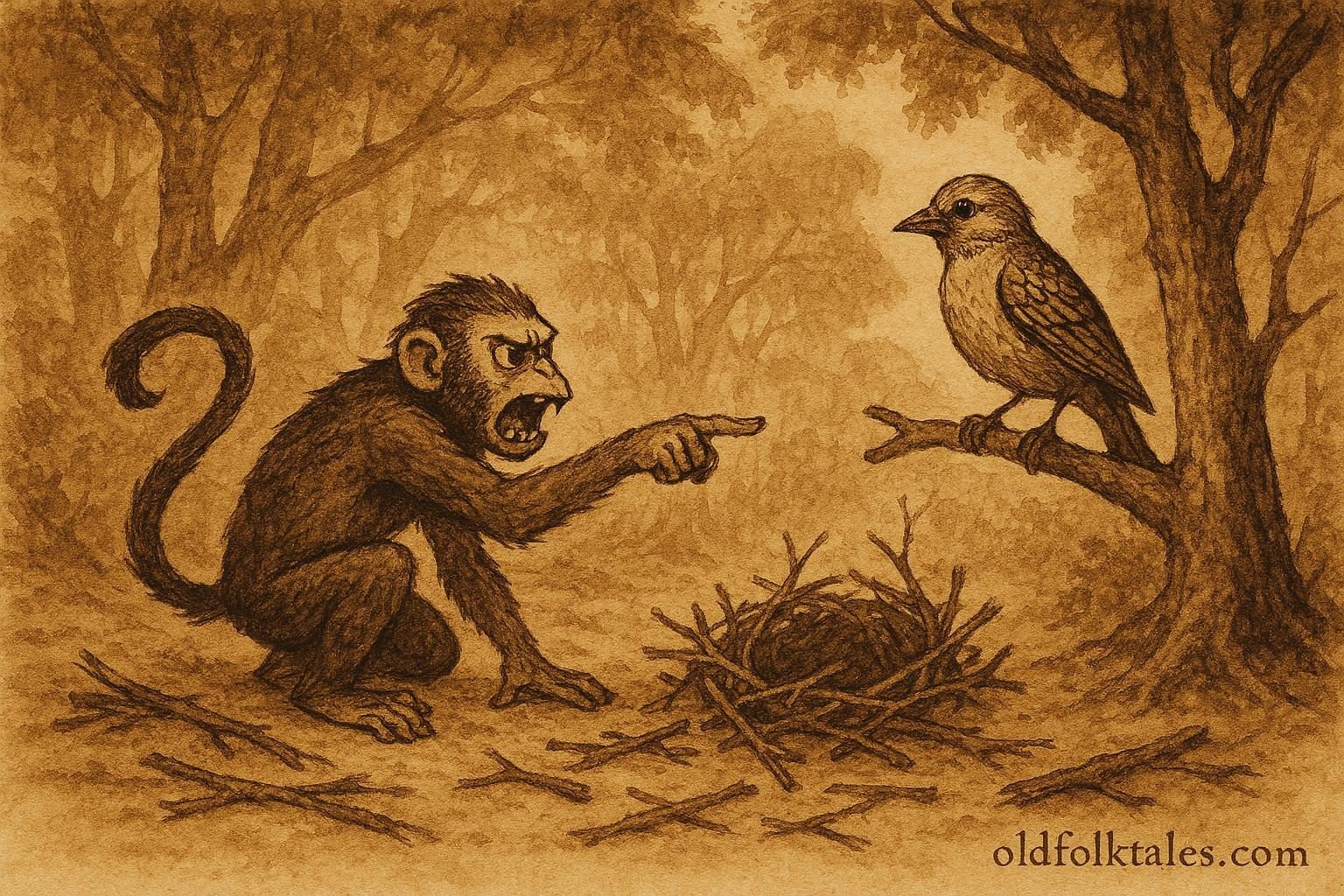
The branches of his nest trembled. Leaves flew out. The structure shook, sagged, and collapsed in a messy heap.
Monkey leaped up in shock. “Ah! My house! Who has done this?”
He looked around wildly until his gaze fell upon the Weaver-Bird, who sat calmly nearby on a branch.
“You!” Monkey cried, pointing accusingly. “You have done this! You ruined my nest because you were jealous of me!”
The Weaver-Bird blinked. “No,” he said softly. “It is the wind.”
Monkey refused to listen. His voice rose with anger. “Do not lie! You destroyed it! You saw my house and you were jealous!”
The Weaver-Bird’s calm did not waver. “Friend, I did not touch your nest. You built it quickly. You did not weave it tightly. The wind blew, and the nest fell. That is all.”
Monkey opened his mouth to argue further, but something in the Weaver-Bird’s steady gaze made him stop. The bird had spoken without anger, without defense, only truth.
Monkey looked back at the pile of leaves and branches that had been his nest. He realized that he had indeed built it carelessly. He had not taken time to weave branches together. He had not watched how the Weaver-Bird worked with patience and skill.
The truth settled on his shoulders like a heavy mantle.
Ashamed, Monkey lowered his voice. “Perhaps… perhaps I was too quick to blame you.”
The Weaver-Bird nodded gently. “Perhaps. But now you understand. A strong house is not made in haste.”
Monkey sighed. “I think I do. I will go elsewhere. I will not trouble you again.”
He leaped away through the trees, not out of anger this time, but out of quiet reflection. Though he did not return to build another nest near the Weaver-Bird, he carried the lesson with him: skill requires patience, and pride without effort brings only disappointment.
Moral Lesson
The story teaches that responsibility and humility are essential virtues. Blaming others for our own lack of effort prevents us from growing, while patience and craftsmanship lead to true stability.
Knowledge Check
1. What is the main lesson of “The Monkey and the Weaver-Bird”?
It teaches responsibility, patience, and accepting the consequences of one’s own actions.
2. Why does the Weaver-Bird refuse to share its nest?
Because it built the nest itself and needs it for its own safety and shelter.
3. What causes the Monkey’s nest to collapse?
The wind destroys it because it was built weakly and without care.
4. Why does Monkey initially blame the Weaver-Bird?
His pride prevents him from admitting his own carelessness.
5. What does the Weaver-Bird symbolize in the story?
Wisdom, patience, and the value of skilled craftsmanship.
6. Where does this folktale originate?
Sri Lanka, particularly from the Sinhalese folk tradition.
Source: Adapted from the Sinhalese folktale “The Monkey and the Weaver-Bird” in Village Folk-Tales of Ceylon, Vol. I, collected by H. Parker (1910).
Cultural Origin: Sri Lanka (Sinhalese folklore)