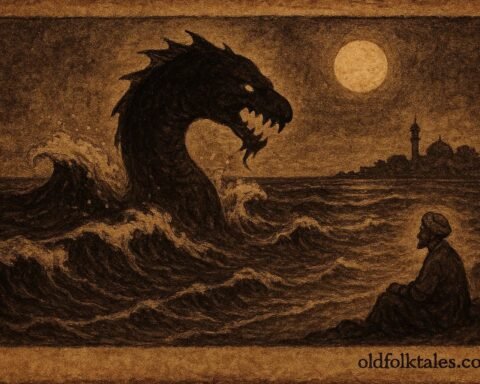
Across the scattered coral islands of the Maldives, where lagoon waters glimmer like polished glass and the outer reefs rumble with the endless breath of the ocean, there lived a creature feared by every islander. They called it Faru Furēta, the Reef Monster. Its name passed from one generation to the next, spoken in lowered voices, especially on nights when the wind rose and the sea darkened.
Faru Furēta was said to dwell at the edge of the deep reef wall, where the turquoise shallows dropped suddenly into a vast blue abyss. Islanders believed that it emerged from this shadowed realm whenever it sensed human disturbance along the reef: careless fishing, night wandering, or children playing too close to the rocks at dusk. No one claimed to have seen its full form, but stories described it as a shifting creature, part spirit, part sea-beast, with eyes that glowed from beneath the water and a voice like the grinding of coral stones.
Journey through enchanted forests and islands in our Southeast Asian Folktales collection.
In those days, life on the islands relied deeply on the reef. The fishermen sought octopus, parrotfish, and lobster among its ridges. Families gathered sea cucumbers and shells. But the reef was also respected as a boundary, a guardian, and a mystery the islanders never fully dared to cross. Faru Furēta embodied that fear, an unseen presence reminding everyone that the sea granted life, but could reclaim it without warning.
One evening, a group of young fishermen prepared their small wooden dhoni to depart for the night’s catch. The sky was heavy with clouds, and the reef murmured with a restless voice. Older men warned them, “The reef speaks tonight. Do not linger. Faru Furēta roams when the winds shift.” But the youths, eager to prove themselves, tied their lanterns high and set out, brushing aside the elders’ unease.
At first, the lagoon felt calm. Their oars cut the water softly, and the lantern reflected warm circles across the surface. But as they approached the reef edge, the sea began to darken. A low rumbling echoed beneath the boat, as though something massive moved through the caverns below.
“Do you hear that?” whispered one of the fishermen.
“It is only the current,” another replied, though his voice shook.
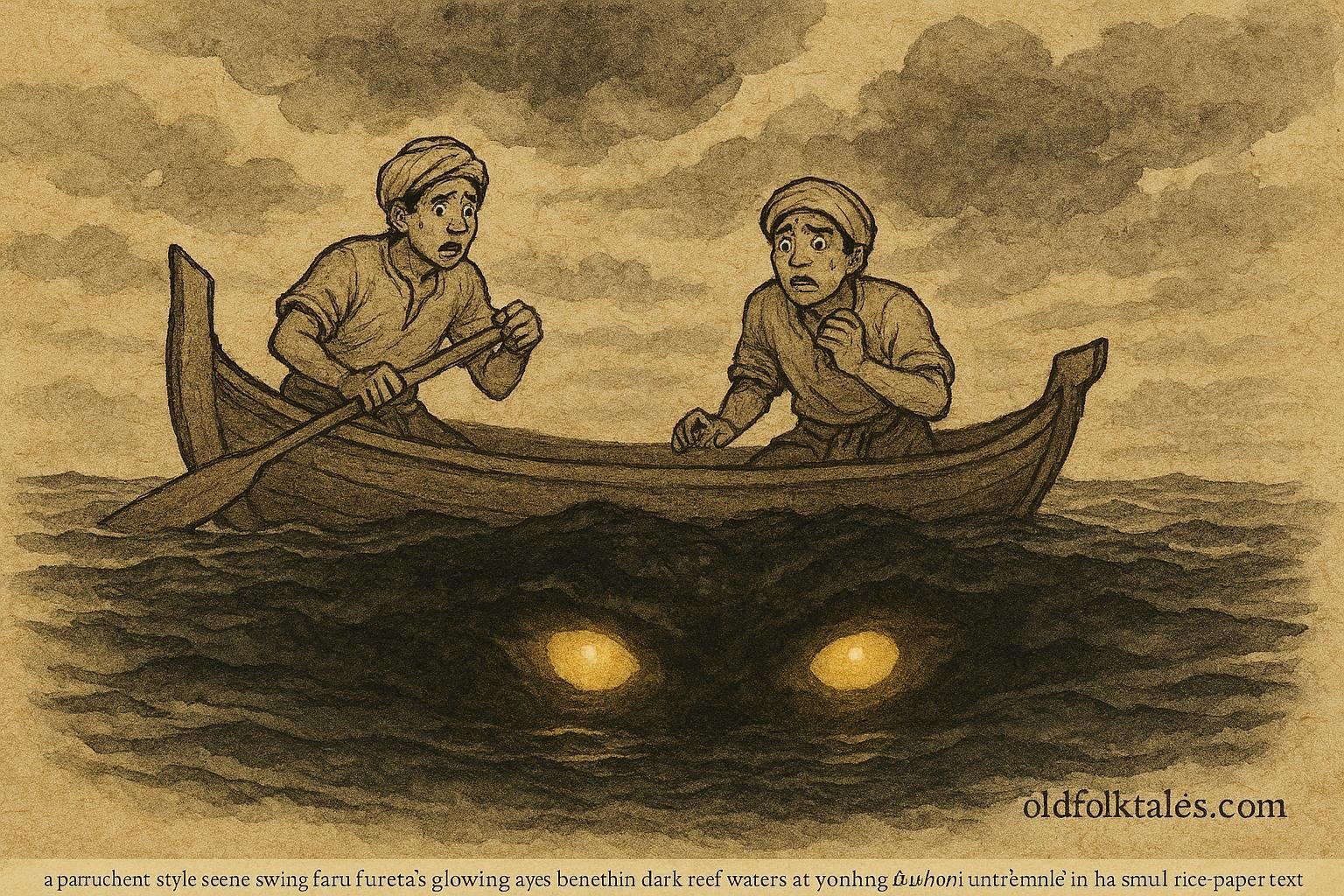
Then came a sound like a long exhale, not the wind, not the waves, but something alive. The lantern flame flickered as a chill swept over the boat. From the water, two pale lights appeared, shifting slowly beneath the surface. They were too far apart to be fish eyes, too steady to be reflections. The boat rocked as if nudged from below.
The fishermen froze.
One finally cried out, “Faru Furēta!” and they all paddled frantically, turning the boat back toward the lagoon. But the current held them as if gripping their hull. The pale lights glided closer, circling them with deliberate, silent motion.
In desperation, the youngest fisherman remembered the words of his grandmother: “When the sea-spirit rises, stay still. Fear feeds it. Silence releases you.” With trembling voice, he urged the others to stop paddling. “Wait. Be quiet. Do nothing.”
It took all their courage to obey. The boat drifted, helpless, as the glowing eyes halted directly beneath them. The sea went unnaturally still.
Moments felt like hours. Then, as slowly as they had appeared, the lights sank into the deep. The boat began to drift freely once more. The current loosened. The fishermen seized their oars and hurried back to shore, shaken but alive.
When the villagers heard what had happened, the elders nodded gravely. They reminded the youths that Faru Furēta never harmed without warning; it emerged only when humans pushed beyond the boundaries set by nature. “The reef is not ours to command,” they said. “It protects us, but it also tests us. Respect keeps us safe.”
From that night onward, the young fishermen no longer challenged the sea in foul weather or ignored the elders’ advice. They timed their journeys with care, spoke softly at the reef edge, and treated the ocean with renewed reverence.
Thus the legend of Faru Furēta continued, not merely as a tale of terror, but as a reminder of the delicate relationship between humans and the sea. In a world made of islands and water, wisdom was as essential as bravery, and caution was a form of respect.
MORAL LESSON
The tale of Faru Furēta teaches that nature demands respect, and those who ignore warnings, whether from elders, environment, or instinct, invite danger. True courage includes humility, patience, and listening to the wisdom passed down through generations.
KNOWLEDGE CHECK
1. Who is Faru Furēta in Maldivian folklore?
Faru Furēta is a feared reef-dwelling sea-spirit believed to guard the deep ocean edges surrounding Maldivian islands.
2. What does the Reef Monster symbolize in the story?
It symbolizes the power of the sea, the unknown dangers of the reef, and the cultural value of respecting nature.
3. Why did the fishermen encounter Faru Furēta?
They ignored weather warnings and ventured too close to the reef at night, disturbing the sea-spirit’s domain.
4. How did the fishermen escape Faru Furēta?
They stayed silent and still, remembering ancestral wisdom about calming the sea-spirit.
5. What lesson does Faru Furēta teach Maldivian communities?
It teaches caution, humility, and respect for natural forces that sustain and threaten island life.
6. What cultural theme is central to this folktale?
The deep connection between Maldivian identity and the surrounding ocean, especially the need to live in harmony with it.
Source: Maldivian folktale, recorded in Folk Tales of the Maldives by Xavier Romero-Frias (2012).
Cultural Origin: Maldives (Maldivian folklore)