In the time when monsoon rains drummed on temple roofs and mist clung to the rice paddies of Cambodia, a young novice monk named Vanna walked the forest paths between villages. He wore the simple saffron robes of his order, carried only his alms bowl and a worn copy of sacred sutras, and traveled alone as part of his spiritual training. His abbot had sent him on a pilgrimage to distant temples, a journey meant to test his resolve and deepen his understanding of the Buddha’s teachings.
The forest path was ancient, carved by generations of pilgrims, merchants, and monks who had walked this route long before Vanna was born. Enormous trees with roots like serpents spread their canopies overhead, filtering the afternoon light into shifting patterns of gold and shadow. The air was thick with humidity and the scent of wild jasmine. Birds called from invisible perches, and somewhere in the distance, a stream murmured over stones.
Click to read all East Asian Folktales — including beloved stories from China, Japan, Korea, and Mongolia.
Vanna walked with mindful steps, reciting sutras under his breath, his bare feet knowing the earth beneath them. He had been warned by village elders about traveling after dark. The forests of Cambodia were home to more than tigers and snakes. They harbored spirits, both benevolent and malevolent, beings that existed in the spaces between the physical and spiritual worlds.
But the path had been longer than expected, and dusk was already painting the sky in shades of purple and deep orange. Vanna quickened his pace, hoping to reach the next village before full darkness fell. Yet with each step, the light faded faster, and soon he found himself walking through a forest transformed by night into something unfamiliar and unsettling.
That was when he heard it.
A sound like wind moving through tall grass, but there was no wind. A rustling, accompanied by a faint luminescence that flickered between the trees ahead. Vanna stopped, his heart suddenly loud in his chest. Every instinct screamed at him to run, to turn back, to hide. But he was a monk, trained in discipline and mindfulness. He steadied his breathing and continued forward, his hand touching the prayer beads around his wrist.
The glow intensified, and then he saw her.
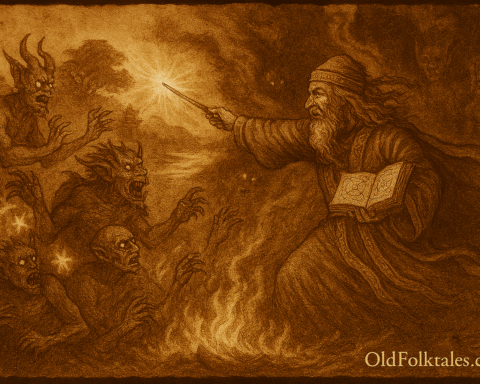
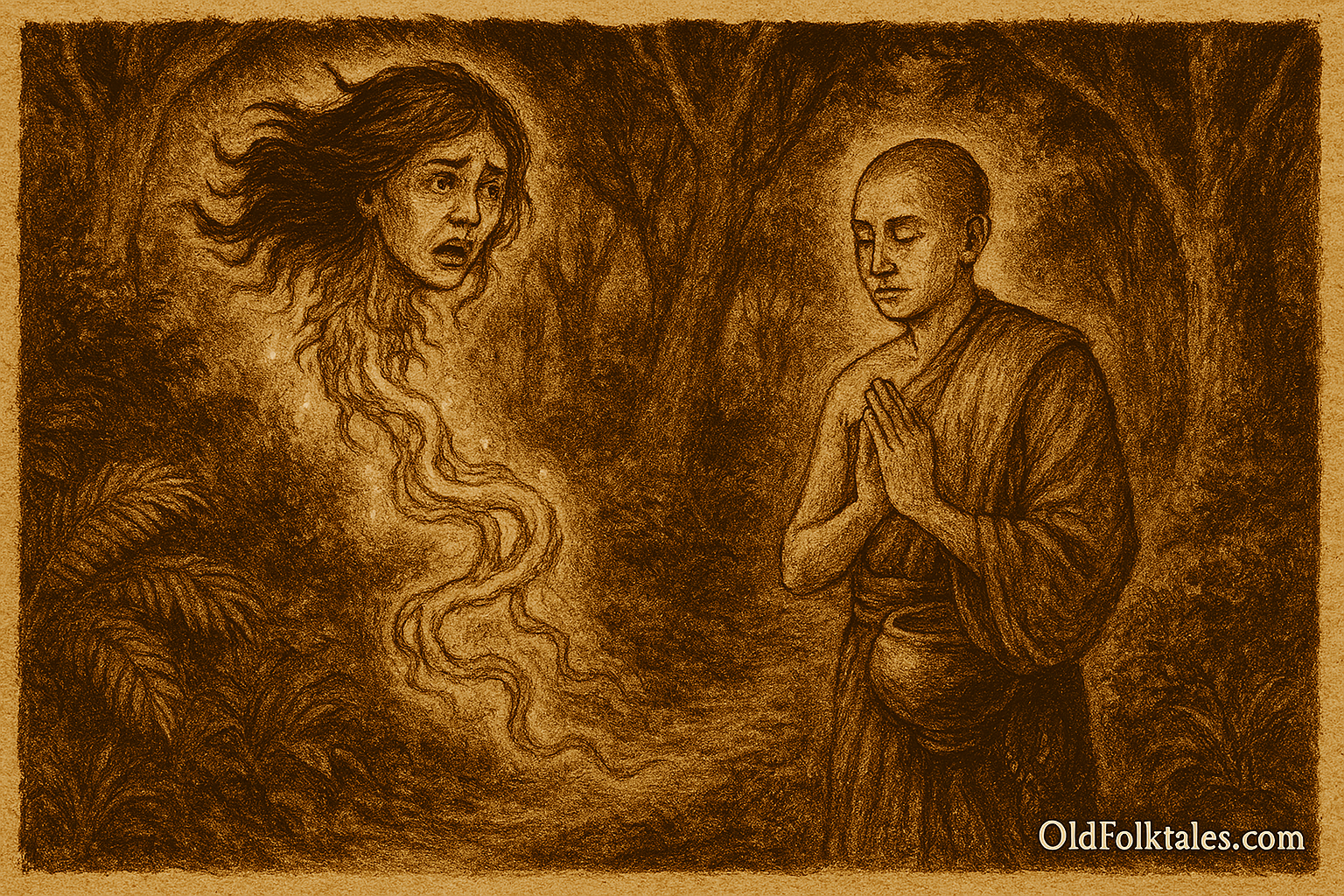
Floating through the air at head height, moving between the trees with eerie grace, was a woman’s head. But this was no ordinary severed head. Below the neck hung glowing entrails, trailing like ghostly ribbons, pulsing with a sickly greenish light that illuminated the surrounding darkness. The head itself was beautiful in a terrible way, long black hair flowing behind it as if underwater, eyes wide and searching, mouth open in an expression that was neither quite hunger nor quite anguish.
This was a krasu, one of the most feared spirits in Khmer folklore.
Krasu was once a living woman, transformed by a powerful curse born from her own consuming jealousy. In life, she had allowed envy to poison her heart until it destroyed her from within. After death, her spirit could not rest. Instead, she was condemned to wander as this grotesque form, her head separated from her body, forever hungry, forever searching, forever tormented by the very emotions that had cursed her.
The krasu drifted closer, and Vanna could now see her face clearly. Her eyes held centuries of suffering, a pain so deep it seemed bottomless. When she opened her mouth, her voice was like dried leaves scraping stone, a sound that barely qualified as human.
“Monk,” she whispered, the word stretching and distorting. “Young monk with your pure heart and your prayers. Do you fear me?”
Vanna felt fear, yes. His hands trembled and his breath came quick. But beneath the fear, something else stirred. His teacher had spoken of this, how true compassion must extend even to beings who inspire terror, how every spirit, no matter how twisted or dangerous, was once someone who suffered.
He pressed his palms together in the traditional gesture of respect and spoke, his voice barely steady. “I see you, sister. I see your pain.”
The krasu recoiled as if struck, her glowing entrails flaring brighter. “Sister? You call this horror sister? Look at me! I am cursed, damned, a monster that frightens children and haunts the dreams of the living!”
“You are suffering,” Vanna replied, and now his voice grew stronger, grounded in the teachings he had internalized through years of study and meditation. “You are trapped by the very emotions that created your curse. But suffering can end. The Buddha taught this above all else.”
“How?” The word came out as a wail, echoing through the forest. “How can this end? I have wandered for lifetimes, bound to this form, unable to die, unable to live, forever caught between worlds!”
Vanna reached into his robe and withdrew his prayer beads and sutra text. He began to chant, not the protective verses meant to ward off evil spirits, but the verses of compassion, the teachings about the nature of suffering and the path to its cessation. His voice rose clear and pure in the darkness, each syllable a thread of light cast into shadow.
The krasu drifted closer, drawn by the sound. As Vanna chanted, he could feel something shift in the air around them. The temperature, which had been oppressively warm, grew cooler and cleaner. The sickly green glow emanating from the spirit began to change, taking on warmer tones, gold mixed with the green.
“In life, I loved a man,” the krasu said, her voice changing, becoming more human, more woman than monster. “He chose another, and the jealousy consumed me. I plotted and schemed. I spoke poison. I wished them harm. When the curse fell upon me, it was my own hatred that shaped it.”
“Jealousy is a fire that burns the one who carries it,” Vanna said gently, continuing to move his prayer beads through his fingers, continuing to chant between his words. “But no fire burns forever. Even the strongest flame can be extinguished by compassion.”
He intensified his prayers, reciting the verses about forgiveness, about letting go of attachment, about the impermanence of all things including suffering itself. The words were not just sounds but intentions, vehicles of genuine compassion that flowed from his heart toward the tortured spirit before him.
The krasu began to weep, tears streaming from her eyes and evaporating before they could fall. “I am so tired,” she whispered. “So tired of hatred. So tired of this form. So tired of wandering.”
“Then rest,” Vanna said. “Release your hatred. Forgive yourself. Forgive those who hurt you. Let it all go and rest.”
The forest seemed to hold its breath. The night sounds ceased. Even the wind stilled. In that profound silence, Vanna chanted the final verses, the ones that spoke of liberation, of the breaking of chains, of the freedom that comes when all attachments dissolve.
The krasu closed her eyes. A profound peace washed over her terrible features, smoothing away the anguish, the hunger, the centuries of torment. The green glow of her entrails shifted to pure gold, bright and warm as sunrise. She smiled, a gentle, human smile that transformed her completely.
“Thank you, young monk,” she said, her voice now clear as temple bells. “Thank you for seeing past the monster to the suffering soul within. You have given me what I could not give myself: compassion without judgment, kindness without fear.”
The golden light intensified, growing brighter and brighter until Vanna had to shield his eyes. When he could look again, the krasu was gone. In her place, suspended in the air where she had floated, was a single white lotus flower, perfect and pristine, glowing with its own gentle luminescence.
As Vanna watched, the lotus dissolved into particles of light that drifted upward through the forest canopy, rising toward the stars, carrying the freed spirit toward whatever realm awaited those who had finally released their burdens.
The forest returned to its normal night sounds. The oppressive feeling lifted. Vanna stood alone on the path, his heart still racing but now filled with profound gratitude and wonder. He had been tested, not by combat or by intellectual challenge, but by the opportunity to offer compassion to a being that most would simply flee from in terror.
He continued his journey through the night, and this time the darkness held no fear. When he reached the next village before dawn, the elders asked if he had encountered anything unusual on the forest path. He told them the story of the krasu and the liberation he had witnessed.
The elders nodded knowingly. “The spirits test us,” one old woman said, “to see if we truly embody the teachings we profess. You have passed a test greater than you know, young monk. You have proven that compassion is stronger than fear, that understanding can dissolve even the most terrible curses.”
Word of the encounter spread through the villages and temples of the region. The story became a teaching tale, repeated to young monks and laypeople alike. It reminded them that the true power of Buddhist practice lies not in rituals performed by rote, but in the genuine cultivation of compassion, in the willingness to see suffering wherever it exists and to offer kindness even to those who appear monstrous.
Vanna continued his pilgrimage and eventually became a respected teacher himself. But he never forgot that night in the forest, the floating head with its glowing entrails, the woman trapped within the curse, and the moment when compassion proved stronger than centuries of torment. It became the foundation of his teaching: that every being, no matter how lost or twisted by suffering, deserves compassion, and that such compassion has the power to liberate both the giver and the receiver.
In Cambodia, when people speak of the krasu today, they remember not just the horror of the floating head, but also the story of the young monk who saw past the monster to the suffering soul within, and through his compassion, set her free.
Click to read all Southeast Asian Folktales — featuring legends from Thailand, Indonesia, Vietnam, and the Philippines.
The Moral of the Story
This Cambodian folktale teaches us that genuine compassion is more powerful than fear, and that moral intention can transform even the most frightening situations. The young monk’s willingness to see the krasu not as a monster but as a suffering being broke the curse that had held her for lifetimes. The story beautifully blends animist spirit beliefs with Buddhist teachings, emphasizing that all beings deserve compassion regardless of their appearance or actions, and that liberation from suffering comes through understanding, forgiveness, and the release of destructive emotions like jealousy and hatred. True spiritual power lies not in protection from evil but in the transformation of suffering through loving kindness.
Knowledge Check
Q1: Who is the main character in this Cambodian folktale?
A: The main character is Vanna, a young novice monk traveling alone through the forest on a pilgrimage to distant temples. He wears simple saffron robes, carries an alms bowl and sacred sutras, and has been sent by his abbot as part of his spiritual training.
Q2: What is a krasu in Khmer folklore?
A: A krasu is one of the most feared spirits in Cambodian folklore, appearing as a floating woman’s head with glowing entrails trailing beneath. It is the cursed form of a woman whose jealousy in life was so consuming that after death, her spirit cannot rest and wanders eternally in this grotesque state.
Q3: How did the woman become a krasu?
A: In life, she loved a man who chose another woman, and her jealousy consumed her completely. She plotted, schemed, and spoke poison, wishing harm on others. When the curse fell upon her, it was shaped by her own hatred and jealousy, transforming her into the krasu after death.
Q4: What did the young monk do when he encountered the krasu?
A: Instead of fleeing in terror as most people would, Vanna showed compassion and respect. He chanted not protective verses to ward her off, but verses of compassion about suffering and liberation. He saw past her monstrous appearance to the suffering soul within and offered her genuine kindness without judgment.
Q5: How was the krasu finally freed from her curse?
A: Through the monk’s compassionate prayers and his recognition of her suffering, the krasu was able to release her hatred, forgive herself and others, and let go of the jealousy that had bound her. She dissolved into golden light and transformed into a white lotus flower before her freed spirit ascended toward the heavens.
Q6: What cultural and spiritual traditions does this story represent?
A: The story beautifully blends Cambodian animist spirit beliefs with Buddhist teachings. It incorporates traditional Khmer folklore about vengeful spirits while emphasizing core Buddhist principles of compassion, the nature of suffering, impermanence, and the power of liberation through letting go of destructive emotions and attachments.
Source: Adapted from Cambodian Folk Stories from the Gatiloke collected by May M. Ebihara and Khmer spirit folklore documented in Royal University of Phnom Penh ethnographic field notes.
Cultural Origin: Khmer people, Cambodia