In the northern highlands of Myanmar, where pagodas rise like golden flames against jade-green mountains and morning mist clings to the valleys like silk scarves, there once lived a princess whose kindness was as renowned as her beauty. Her name was Saw Mon Hla, which means “Golden Jasmine,” and she was the beloved daughter of a regional prince whose territory stretched from the Irrawaddy River to the forest covered hills beyond.
Princess Saw Mon Hla was not like the other royal children who spent their days in luxury and idleness. From her earliest years, she demonstrated a deep reverence for all living things and a profound devotion to the teachings of the Buddha. While other princesses adorned themselves with jewels and expensive silks, Saw Mon Hla preferred simple white robes and spent her time tending to the sick in nearby villages, offering food to monks during their morning alms rounds, and meditating beneath the sacred bodhi trees that dotted the palace grounds.
Click to read all East Asian Folktales — including beloved stories from China, Japan, Korea, and Mongolia.
Near the eastern wall of the palace compound, there lay a sacred pond fed by an underground spring. The water was so clear that one could see every pebble at the bottom, and it was said that the nats (the spirits of nature) blessed this place with particular favor. Lotus flowers bloomed there in abundance, their pink and white petals opening each morning to greet the sun, and the air around the pond always carried the scent of jasmine and sandalwood.
One day, as Princess Saw Mon Hla sat beside this sacred pond in quiet meditation, a traveling merchant approached her father’s court. Among his many goods, he carried a seedling of a special mango tree from the southern regions a variety known for producing fruit of exceptional sweetness and medicinal properties. The princess, with her intuitive wisdom, felt drawn to this young tree. She purchased it with her own modest allowance and, with her own hands, planted it at the edge of the sacred pond.
“May this tree grow strong and bring blessings to all who seek shelter beneath its branches,” she whispered as she patted the earth around its roots and poured water from the sacred pond to nourish it. “May its fruit heal the suffering and bring comfort to those in need.”
The princess tended the mango tree with devoted care, visiting it each morning after her prayers, watering it during the dry season, and speaking to it as one might speak to a dear friend. The villagers, seeing her gentle ministrations, began to say that the tree absorbed not just water and sunlight, but the princess’s own pure spirit, her loving-kindness, and her compassion.
Years passed, and the mango tree grew tall and strong, its branches spreading wide like protective arms, its leaves rustling with a sound like gentle laughter. Princess Saw Mon Hla grew into a young woman of exceptional grace and wisdom, beloved by all who knew her. She continued her charitable works, healing the sick with herbal medicines she prepared herself, teaching village children to read and recite Buddhist scriptures, and offering counsel to those troubled by grief or hardship.
But human life, like the flame of a candle, burns brightly yet briefly. When Princess Saw Mon Hla reached her twenty-fifth year, a fever swept through the region, one of those mysterious illnesses that even the most skilled healers could not cure. The princess, who had spent weeks tending to afflicted villagers without regard for her own safety, finally succumbed to the disease herself. She died peacefully at sunset, her final words a prayer for the wellbeing of all sentient beings.
The kingdom mourned deeply. Her father, the prince, was inconsolable. Monks chanted prayers for forty-nine days, and villagers brought offerings of flowers and incense to her memorial shrine. She was cremated according to Buddhist custom, and her ashes were scattered in the sacred pond where she had spent so many hours in meditation and prayer.
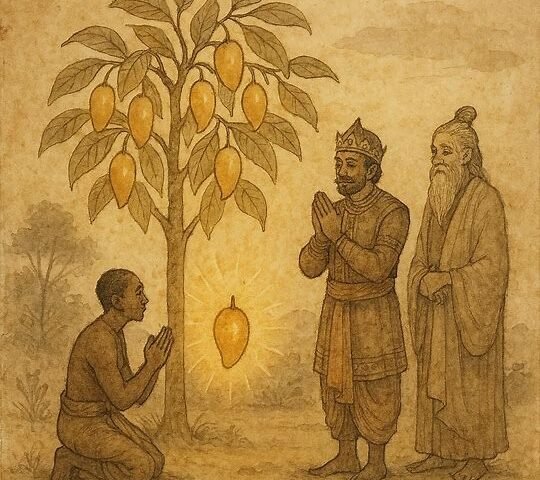
That same year, as if responding to the kingdom’s grief, the mango tree that Princess Saw Mon Hla had planted began to bear fruit for the first time. But these were no ordinary mangoes. They were larger than any seen before, with golden skin that seemed to glow with inner light, and their fragrance could be detected from a hundred paces away. When villagers tasted the fruit, they found it impossibly sweet, and those who were sick discovered that eating even a single slice brought relief from pain and hastened recovery from illness.
Word of the miraculous mango tree spread throughout the region. Pilgrims came from distant villages, the sick were carried on litters by their families, and monks established a small meditation pavilion nearby to accommodate the constant stream of visitors. The tree’s fruit seemed inexhaustible: no matter how many mangoes were picked, more appeared the next day, and the tree never showed signs of withering or disease.
The villagers began to understand that this was no ordinary tree. They had witnessed Princess Saw Mon Hla’s devotion to it in life, and now they believed that her spirit resided within its trunk and branches, continuing her work of healing and compassion even after death. They called it “Saw Mon Hla’s Tree” and built a small shrine at its base, where they left offerings of flowers, fruit, and prayers of gratitude.
But peace, like happiness, is often tested by darkness. Several years after the princess’s death, a powerful warlord from the eastern territories invaded the region, bringing an army of battle-hardened soldiers who showed no mercy to those they conquered. They burned villages, seized food supplies, and desecrated sacred sites with cruel indifference. When they reached the palace grounds, their commander, a man whose heart had been hardened by years of warfare and whose eyes held no trace of compassion, heard about the miraculous mango tree.
“Such a tree would fetch a great price,” he declared, his voice rough as grinding stones. “Cut it down. We will sell the wood and take the fruit for ourselves.”
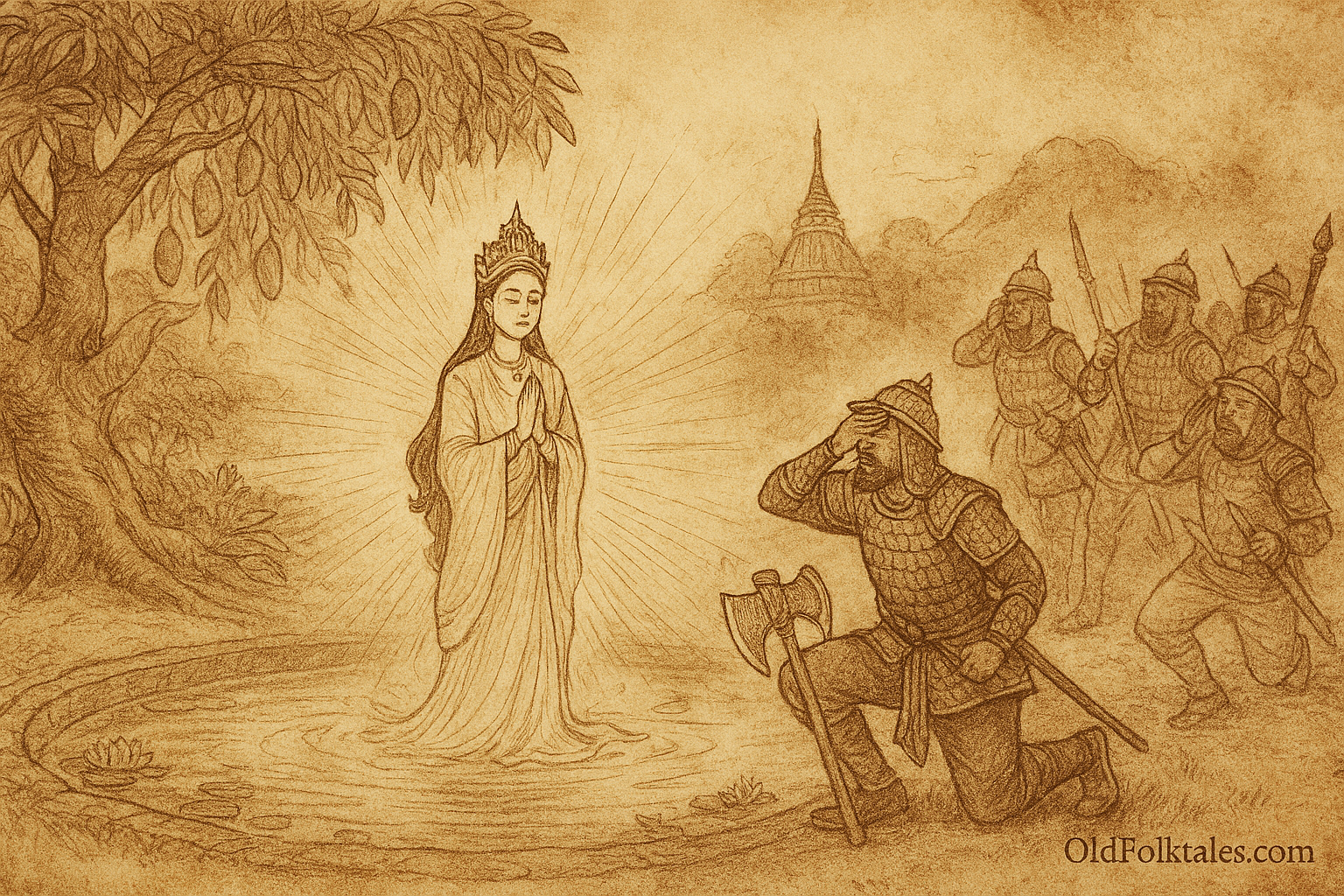
His soldiers approached the sacred pond with axes raised, their faces grim with determination. The villagers who had gathered to protect the tree cried out in horror and despair, but they were unarmed farmers and merchants, no match for trained warriors. As the first soldier raised his ax to strike the trunk, the air around the sacred pond suddenly grew thick and luminous.
The surface of the pond began to glow with golden light, and from its center rose a radiant figure: Princess Saw Mon Hla herself, appearing in spirit form. She was dressed in pure white robes that seemed woven from moonlight, her face serene yet commanding, her eyes filled with both compassion and fierce determination. The light emanating from her form was so brilliant that the soldiers dropped their weapons and fell to their knees, shielding their eyes.
“This tree is sacred,” her voice rang out, clear as temple bells, resonating in the chest of every person present. “It exists not for profit or plunder, but to serve all beings with compassion. Those who would harm it harm the very spirit of healing and kindness. Turn back now, or face the consequences of defiling what is holy.”
The warlord, despite his fearsome reputation, felt his courage drain away like water through sand. He had faced many enemies in battle, but never had he encountered a force of such pure spiritual power. The soldiers, trembling and awestruck, backed away from the tree, their axes forgotten on the ground. The warlord ordered a hasty retreat, and his army left the region that very day, never to return.
From that moment forward, the mango tree was considered not just miraculous but divinely protected. The spirit of Princess Saw Mon Hla was said to watch over it eternally, and the tree’s fruit continued to heal the sick for generations. Even today, centuries later, pilgrims visit the site where the sacred pond once lay, seeking blessings and healing, and many claim to see a gentle female figure in white robes walking among the trees at sunset, her presence bringing peace to troubled hearts.
The mango fruit became a symbol throughout northern Myanmar, a reminder that true power lies not in weapons or wealth, but in compassion, selflessness, and the enduring nature of loving kindness. Princess Saw Mon Hla’s legacy lived on not in monuments of stone or gold, but in the living tree and the countless lives it touched with healing and hope.
Click to read all Southeast Asian Folktales — featuring legends from Thailand, Indonesia, Vietnam, and the Philippines.
The Moral Lesson
The legend of Princess Saw Mon Hla teaches profound lessons about compassion, legacy, and the enduring power of selfless devotion. The princess’s lifetime of kindness and service created a legacy that transcended death itself, transforming into a source of healing that continued to serve others. The story illustrates that acts of genuine compassion like planting a tree for future generations create blessings that outlast our physical existence. It also demonstrates that what is sacred and pure is protected by spiritual forces, and that violence and greed cannot ultimately prevail against true goodness.
Knowledge Check
Q1: Who is Princess Saw Mon Hla in Myanmar folklore?
A: Princess Saw Mon Hla, meaning “Golden Jasmine,” is the protagonist of a beloved northern Myanmar legend. She was a royal princess known for her exceptional kindness, devotion to Buddhism, and service to the sick and poor. Unlike typical royalty, she lived simply, tended to villagers, and cared for all living things. After planting a mango tree by a sacred pond and tending it with devotion, she died young from fever. Her spirit then inhabited the tree, causing it to produce miraculous healing fruit and ultimately protecting it from invaders.
Q2: What is the significance of the sacred pond in the story?
A: The sacred pond represents a spiritually charged threshold between the physical and spiritual worlds in Buddhist Myanmar cosmology. Fed by underground springs and blessed by nats (nature spirits), it was a place where Princess Saw Mon Hla meditated and prayed. She planted the mango tree at its edge and watered it with the pond’s sacred water, creating a connection between the tree, the spiritual realm, and her own devotion. Later, her ashes were scattered in the pond, and her spirit emerged from it when the tree needed protection, showing the pond as a gateway for her guardian presence.
Q3: Why does the mango tree produce miraculous healing fruit?
A: The mango tree produces miraculous healing fruit because Princess Saw Mon Hla’s spirit inhabits it, continuing her lifetime work of healing and compassion after death. She had planted and tended the tree with devotion, speaking to it and blessing it with prayers. After her death, the tree absorbed her pure spirit and loving-kindness, transforming ordinary fruit into medicine that could cure diseases and relieve suffering. This reflects Buddhist beliefs about merit, intention, and how virtuous acts create lasting spiritual power that can manifest in miraculous ways.
Q4: What does the warlord represent in the Princess Saw Mon Hla legend?
A: The warlord represents greed, violence, and the desecration of sacred things the antithesis of Princess Saw Mon Hla’s compassion and purity. His attempt to cut down the mango tree for profit symbolizes how worldly power and material desires threaten what is holy and beneficial to communities. His defeat by the princess’s spirit demonstrates that spiritual power rooted in virtue is stronger than military might, and that those who seek to destroy sources of healing and compassion will ultimately fail. He serves as a cautionary figure about respecting sacred traditions.
Q5: How does Princess Saw Mon Hla’s spirit protect the mango tree?
A: When soldiers threaten to cut down the mango tree, Princess Saw Mon Hla’s spirit rises from the sacred pond in radiant form, dressed in luminous white robes and emanating golden light. Her appearance is so powerful and spiritually commanding that even hardened warriors drop their weapons and fall to their knees in awe. Through her presence and authoritative words, she turns the invaders away without violence, demonstrating that spiritual protection is more powerful than physical force. This illustrates Buddhist concepts of spiritual guardianship and how virtue creates protective power.
Q6: What cultural values does this Myanmar legend reflect?
A: The legend embodies core Buddhist and Myanmar cultural values including compassion (metta), selfless service, reverence for nature, and the belief in protective spirits. Princess Saw Mon Hla’s devotion to healing and helping others reflects the Buddhist ideal of bodhisattva-like behavior. The story emphasizes that true nobility comes from virtue, not status, and that merit accumulated through good deeds creates lasting spiritual power. The integration of Buddhist teachings with nat spirit beliefs reflects Myanmar’s syncretic religious culture. The tale also values humility, respect for sacred sites, and the understanding that genuine protection comes from living righteously rather than from military strength.
Cultural Origin: Burmese people, Northern Myanmar (Burma), Southeast Asia