In an ancient land where desert winds swept over rolling hills and bustling markets glimmered beneath the sun, there lived a powerful Sultan whose rule stretched across the kingdom like an unbroken shadow. His subjects feared his authority, admired his wealth, and whispered stories of his strict justice. Yet none of them suspected the truth hidden beneath his grand silk turban: the Sultan had the curved horns of a goat growing from his head.
He concealed them carefully, wrapping layer upon layer of fabric every morning, ensuring no servant or guard ever glimpsed the shame he carried. Only one man in the entire kingdom knew the truth, the royal barber, a humble and loyal figure whose hands had tended the Sultan’s hair and beard for years.
But knowing the secret came at a high cost.
Each time the barber was summoned to the private chamber, he approached with trembling steps. The moment the Sultan’s turban was lifted away, the sight of those horns, dark, curved, and unmistakable, sent a chill through him. Yet it was not the horns themselves that frightened him, but the Sultan’s warning.
“If you speak a word of this to any living soul, your life will end,” the Sultan said with the gravity of a king who tolerated no betrayal.
The barber swore obedience. He meant it with all his heart. But as days passed, and then months, the burden of the secret began to crush him from the inside. He found himself flinching when people joked near him, as though they might accidentally guess what he carried inside. He avoided gatherings, grew pale and thin, and lost sleep. His wife worried. His neighbors speculated. His hands shook even when grooming a simple mustache.
Finally, when he could bear it no longer, he sought out a wise man renowned throughout Israel for his guidance. The wise man lived simply, yet people traveled far to seek his counsel. When the barber confessed, not the secret itself, but the suffering it brought, the wise man listened with calm understanding.
“Secrets held in fear,” the wise man said gently, “become too heavy for the heart. You must not reveal it to any person, but you can give the truth to the earth, which keeps all things without judgment.”
He instructed the barber to travel beyond the edges of the city, to a lonely crossroads where few passed. There, he must dig a deep hole, whisper his secret into it, and cover it again. “Let the earth swallow what you cannot carry,” the wise man said.
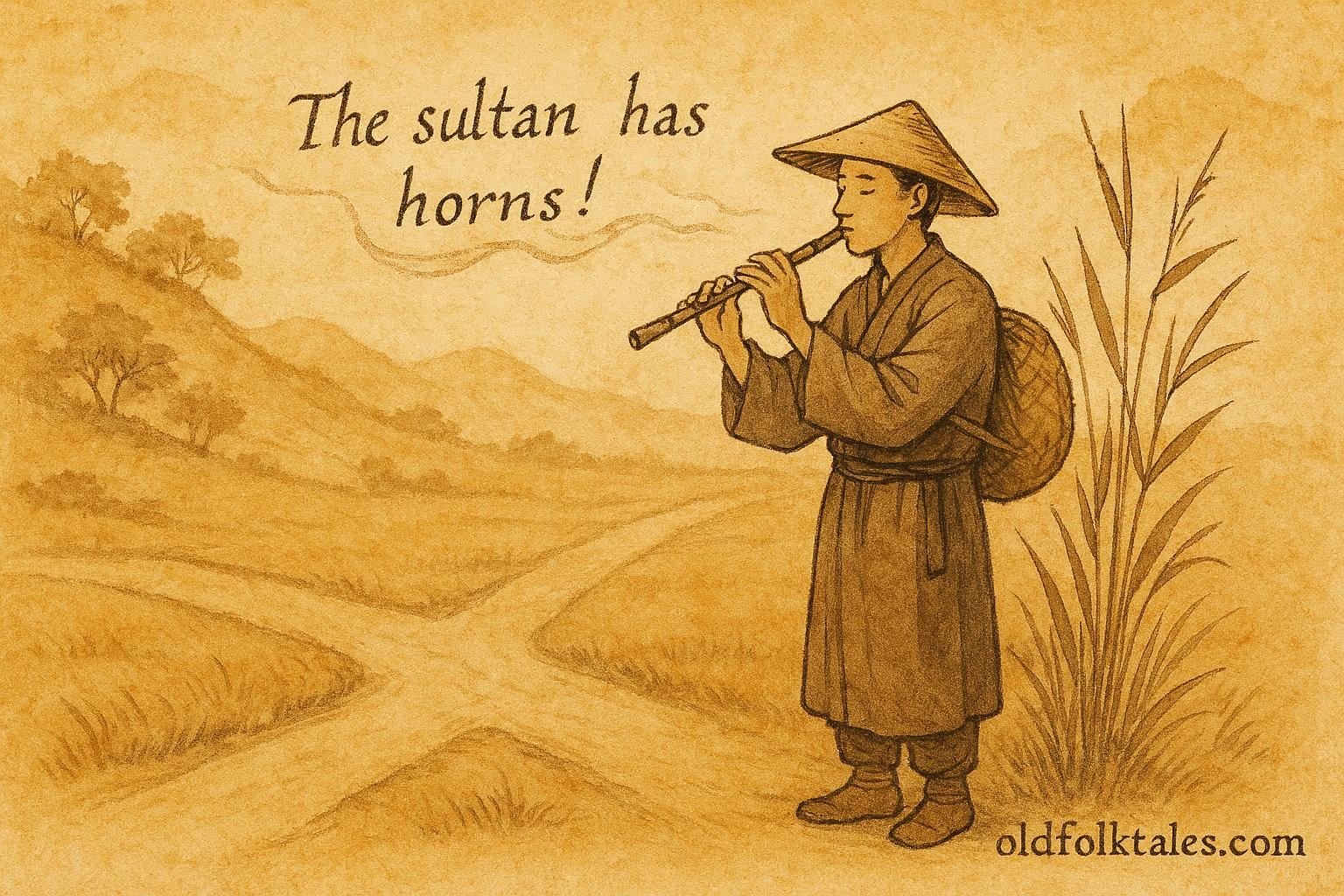
Desperate for relief, the barber obeyed. Under the cover of night, with stars shimmering like quiet witnesses, he walked to the remote crossroads. The air was cool, silent except for the faint rustle of desert grasses. He dug into the dry soil until a hollow space opened. Kneeling down, trembling, he pressed his lips to the darkness and whispered what had burned his soul for so long:
“The Sultan has horns… The Sultan has horns…”
When he filled the hole and smoothed the earth flat, a wave of calm washed through him. He felt suddenly lighter, as though invisible chains had broken. That night, for the first time in many weeks, he slept peacefully.
Time passed. Seasons shifted, rain softened the ground, and the sun warmed it again. From the very spot where the barber had whispered his secret, a cluster of reeds began to grow, tall, slender, and singing softly whenever the wind swept through them.
Years later, a shepherd roaming the area noticed the reeds. Drawn by their straightness and tone, he cut a few to craft a new flute. He shaped it carefully, smoothing its surface and carving openings with practiced hands.
But when he brought the flute to his lips, the sound that emerged shocked him.
It wasn’t music.
It was a voice, clear, rhythmic, and unmistakable:
“The Sultan has horns!
The Sultan has horns!”
Startled, the shepherd stopped playing. He tried again, slower, then faster. But no matter how he blew, the flute repeated the same phrase. Soon others heard it. Word traveled from the shepherd to villagers, from villagers to travelers, and from travelers to the palace walls.
The secret the Sultan had guarded so fiercely was now spreading across the kingdom like windborne fire.
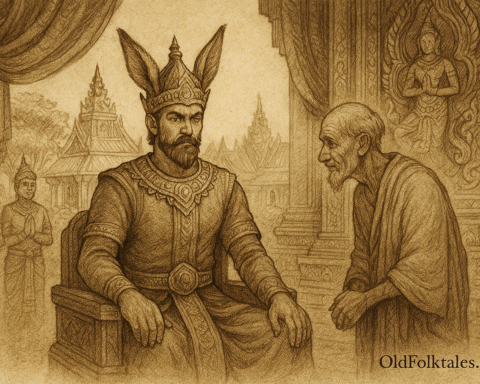
Enraged, the Sultan summoned his guards and ordered them to seize the barber at once. Dragged before the throne, the frightened barber fell to his knees, trembling as the Sultan towered over him.
“You have betrayed me!” the Sultan roared. “You spread my shame to the world!”
But the barber shook his head fiercely. “No, Majesty! I told no one, not my wife, not my children, not a friend or enemy. I obeyed your command. I only whispered the secret into the earth, and I thought it would remain buried forever.”
When the shepherd and witnesses spoke of the flute carved from reeds, and when the wise man confirmed his advice, the Sultan’s fury slowly cooled into stunned reflection.
He realized then that some truths cannot be hidden forever, no matter how fiercely one tries to bury them. The earth itself may speak when silence grows too heavy.
In some tellings, the Sultan removed his enormous turban and stood before his court, revealing the horns openly at last. In others, he kept his shame private but spared the barber, understanding that neither fear nor secrecy can hold back what destiny chooses to reveal.
But in all versions, the same truth endures:
What the heart cannot bear, the earth will one day speak.
Moral Lesson
Secrets born from fear grow heavier with time. Nature has its own ways of revealing truth, reminding us that honesty brings peace, while buried shame may rise from the ground itself.
Knowledge Check
1. What is the main theme of “The Sultan’s Horns”?
The story explores how hidden truths eventually surface, even when fiercely guarded.
2. Why does the barber become ill in the story?
He suffers from the overwhelming burden of keeping the Sultan’s secret under threat of death.
3. How does the secret become public in this Israeli folktale?
Reeds grow where the secret was whispered, and a flute made from them sings, “The Sultan has horns!”
4. What cultural meaning appears in this Middle Eastern tale?
It reflects the belief that justice and truth can emerge through nature when human voices are silenced.
5. Why does the Sultan spare the barber?
He realizes the barber obeyed him and that the earth itself revealed the truth.
6. Where does this version of the tale originate?
It comes from the Israel Folktale Archives (IFA 6792), recorded in Tel Aviv, Israel.
Source
Adapted from an Israeli folktale in the Israel Folktale Archives (IFA 6792), University of Haifa. Collected in Tel Aviv (1975) from Zion Bohbut, born in Izmir, Turkey.