In the ancient lands that would one day form the heart of Israel’s story, a kingdom once trembled beneath the weight of treachery. A newborn prince, barely days old, became the target of plots spun in the shadows. Fearing a prophecy that foretold the child’s future greatness, a power-hungry usurper seized his chance. One moonless night, while loyal guards dozed at their posts, the infant prince was stolen from his cradle and taken far from the palace walls.
The usurper believed the desert would finish what he dared not do with his own hands. But destiny had another guardian waiting.
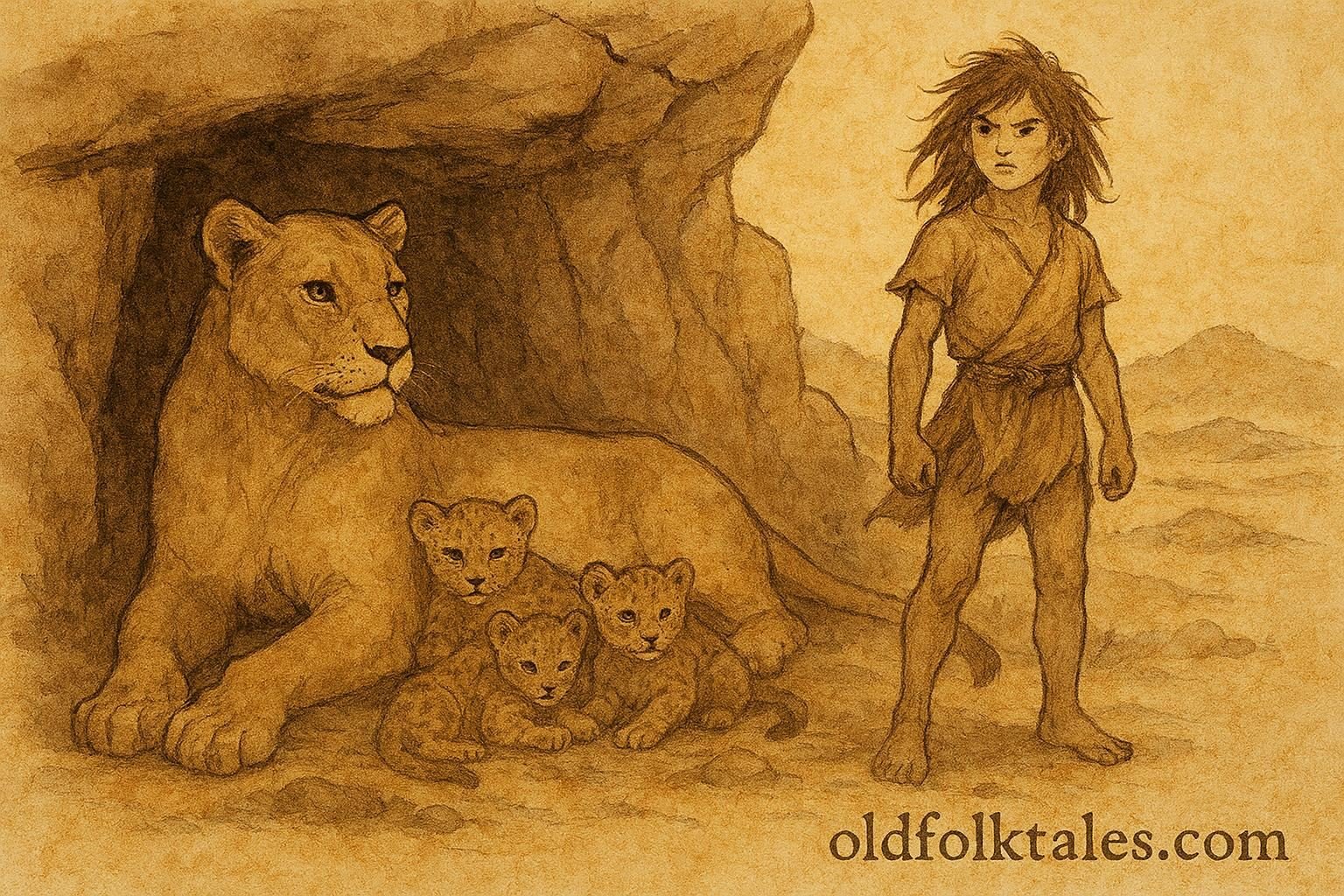
At dawn, a lioness prowled across the scrublands, searching for prey to carry back to her cubs. Instead, she found a human child crying weakly beneath a thorn bush. Something in the helpless wail stirred her. Instinct softened into something almost maternal. Rather than harm him, she lifted the infant gently in her jaws and carried him to her den among the rocks. There, the lioness suckled him alongside her cubs, giving him warmth and life in a world that had cast him aside.
Years passed. The child grew wild and strong, running barefoot across the sunbaked earth. He learned the language of roars and rustling grass long before he understood human speech. The lioness treated him as her own, and her cubs romped with him as a brother. As he aged, he gained a formidable strength that astonished even the desert creatures. He could climb cliffs with the agility of a panther, lift stones twice his size, and run for hours beneath the blazing sun. More than that, he possessed something rare: an uncanny ability to understand the moods and needs of animals, as though the natural world whispered to him directly.
One afternoon, a hunting party from the nearby kingdom passed through the region. They expected gazelles or game, but instead found a wild young man, his hair sun-bleached and tangled, standing between them and a lioness protecting her cubs. Surprised by his strength and unafraid stance, they captured him and brought him to the royal court.
The Sultan, who ruled uneasily under the shadow of his predecessor’s mysterious loss, studied the feral youth closely. There was something in his eyes—something familiar and unsettling. Rumors spread quickly: Could this be the long-lost prince?
To uncover the truth, the court devised trials.
Trial One: Recognition
They summoned all the noblewomen who had served the late queen. One by one, they approached the young man. Most he ignored, but when the former queen, now an older and weary woman who had never stopped mourning her missing child, stepped forward, he froze. The moment her eyes filled with tears, he touched her cheek gently, as though recalling a scent buried deep in memory. The palace murmured; the first sign was undeniable.
Trial Two: The Strength of Royal Blood
The usurper, still lurking with influence at court, demanded a test of strength. Massive stones were rolled into the courtyard, stones that only the strongest guards could move. The young man lifted them effortlessly, his muscles rippling like those of a lion stretching at dawn. The crowd gasped.
Trial Three: The Trial of Truth
Still unconvinced, the court proposed a final test. Strange happenings had troubled the palace: birds had been circling the battlements for days, crying warnings no one could understand. When the feral youth entered the courtyard, the birds swooped low, circling him as though greeting an old friend. The young man tilted his head, listened, and then said softly:
“The birds say there is a plot to kill the Sultan. The traitor stands among us.”
The usurper paled. His wavering courage gave him away. Guards seized him at once, and the accusation proved true. Justice was swift.
The Sultan, shaken yet grateful, now looked upon the wild youth with new eyes, not as an intruder, but as the rightful heir returned by the mercy of the natural world. He embraced him, declaring him the lost prince.
In time, the prince rose to power, ruling with a blend of fierce strength and instinctive compassion. People said he kept the wisdom of the lions in his heart. He protected the weak with the courage of a lioness defending her cubs, and he listened to the whispers of nature when others ignored them.
Under his rule, the kingdom flourished in peace.
Moral Lesson
This folktale teaches that true leadership is shaped not by birth alone but by character, instinct, and the natural world’s favor. Those who grow through hardship may carry a strength and wisdom no palace can teach.
Knowledge Check
1. Who raised the prince in the Israeli folktale “The Prince Raised by Lions”?
He was nurtured and protected by a lioness who treated him as one of her own cubs.
2. How does the prince prove his royal identity in the story?
Through three trials: recognizing his mother, showing extraordinary strength, and understanding birds who reveal a traitor’s plot.
3. What is the main symbolism of the lioness in the tale?
She represents nature’s protection and the idea that true strength is shaped outside royal privilege.
4. What cultural theme does this Israeli folktale emphasize?
It highlights the connection between natural strength and rightful leadership, a motif echoing ancient hero traditions.
5. How is justice restored in “The Prince Raised by Lions”?
The prince reveals the usurper’s plot during the truth trial, leading to the traitor’s capture.
6. What lesson does the folktale teach about destiny?
That destiny cannot be erased, what is meant to rise will rise, even when abandoned.
Source
Adapted from the Israeli folktale “The Prince Raised by Lions,” Israel Folktale Archives (IFA 5128), University of Haifa.
Collected from Yehuda Ben Shimon. Recorded in Beit She’an, Israel, 1969.