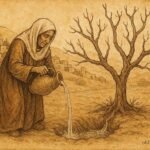
Long ago, in a small Palestinian village cradled between sun-scorched hills and winding desert valleys, there lived a young girl named Laila. Known for her bright eyes and quiet courage, Laila’s presence brought light to her family and neighbors alike. Yet one morning, she awoke to a terrible realization, her name had been stolen. She could not recall it, and when she called herself aloud, the words fell hollow, as if swallowed by the wind.
The villagers whispered of jealous ghouls that roamed the hills at night, stealing what they coveted, and of curses laid upon those who dared attract envy. Laila’s parents, distraught, sought remedies, but none could restore her lost identity. In Bedouin and fellahin belief, a name was far more than a word, it was one’s essence, the mark of one’s place in the family, the village, and the world itself. To lose it was to be adrift in both social and cosmic order.
Determined to reclaim herself, Laila set out on a journey that would test her courage, wisdom, and heart. Her first challenge was the Valley of Shadows, a place where the sunlight barely touched the ground, and the wind whispered secrets of the forgotten. Here, shadows moved independently, forming illusions that tempted travelers to turn back. Laila pressed forward, her feet barely touching the rocky earth, listening carefully to the whispering winds. She realized that only by speaking truths about herself, her kindness, her fears, her hopes, could she dispel the illusions. Slowly, the shadows yielded, revealing the path forward.
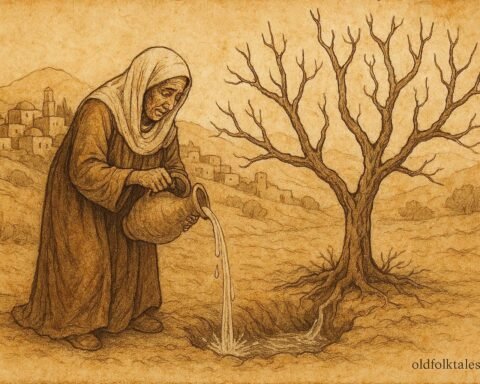
Next, she sought the Tree of Whispers, a massive, ancient olive tree whose leaves murmured wisdom and warnings to those who dared approach. Laila knelt at its roots, placing her hands on the gnarled bark, and asked the tree for guidance. The wind rustled the branches, carrying voices that recounted the history of names, of stolen identities, and the power of memory. Following the murmured hints, she learned that her name had been taken by a jealous ghoul who dwelled beyond the Desert of Forgotten Sands, a being who thrived on envy and despair.
Armed with the tree’s counsel, Laila journeyed to a lonely well atop the desert cliffs, where the Old Woman of the Well lived. Legends said that this wise crone had known every child of the valley and could glimpse truths hidden from ordinary eyes. The old woman peered into the water, where reflections shimmered with the past, present, and future. She instructed Laila to face the ghoul not with weapons, but with cleverness, courage, and the declaration of her true self. Only by asserting her inner worth and speaking her essence aloud could the ghoul be overcome.
Laila’s final trial lay beyond a harsh expanse of sand and stone, where the ghoul awaited, a dark shadow with glinting eyes and a mocking smile. Trembling but resolute, Laila stepped forward, reciting the truths she had discovered about herself. She spoke of her family, her village, and her dreams, letting the words ring through the barren air. The ghoul screeched in frustration, unable to bind what was firmly reclaimed, and slowly, with a hiss that faded like smoke, released her stolen name. Laila’s identity returned to her like a warm light, filling her with strength, joy, and an unshakable sense of place in the world.
When Laila returned to her village, the people rejoiced. She had not only reclaimed her name but also brought back the lessons of courage, wisdom, and resilience. Her journey reminded all who heard it that a person’s name, identity, and honor are sacred, and that bravery, cleverness, and self-awareness are the keys to navigating a world full of envy, challenges, and mystical forces.
Moral Lesson
This Palestinian folktale teaches that identity and honor are invaluable. Courage, self-knowledge, and perseverance are essential to reclaim what is lost and assert one’s rightful place in society and the cosmos.
Knowledge Check
1. Who is the main character of the story?
Laila, a young girl whose name is stolen and who must reclaim her identity.
2. What does losing one’s name symbolize in the story?
It represents the loss of identity, social place, and cosmic order according to Bedouin and fellahin beliefs.
3. What is the Valley of Shadows?
A mystical place of illusions where Laila must speak truths about herself to proceed.
4. How does the Tree of Whispers help Laila?
It provides guidance and wisdom about names, stolen identities, and her journey ahead.
5. What advice does the Old Woman of the Well give?
To confront the ghoul with courage, cleverness, and the declaration of her true self.
6. What is the ultimate lesson of this Palestinian folktale?
Personal identity and honor are sacred; bravery and self-awareness are necessary to reclaim them.
Source
Adapted from the Palestinian folktale “The Girl Who Lost Her Name,” Bedouin and fellahin oral tradition, collected in On Palestinian Journeys (Folktale Archive).